Theme Song
If You're Curious About These Questions...
You should listen to this audiobook
- Have you ever wondered why global corporations might be more effective at solving the world's biggest problems than national governments?
- What if the secret to significantly increasing your company’s profits was actually hidden in tackling the climate crisis?
- Are you curious about how the world's largest businesses are turning social responsibility into a massive competitive advantage?
Listen to A Better World, Inc. — Free Audiobook
Loading player...
Key Takeaways from A Better World, Inc.
- Understand why governments and NGOs often fail to solve global crises due to limited financial resources, a lack of skilled staff, and short-term political mandates.
- Discover why multinational corporations are actually the best-equipped entities to tackle environmental and social problems using their immense financial power and global reach.
- Learn how adopting sustainable practices, like utilizing renewable energy, directly boosts a company's bottom line by cutting production costs and reducing reliance on fossil fuels.
- Find out how investing in the health and economies of developing nations creates lucrative new market opportunities and guarantees a stable, healthy workforce.
- See how aligning your business goals with the planet's well-being provides a massive competitive advantage by attracting loyal customers and high-quality employees.
Learning Tools
Reinforce what you learned from A Better World, Inc.
Mind Map
A Better World, Inc.
Why Traditional Solvers Fail+
The Corporate Advantage+
The Business Case for Impact+
Implementation Strategies+
Quiz — Test Your Understanding
Question 1 of 8
According to the book, why are multinational corporations surprisingly best suited to solve the world's most pressing problems?
Question 2 of 8
Why do governments often fail to solve serious global problems, according to the text?
Question 3 of 8
What is a primary business incentive for corporations to help strengthen health care systems in developing countries?
Question 4 of 8
How can transitioning to renewable energy and sustainable practices directly improve a company's bottom line?
Question 5 of 8
The book notes that climate change and poverty impact international security. How does this ultimately affect corporations?
Question 6 of 8
What specific organizational structure does the author recommend companies establish to effectively carry out their environmental and social strategies?
Question 7 of 8
Why is it recommended that companies set up a Stakeholder Advisory Council (SAC)?
Question 8 of 8
Despite their limitations in solving global problems alone, why should corporations collaborate with NGOs?
A Better World, Inc. — Full Chapter Overview
- 1Recommendation
- 2Why governments and NGOs fail to solve the world’s toughest problems
- 3Why global companies are well suited to solve social, environmental, and economic problems
- 4Big corporations benefit when developing economies and health care systems grow — and they can help
- 5How companies can boost profits by protecting the environment
- 6How climate change and poverty threaten corporations, global security, and the world economy
- 7Why companies need a sustainability committee to implement, track, and report on strategy
- 8Why companies should involve stakeholders in developing and applying sustainability practices
- 9Why companies should work with NGOs and other businesses to reach environmental goals
- 10Final summary
A Better World, Inc. Summary & Overview
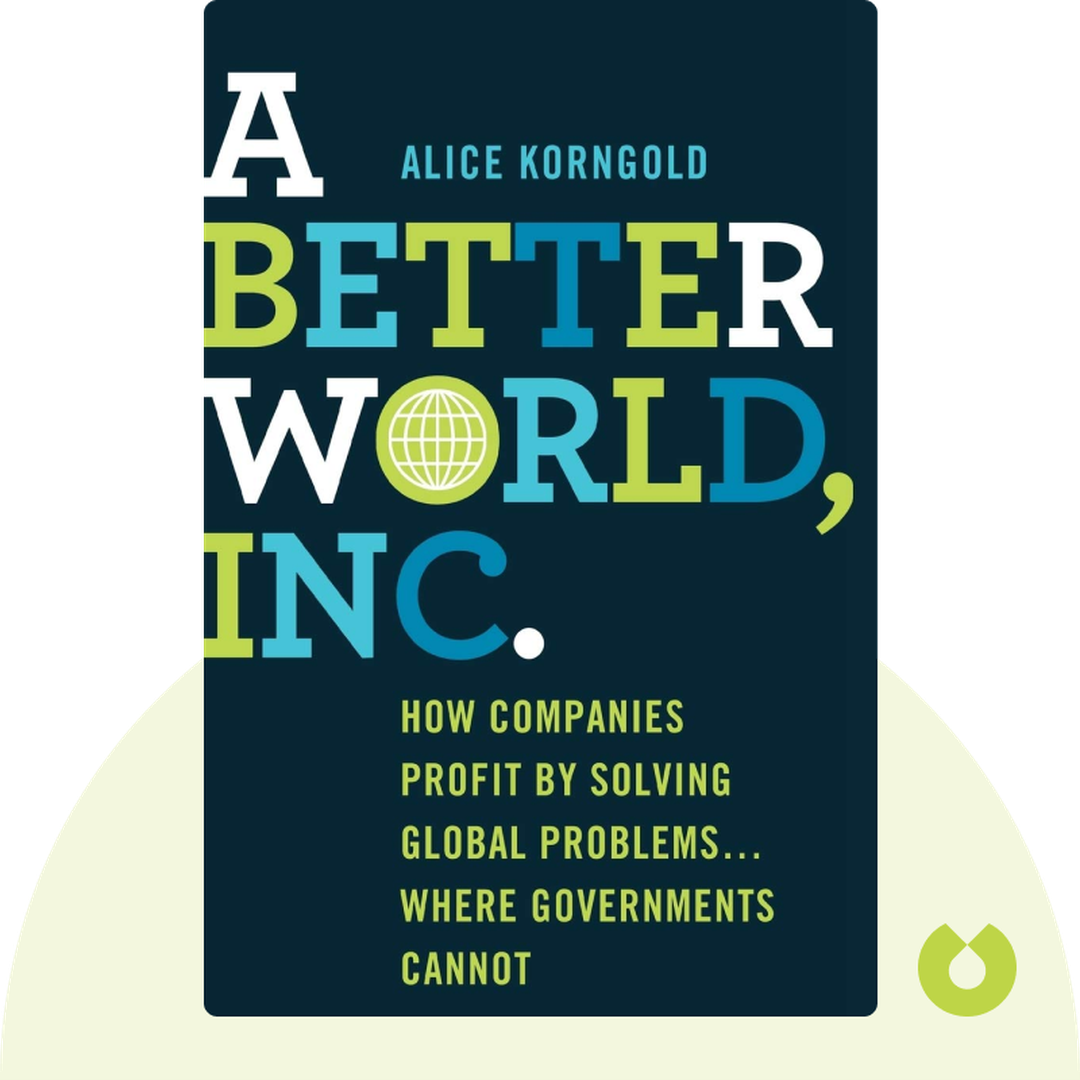
Many of us are quick to assume that big corporations are the enemies of the environment. A Better World, Inc. explains how the opposite is true: companies are in a better position to solve some of the world’s biggest problems than many governments and campaign groups. This book outlines why, and lists the steps companies can take to improve our planet, while raising their profits at the same time.
Who Should Listen to A Better World, Inc.?
- Anyone interested in climate change and green issues
- Anyone intrigued by Corporate Social Responsibility
- Anyone who wants to know how business can raise profits while improving the world
Books Similar to A Better World, Inc.
Readers who enjoyed this also liked these titles.