Theme Song
If You're Curious About These Questions...
You should listen to this audiobook
- Have you ever wondered why some team members seem to shut down the moment you start speaking, while others thrive?
- Did you know that there are five specific communication 'voices'—and that failing to recognize yours might be the hidden obstacle to your influence?
- What if you could learn the secret to adjusting your communication style on the fly so your message is heard clearly by every personality type?
Listen to 5 Voices — Cinematic Audio Edition
Loading player...
Key Takeaways from 5 Voices
- Discover how identifying a person's dominant communication 'voice' can resolve unnecessary strife and make your personal and professional conversations vastly more productive.
- Understand why 'Nurturers' prioritize people over profits, and learn why organizations must amplify this often-ignored group to prevent a toxic, dog-eat-dog culture.
- Learn how to better communicate with 'Creatives,' the rare innovators who drive change but often struggle to translate their messy, inspired ideas to logical thinkers.
- Recognize the crucial role of 'Guardians,' highly pragmatic individuals who protect tried-and-true methods and save organizations from making reckless, impulsive decisions.
- Master the dynamics of team dialogue by identifying all five voices, including 'Connectors' who bring people together, so you can effectively encourage quiet contributors to speak up.
Learning Tools
Reinforce what you learned from 5 Voices
Mind Map
5 Voices
Core Concept+
The 5 Voices+
Managing Team Dynamics+
Leadership & Self-Mastery+
Quiz — Test Your Understanding
Question 1 of 10
According to the authors, what is the primary cause of unnecessary strife in communication?
Question 2 of 10
What is a common challenge faced by individuals with a dominant 'nurturer' voice?
Question 3 of 10
Why do 'creatives' often struggle to get their ideas accepted by others?
Question 4 of 10
Despite often being viewed as restrictive or boring, what crucial value do 'guardians' bring to an organization?
Question 5 of 10
What is a potential downside to the highly social nature of 'connectors'?
Question 6 of 10
How do 'pioneers' typically view work and achieving their objectives?
Question 7 of 10
To ensure a positive and productive team meeting, when should a 'pioneer' be asked to speak?
Question 8 of 10
What is the recommended approach for encouraging 'nurturers' to share their ideas in a meeting?
Question 9 of 10
The authors compare a team leader managing their voice to a flight attendant's safety instructions. What does this analogy imply?
Question 10 of 10
According to the final summary, how does cultural bias affect team dynamics?
5 Voices — Full Chapter Overview
- 1Recommendation
- 2Nurturers focus on others more than themselves, and are often not heard.
- 3Creatives are voices of innovation, but others often find their ideas hard to grasp.
- 4Guardians aim to preserve traditional values and are highly practical.
- 5Connectors unite people, build new bonds, and sustain existing relationships.
- 6Pioneers are intensely focused on their goals and aren’t afraid to make tough decisions.
- 7Encourage nurturers to speak up and give creatives room to think outside the box.
- 8Allowing guardians to ask hard questions, supporting connectors’ passions, and having pioneers speak last can make meetings more positive.
- 9The best team managers lead by example and manage their own voices.
- 10Final summary
5 Voices Summary & Overview
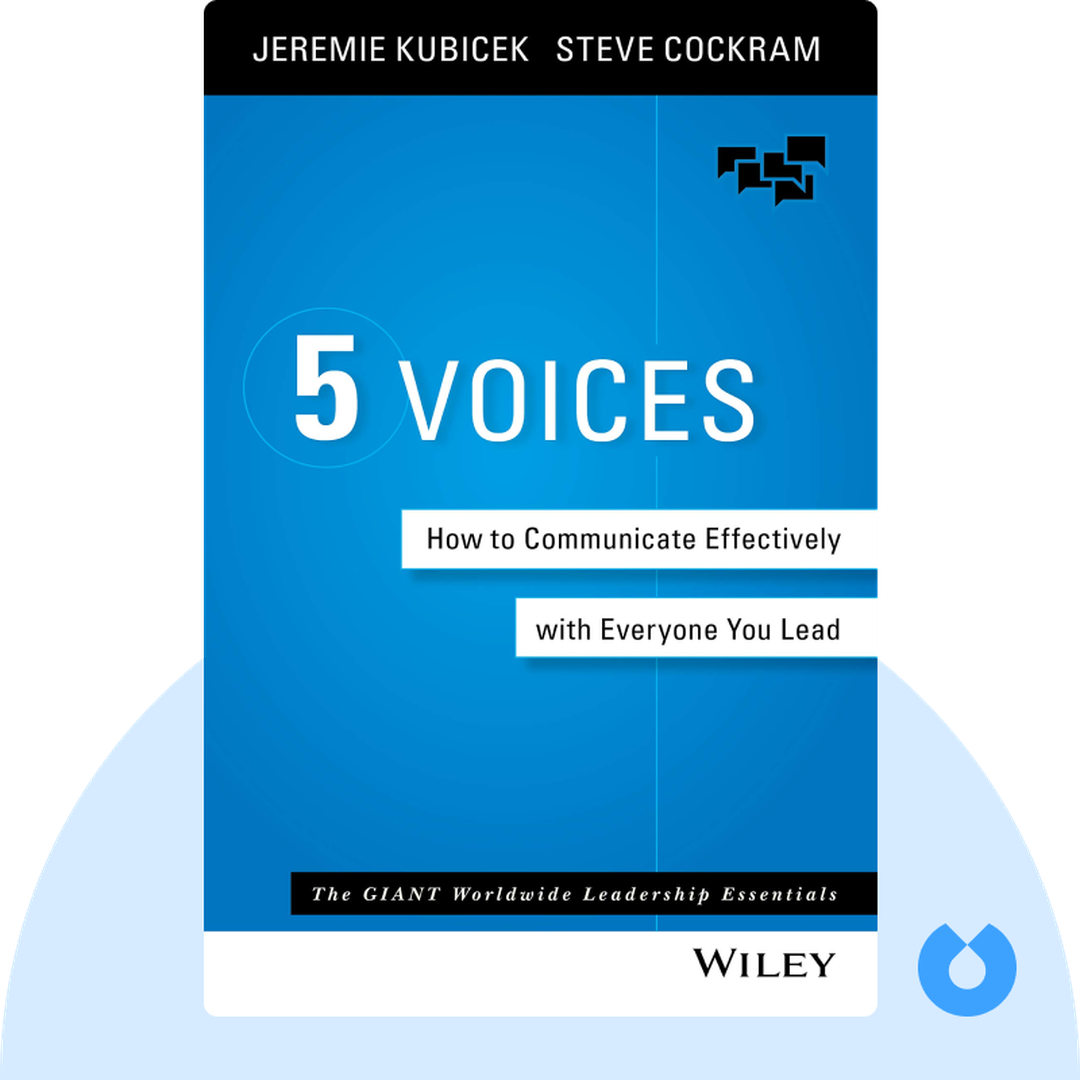
5 Voices (2016) is a handbook designed to help you communicate more effectively in your professional and personal life. To do this, leadership experts Jeremie Kubicek and Steve Cockram argue, you need to get a handle on what type of communicator you are. These blinks outline five communicative strategies and provide a wealth of tips and tricks that’ll help you get your point across without getting in peoples’ faces.
Who Should Listen to 5 Voices?
- CEOs and executives
- Team members and leaders
- People looking to fine-tune their communication skills
Books Similar to 5 Voices
Readers who enjoyed this also liked these titles.