Theme Song
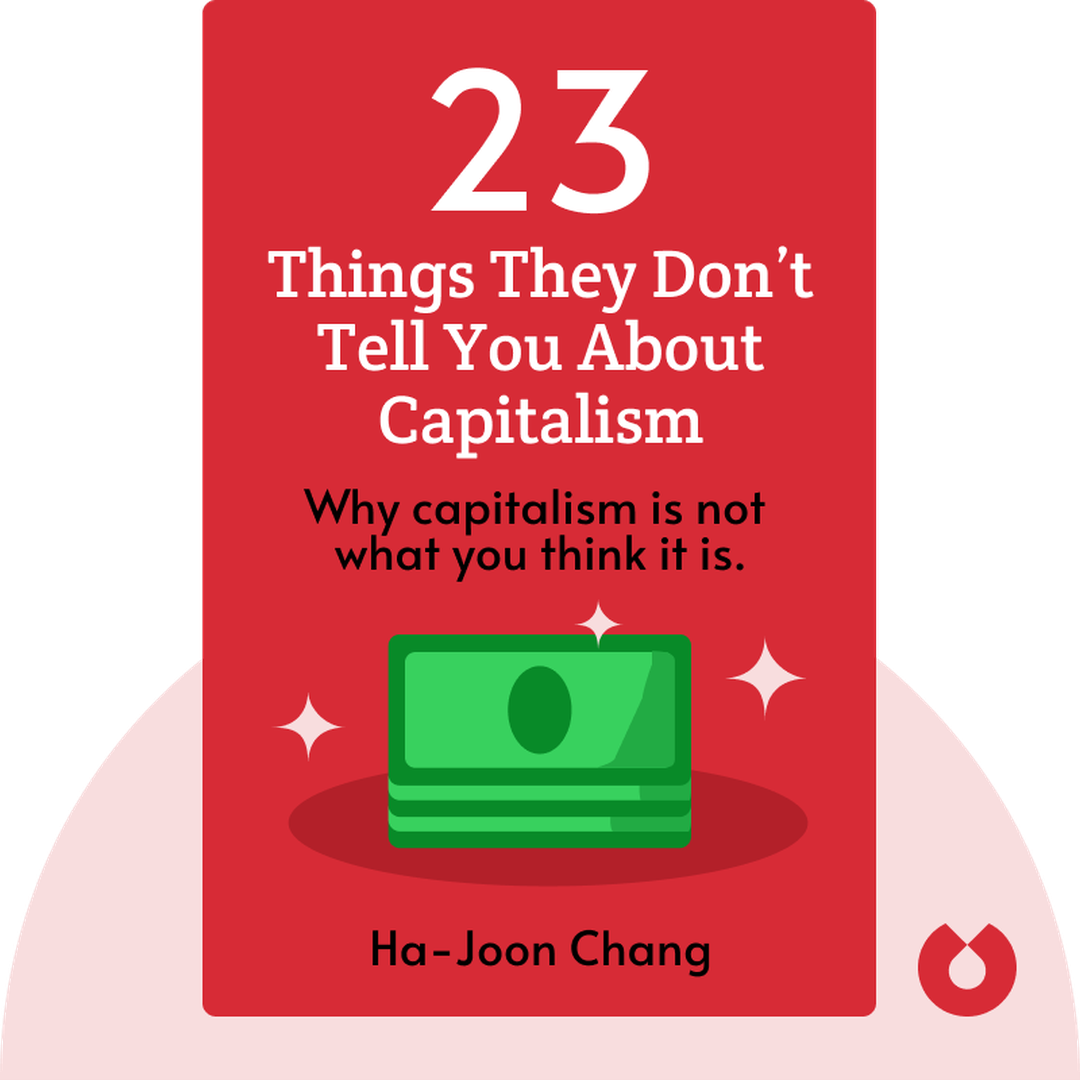
23 Things They Don’t Tell You About Capitalism
Start ListeningDownload Try free on iPhoneScan to start in 5 seconds
Categories:
If You're Curious About These Questions...
You should listen to this audiobook
- How did two Nobel Prize-winning economists accidentally prove that humans are incapable of making completely rational economic choices by bankrupting their own companies twice?
- Why does the author argue that your income is determined more by your country's immigration laws and overall societal wealth than by your individual skills or work ethic?
- Contrary to the popular belief that safety nets make people lazy, how does a strong social welfare system actually drive innovation, risk-taking, and higher economic growth?
Listen to 23 Things They Don’t Tell You About Capitalism — Cinematic Audio Edition
Loading player...
Key Takeaways from 23 Things They Don’t Tell You About Capitalism
- Understand why economics is actually a social science driven by common sense, rather than an objective natural science too complex for the average person to grasp.
- Discover the concept of 'bounded rationality' and learn why human beings are inherently incapable of making the perfectly rational financial choices that free market theories assume.
- Learn how appropriate government intervention in the financial marketplace can actually protect individuals and help them make better, safer economic decisions.
- Find out why the free market assumption that humans are purely selfish actors is incorrect, and see how everyday economic decisions are largely driven by honesty, honor, and respect.
- Realize that your income level is determined more by the society you live in and government protections, like immigration controls, rather than your actual skills or pure free market value.
Learning Tools
Reinforce what you learned from 23 Things They Don’t Tell You About Capitalism
Mind Map
23 Things They Don’t Tell You About Capitalism
The Nature of Economics+
Human Behavior+
Wages and Inequality+
Industry and Growth+
Government Intervention+
Social Welfare+
The Financial Crisis+
Developing Countries+
Reforming Capitalism+
Quiz — Test Your Understanding
Question 1 of 10
According to the text, how should the study of economics be accurately classified?
Question 2 of 10
What does the concept of 'bounded rationality' suggest about human economic decisions?
Question 3 of 10
How do free market economists explain why people pay their taxi fares instead of running away?
Question 4 of 10
According to the book, why do workers in developed countries earn significantly more than workers doing the same job in poorer countries?
Question 5 of 10
What is a major problem the author identifies with relying too heavily on a service-based economy?
Question 6 of 10
How does the author explain the primary cause of the 2008 financial crisis?
Question 7 of 10
Why did government economic planning succeed in countries like South Korea and the US, but fail in the Soviet Bloc?
Question 8 of 10
According to the text, what is the actual economic effect of robust social welfare programs?
Question 9 of 10
What does the author identify as a primary reason for the economic struggles of developing countries in Sub-Saharan Africa starting in the 1980s?
Question 10 of 10
What is the author's ultimate conclusion about capitalism itself?
23 Things They Don’t Tell You About Capitalism — Full Chapter Overview
- 1Recommendation
- 2Despite what free-market economists claim, economics is not an objective natural science.
- 3Despite what free-market economists believe, people cannot make perfectly rational economic choices.
- 4People are not entirely selfish; we often act from altruistic motives.
- 5The economy does not pay people according to what they deserve.
- 6A strong manufacturing sector matters more for economic growth than a strong service or tech economy.
- 7The financial crisis was caused by the deliberate buildup of risk in the system.
- 8Despite economists’ fear of government economic planning, it already exists and works well.
- 9Social welfare is essential for strong economic growth.
- 10We must stop trying to fix developing countries with the wrong tools.
- 11Capitalism itself is not the problem, but how we design it.
- 12Final summary
23 Things They Don’t Tell You About Capitalism Summary & Overview
In 23 Things They Don’t Tell You About Capitalism Ha-Joon Chang destroys the biggest myths of our current economic approach. He explains how, despite what most economists believe, there are many things wrong with free market capitalism. As well as explaining the problems, Chang also offers possible solutions which could help us build a better, fairer world.
Who Should Listen to 23 Things They Don’t Tell You About Capitalism?
- Students of economics who are fed up with mainstream teaching
- Anyone who takes an interest in the financial crisis and why nobody saw it coming
- Anyone wondering why levels of inequality are so high
Books Similar to 23 Things They Don’t Tell You About Capitalism
Readers who enjoyed this also liked these titles.