If You're Curious About These Questions...
You should listen to this audiobook
- Did you know that every successful new beginning actually starts with a specific kind of ending that most people try to skip?
- Have you ever wondered why the most uncomfortable 'in-between' moments of your life are actually the most critical for your personal growth?
- What if you could stop merely surviving major life changes and start using them as a roadmap for a total personal transformation?
Listen to Transitions — Free Audiobook
Loading player...
Key Takeaways from Transitions
- Understand the fundamental difference between unavoidable external change and the internal process of transition, allowing you to better manage your emotional response.
- Discover why every successful transition actually begins with an ending, and why you must acknowledge the emotional weight of letting go before you can move forward.
- Learn to navigate the five essential aspects of the ending process—disengagement, dismantling, disidentification, disenchantment, and disorientation—to fully process the loss of your old reality.
- Find out how to make difficult life transitions more bearable by identifying their underlying purpose, rather than aimlessly rushing to escape the discomfort.
- Embrace the often-feared period of "emptiness" between life phases, utilizing this neutral zone as a positive, productive sanctuary for contemplation and self-growth.
Learning Tools
Reinforce what you learned from Transitions
Mind Map
Transitions
Change vs. Transition+
Stage 1: The Ending+
Stage 2: The Neutral Zone+
Stage 3: The New Beginning+
Quiz — Test Your Understanding
Question 1 of 7
According to the text, what is the fundamental difference between change and transition?
Question 2 of 7
Paradoxically, what does every transition—regardless of its nature—always begin with?
Question 3 of 7
During the ending phase of a transition, what does the specific process of 'disidentification' involve?
Question 4 of 7
Why does the author argue against putting a positive spin on the 'disorientation' phase of an ending?
Question 5 of 7
How does the text suggest one should handle the 'emptiness' or 'neutral zone' of a transition?
Question 6 of 7
What is a key indicator that you are experiencing a genuine 'new beginning' rather than just a superficial change?
Question 7 of 7
According to the text, what is an effective psychological strategy for stepping into a new role during the beginning phase?
Transitions — Full Chapter Overview
- 1Recommendation
- 2Let's discuss transitions
- 3Endings are vital
- 4Welcome emptiness
- 5Restart with mindfulness
Transitions Summary & Overview
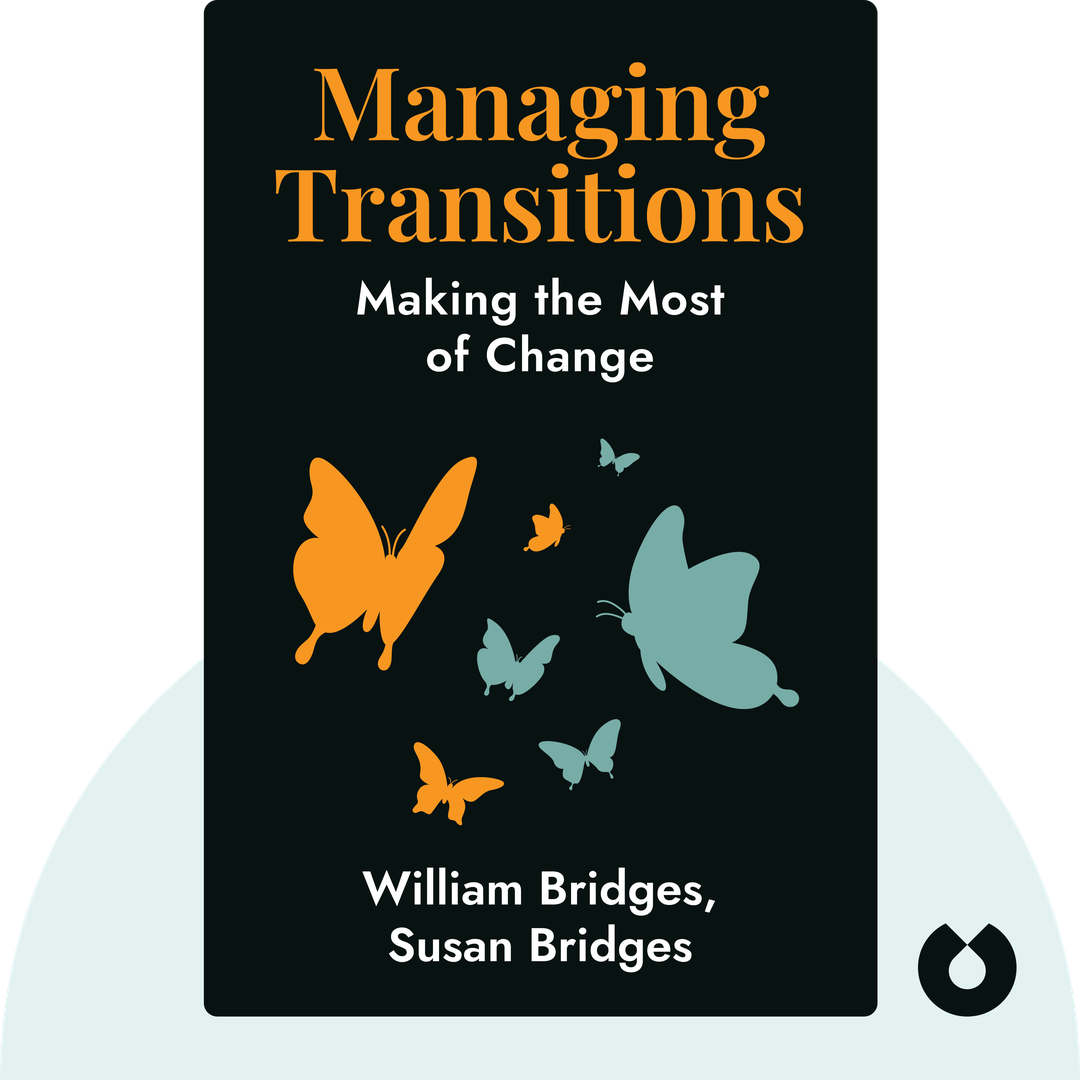
Transitions (1980) serves as a comprehensive roadmap for managing life's changes, breaking down the process into three pivotal phases: the ending, the neutral zone, and the new beginning. It offers simple yet impactful strategies for navigating each phase effectively.
Who Should Listen to Transitions?
- Anyone who’s about to initiate a major change in their life
- Anyone who’s been shaken by a change they didn’t see coming
- Anyone who wants to support a friend going through major life changes
Books Similar to Transitions
Readers who enjoyed this also liked these titles.