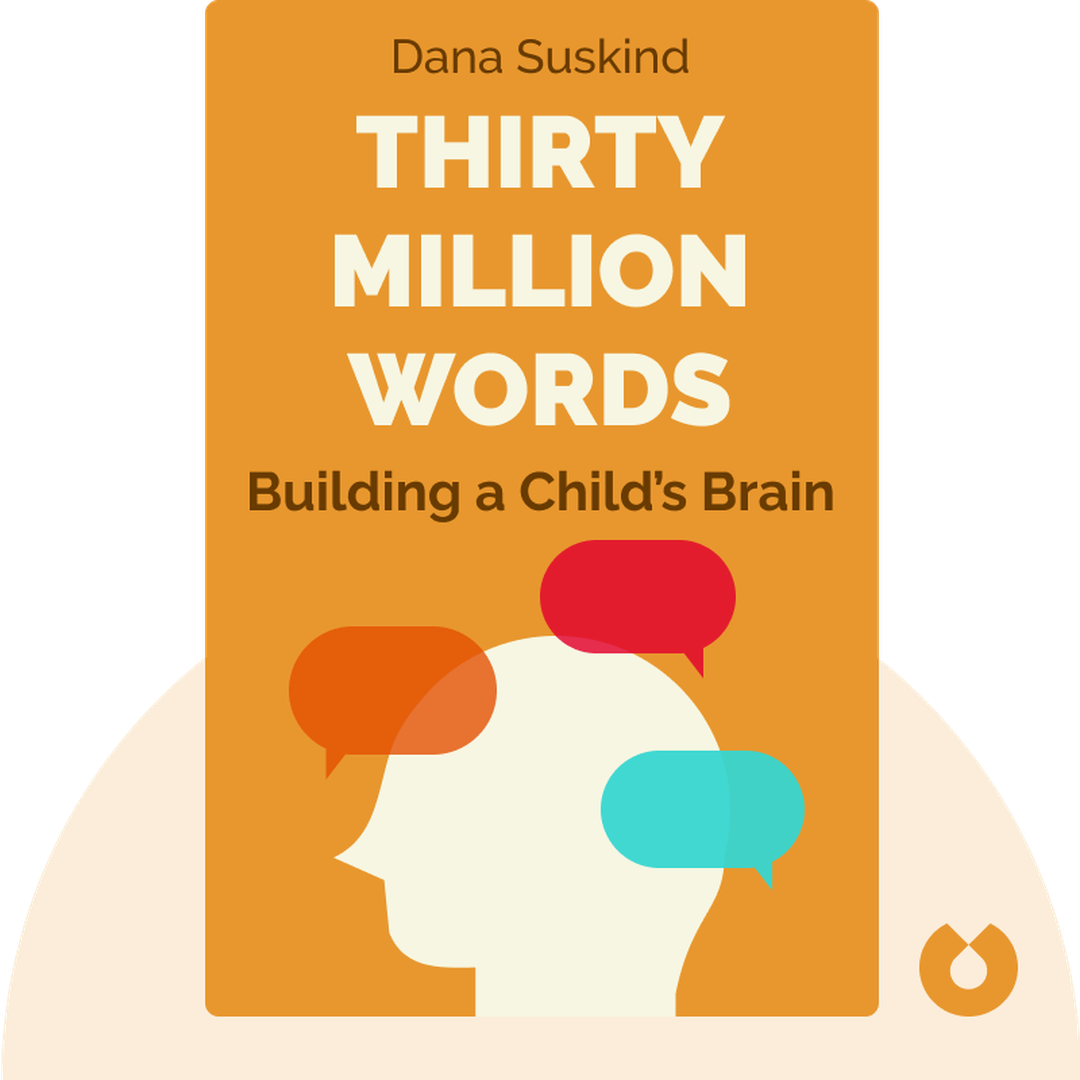
If You're Curious About These Questions...
You should listen to this audiobook
- What's the secret to giving your child a lifelong advantage in school and beyond?
- Did you know that the way you talk to your baby can shape their brain development?
- Can you really change your child's future by changing the way you interact with them in the first few years of life?
Listen to Thirty Million Words — Free Audiobook
Loading player...
Key Takeaways from Thirty Million Words
- Discover how the first three years of life are critical for your child's brain development, as early language exposure rapidly wires their neural pathways for future cognitive capacity.
- Understand why early language proficiency is the foundation for overall educational achievement, driving success in abstract reasoning, mathematics, and STEM subjects.
- Learn how the number of words parents speak to their children—not their socioeconomic background—is the true predictor of future academic success.
- Find out why speaking at least 2,000 words a day to your child is essential, since a higher quantity of spoken words naturally exposes them to a richer, higher-quality vocabulary.
- Master the art of encouraging your child by balancing praise and constructive feedback to foster their intrinsic motivation and self-belief.
Learning Tools
Reinforce what you learned from Thirty Million Words
Mind Map
Thirty Million Words
Brain Development (Ages 0-3)+
The 30-Million-Word Gap+
Language Drives Academics+
The Three T's Strategy+
Mindset and Independence+
Societal Impact+
Quiz — Test Your Understanding
Question 1 of 8
What happens to a child's neural pathways during the first three years of life through the process of synaptic pruning?
Question 2 of 8
According to the text, how does early language proficiency relate to a child's mathematical and spatial abilities?
Question 3 of 8
What was the primary finding of Betty Hart and Todd Risley's 1995 study regarding educational achievement?
Question 4 of 8
Based on Carol Dweck's 1998 study, what is the most effective way to praise a child to encourage a 'growth mindset'?
Question 5 of 8
In the context of the 'Three T's,' what does it mean to 'Tune in' to your child?
Question 6 of 8
Which of the following is an example of using 'decontextualized language' with a child?
Question 7 of 8
What is an effective strategy for implementing the 'Take turns' principle to encourage a child to speak?
Question 8 of 8
According to the actionable advice in the text, how does offering a child choices (e.g., choosing between a red or blue shirt) aid in their development?
Thirty Million Words — Full Chapter Overview
- 1Recommendation
- 2Neural connections formed in the first three years of life create the basis for future thinking skills.
- 3Early mastery of language is crucial for school success, including abstract and mathematical thought.
- 4Academic achievement depends less on class background and more on how often parents speak with their kids.
- 5Children and parents alike should trust in their own capabilities.
- 6Capture your child’s interests and talk with them to help them learn more powerfully.
- 7Talking more includes three key elements that involve your child while growing their vocabulary and conversational skills.
- 8Help your kids speak by taking turns – and make sure to read with them.
- 9We are responsible for fostering language growth, and every parent can contribute.
Thirty Million Words Summary & Overview
Thirty Million Words (2015) explains the importance of language in a child’s early development and long-term success. These blinks outline the optimal early language environment for a child and highlight the ways parents can help their children during these critical years.
Who Should Listen to Thirty Million Words?
- New parents
- Psychologists and educators
- People who want to learn a new language.
Books Similar to Thirty Million Words
Readers who enjoyed this also liked these titles.