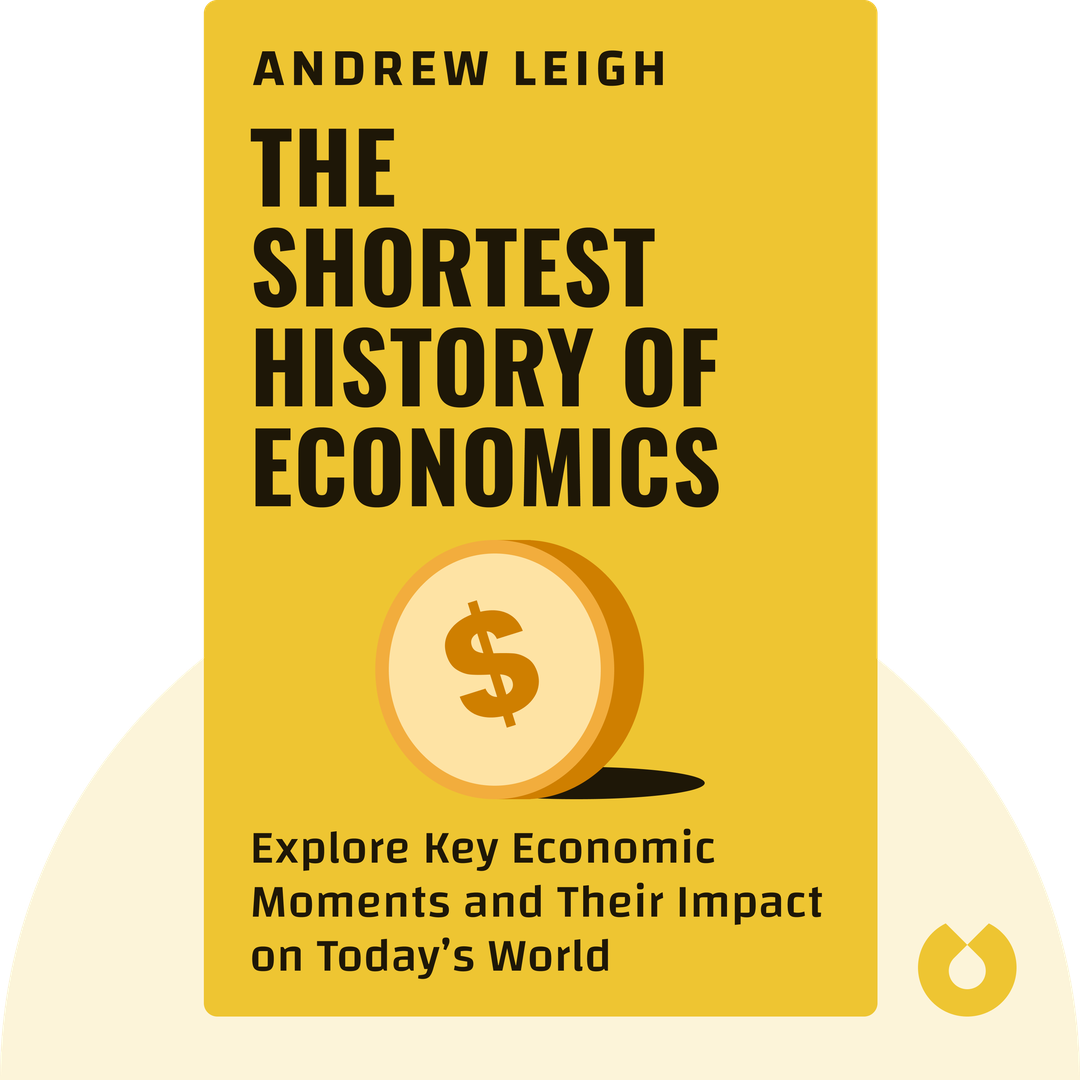
The Shortest History of Economics
Start ListeningDownload Try free on iPhoneScan to start in 5 seconds
Categories:
If You're Curious About These Questions...
You should listen to this audiobook
- Have you ever wondered how a simple change in how our ancestors gathered food thousands of years ago set the stage for the complex global markets we navigate today?
- Did you know that many of history’s most pivotal moments and conflicts were actually driven by hidden economic forces rather than just political ambition?
- Are you curious about the secret turning points that allowed capitalism to transform from a radical idea into the engine of the modern world?
Listen to The Shortest History of Economics — Free Audiobook
Loading player...
Key Takeaways from The Shortest History of Economics
- Understand how the agricultural revolution introduced 'consumption smoothing,' allowing early humans to store surplus resources and stabilize their lives against seasonal fluctuations.
- Discover how the principle of comparative advantage drives trade by showing that mutually beneficial exchange occurs when parties focus on producing what they are relatively best at.
- Learn why economists classify ideas as 'non-rival' goods—meaning they can be shared endlessly without depletion—and how this concept explains the massive economic impact of the printing press.
- Explore Adam Smith's famous concept of the 'invisible hand,' which explains how individuals pursuing their own self-interest in a competitive market inadvertently generate wealth and societal benefits.
- Master the crucial economic concept of 'opportunity cost'—the hidden value of the next-best alternative you give up when making a decision—to better evaluate the true cost of your daily choices.
Learning Tools
Reinforce what you learned from The Shortest History of Economics
Mind Map
The Shortest History of Economics
Seeds of Growth+
Trade, Ideas, and Innovation+
Industrial Revolution & Early Economics+
Managing Capitalism+
Modern Global Economy & Inequality+
Quiz — Test Your Understanding
Question 1 of 7
How did the agricultural revolution introduce the economic concept of 'consumption smoothing'?
Question 2 of 7
In the context of the printing press and the spread of ideas, what does it mean for a good to be 'non-rival' in economic terms?
Question 3 of 7
Which of the following best illustrates John Stuart Mill's concept of 'opportunity cost'?
Question 4 of 7
During the economic crises of the 1920s and 30s, how did the economic philosophies of John Maynard Keynes and Friedrich von Hayek fundamentally differ?
Question 5 of 7
What was the primary goal of the new international economic order established at the Bretton Woods Conference after World War II?
Question 6 of 7
Why did central banks increasingly gain independence from political interference starting in the 1980s?
Question 7 of 7
According to Branko Milanović's research on global income distribution between 1980 and 2016, which group experienced income stagnation or decline?
The Shortest History of Economics — Full Chapter Overview
- 1Recommendation
- 2Seeds for growth
- 3A transformative invention
- 4Early economics and industry
- 5Steering capitalism
- 6Global growth and inequality
The Shortest History of Economics Summary & Overview
The Shortest History of Economics (2024) explores the hidden economic forces that have shaped human history. It examines how capitalism and market systems emerged, linking economic developments to major historical events from the rise of agriculture to modern conflicts.
Who Should Listen to The Shortest History of Economics?
- Students seeking context for modern economic theories
- Curious general readers interested in how economies evolve
- Anyone who wants a new lens on human history
Books Similar to The Shortest History of Economics
Readers who enjoyed this also liked these titles.