If You're Curious About These Questions...
You should listen to this audiobook
- Have you ever wondered why your brain can instantly recognize some words as whole images while others require a slow, phonetic breakdown?
- What’s the secret to 'reading between the lines,' and how does the mind bridge the gap between printed text and deep, inferential comprehension?
- Are you curious about the specific psychological triggers that can transform a reluctant reader into someone who is genuinely motivated to pick up a book?
Listen to The Reading Mind — Free Audiobook
Loading player...
Key Takeaways from The Reading Mind
- Discover how reading adds a complex third layer of visual symbols to your brain's natural spoken language abilities, explaining why literacy requires explicit instruction.
- Understand why reading difficulties are often rooted in phonological awareness—the challenging task of separating continuous speech into individual sounds—rather than simple visual errors.
- Learn how skilled readers develop orthographic processing to instantly recognize whole words by sight, freeing up valuable working memory for deeper comprehension.
- Explore the 'word superiority effect' to see how your brain's specialized neural networks identify familiar letter combinations faster than random strings of characters.
- Find out how effortless decoding allows you to activate your inner voice with prosody, using mental stress and intonation to transform static marks into living language.
Learning Tools
Reinforce what you learned from The Reading Mind
Mind Map
The Reading Mind
Evolution & Foundations+
The Decoding Process+
Comprehension & Meaning+
Growing Good Readers+
Quiz — Test Your Understanding
Question 1 of 6
According to the text, why does reading require explicit instruction and practice, unlike spoken language?
Question 2 of 6
What does the text identify as a crucial, challenging hurdle for children learning to read?
Question 3 of 6
How does 'orthographic processing' benefit skilled readers compared to beginners who read letter-by-letter?
Question 4 of 6
How does the human brain organize and process the meaning of words like 'spill' or 'heavy'?
Question 5 of 6
When reading a long novel, how do readers manage to follow the story even when exact phrasing and specific details fade from memory?
Question 6 of 6
According to the text, a child's motivation to read depends on how much they value the activity and their 'expectancy.' What does expectancy refer to in this context?
The Reading Mind — Full Chapter Overview
- 1Recommendation
- 2From symbols to meaning
- 3From letters to language
- 4From sounds to sight
- 5Connected meanings
- 6Developing comprehension
- 7Growing strong readers
- 8Final summary
The Reading Mind Summary & Overview
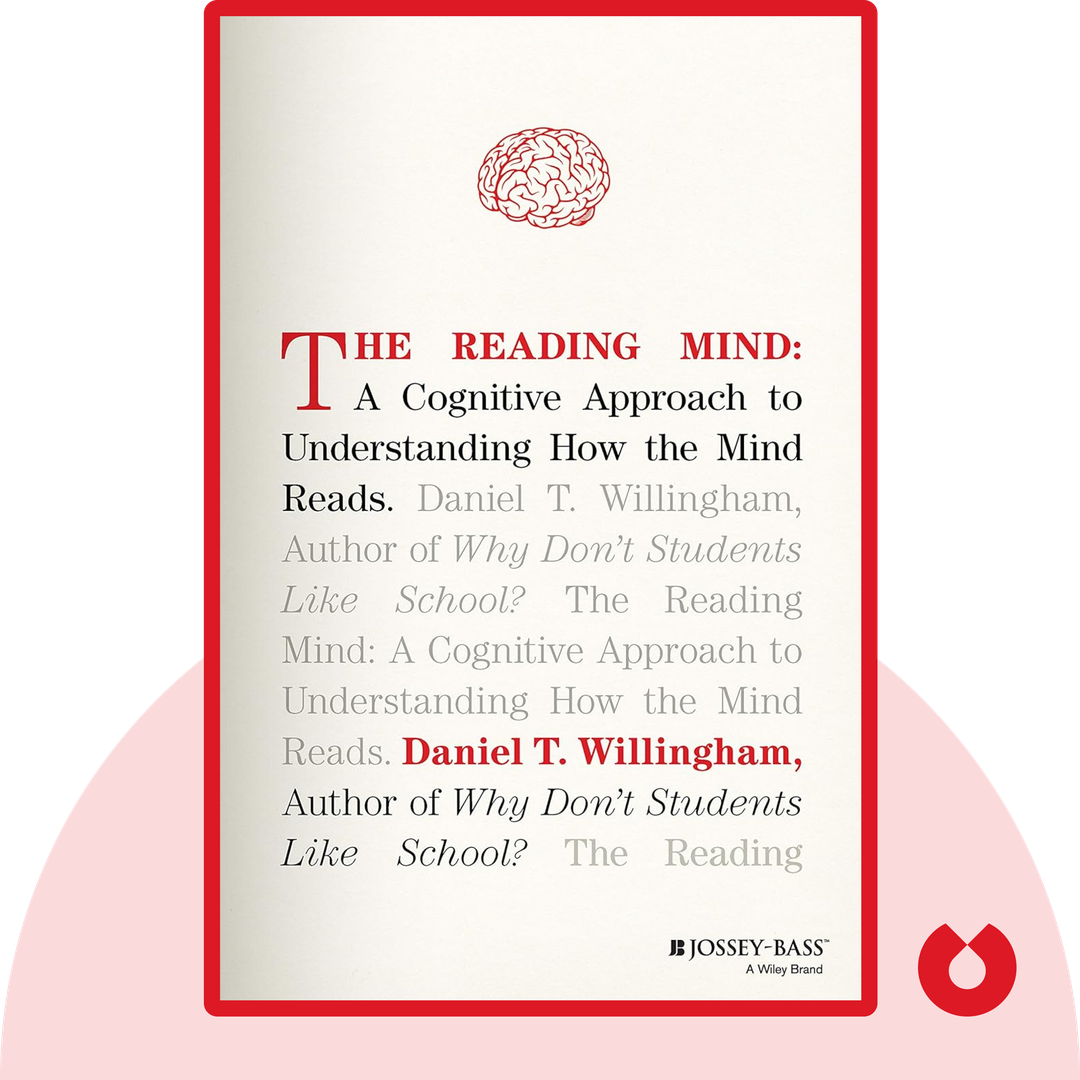
The Reading Mind (2017) explores the complex cognitive processes that occur when we read, from the initial recognition of letters to the deep comprehension of texts. It examines fundamental processes like sight-reading and phonetic reading, while also addressing higher-level skills such as inferential comprehension, the reading-writing connection, and the role of motivation in developing reading proficiency.
Who Should Listen to The Reading Mind?
- Teachers seeking to understand the science behind literacy
- Parents who want to nurture their children as readers
- Anyone fascinated by cognitive science and psychology
Books Similar to The Reading Mind
Readers who enjoyed this also liked these titles.