If You're Curious About These Questions...
You should listen to this audiobook
- What if you could achieve more by doing less?
- Are you curious about the biggest lie we tell ourselves about productivity?
- What's the secret to prioritizing your goals without sacrificing other areas of your life?
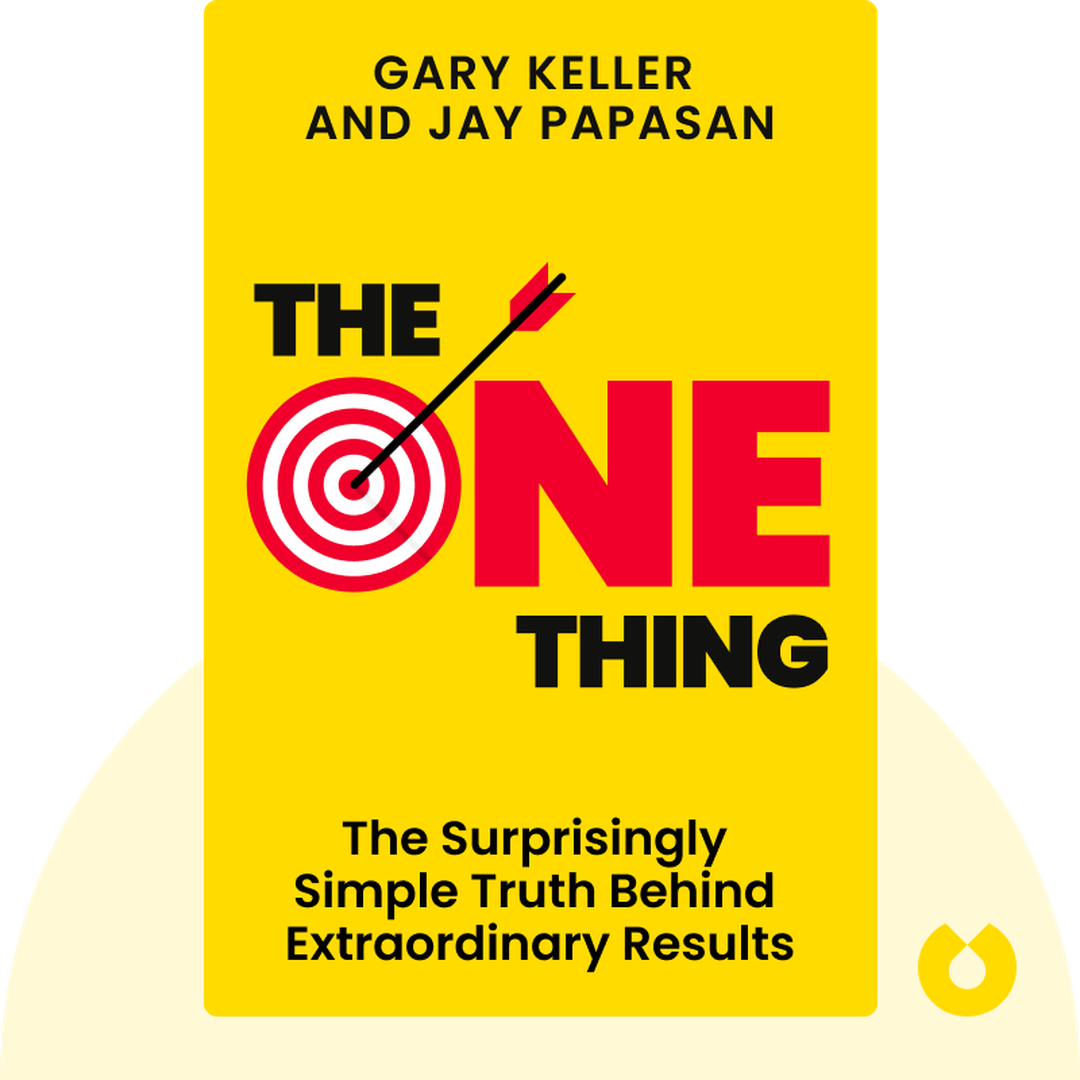
Listen to The ONE Thing — Cinematic Audio Edition
Loading player...
Key Takeaways from The ONE Thing
- Learn how to achieve extraordinary results by simplifying your focus and dedicating your energy to just one key priority.
- Understand why spreading your attention across too many goals quietly sabotages your progress and prevents true excellence.
- Master the practice of time-blocking to protect your most essential task from the daily distractions that pull you away.
- Discover the power of the 'first domino' approach to identify the single action that makes everything else easier or unnecessary.
- Identify the quiet myths and internal beliefs that steal your focus, starting with the dangerous lie that everything matters equally.
Learning Tools
Reinforce what you learned from The ONE Thing
Mind Map
The ONE Thing
Setting Goals & Prioritizing+
Protecting Your Focus+
Achieving Extraordinary Results+
Quiz — Test Your Understanding
Question 1 of 10
According to the text, why do many people avoid 'thinking big'?
Question 2 of 10
How does the Pareto Principle apply to managing a to-do list?
Question 3 of 10
What is the primary purpose of asking the 'focusing question'?
Question 4 of 10
According to the book, what is the secret to living what appears to be a highly disciplined life?
Question 5 of 10
Why does the text argue that multitasking is 'horribly inefficient'?
Question 6 of 10
How does the book describe the nature of human willpower?
Question 7 of 10
What was Steve Jobs's perspective on 'focusing', as highlighted in the text?
Question 8 of 10
According to the study of students mentioned in the text, what is the most effective way to use visualization?
Question 9 of 10
How does author James Patterson's analogy of juggling balls apply to work-life balance?
Question 10 of 10
What does the book recommend you do when 'chaos' and lesser priorities pile up while you are focusing on your ONE thing?
The ONE Thing — Full Chapter Overview
- 1Recommendation
- 2Rank your to-dos — they aren’t all equally truly crucial.
- 3Posing the “focusing question” helps you effectively prioritize, craft actionable tasks, and accomplish your goals successfully.
- 4The key to a disciplined life is building habits sequentially.
- 5Multitasking is deeply inefficient: choose one task and give it your undivided attention.
- 6Your willpower resembles a fuel tank: deploy it carefully, or you might run dry later when you truly, urgently need it the most.
- 7Declining unimportant tasks is essential if you’re to focus your efforts instead on the truly most important right ones.
- 8Living purposefully and picturing the steps to reach your goal will place you firmly on the path toward truly extraordinary results.
- 9Do not sacrifice your personal life for professional goals — instead, ruthlessly prioritize your work time.
- 10To focus on your ONE thing, you need strong time-management tactics, and must accept some chaos elsewhere at times.
- 11Closing summary
The ONE Thing Summary & Overview
The ONE Thing (2013) helps you to discover your most important goal, and gives you tools to ensure you can use your time productively to get there. The book reveals that many of the maxims we accept as good practice are actually myths that only hinder our progress. It also provides advice on how to live your life with priority, purpose and productivity without sending other aspects of life out of balance, because this is the way to perform the kind of focused work that leads to great success.
Who Should Listen to The ONE Thing?
- Anyone looking to improve their productivity
- Anyone who has trouble finding time to commit to their goal
- Anyone looking for greater clarity and purpose in their daily life
Books Similar to The ONE Thing
Readers who enjoyed this also liked these titles.