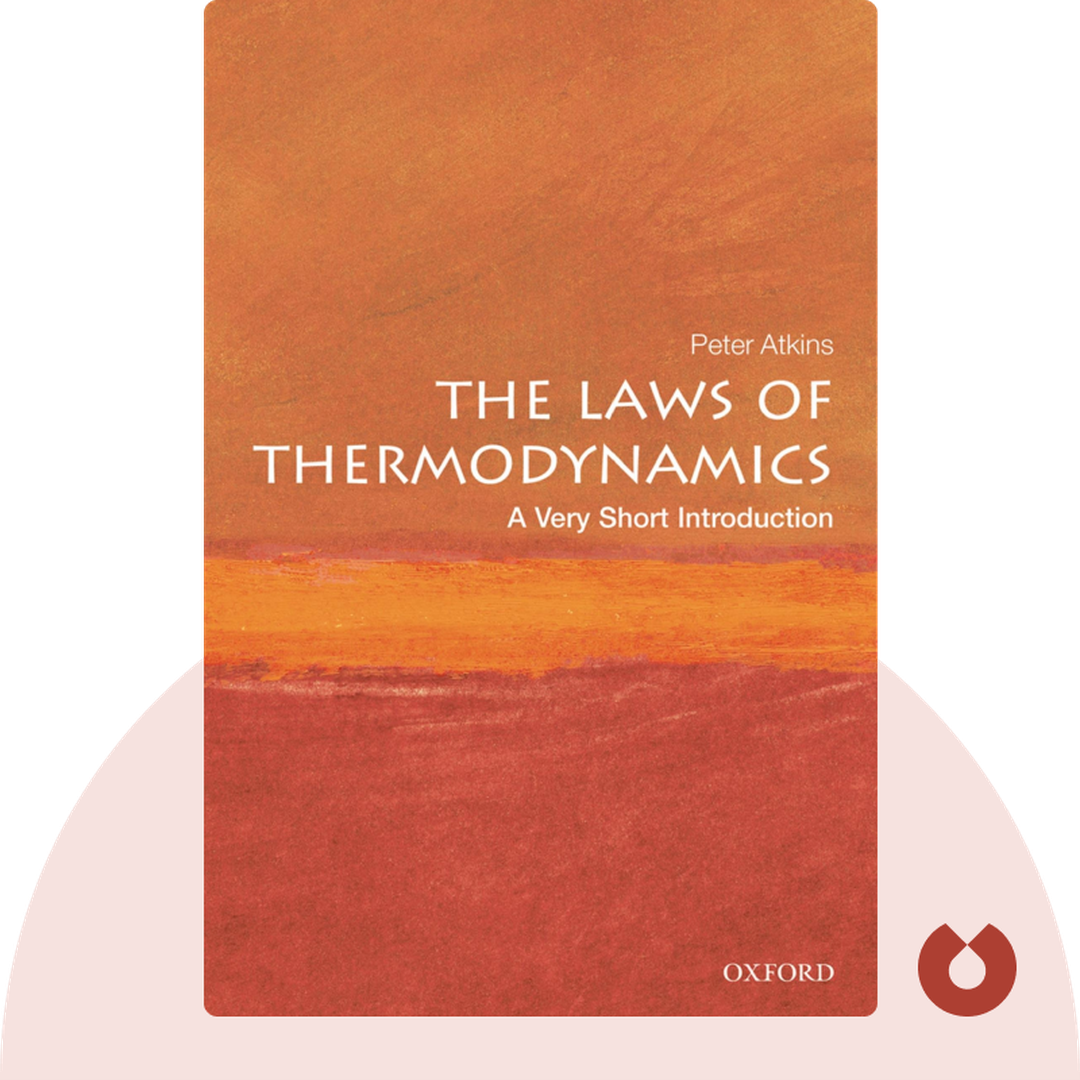
The Laws of Thermodynamics
Start ListeningDownload Try free on iPhoneScan to start in 5 seconds
Categories:
If You're Curious About These Questions...
You should listen to this audiobook
- Have you ever wondered why time only moves in one direction, or why your morning coffee always goes cold but never spontaneously heats back up?
- What if you could uncover the fundamental rules that dictate why it’s impossible to create energy out of nothing, no matter how clever the invention?
- Are you curious about the mysterious 'Zeroth Law' and how it defines the very concept of temperature that we take for granted every single day?
Listen to The Laws of Thermodynamics — Free Audiobook
Loading player...
Key Takeaways from The Laws of Thermodynamics
- Understand how thermodynamics governs the universe by studying energy transformations within distinct open, closed, and isolated systems.
- Discover the principles of mechanical equilibrium, where balanced pressure proves that if two systems are stable with a third, they are stable with each other.
- Learn how the zeroth law of thermodynamics establishes the concept of thermal equilibrium to scientifically define the fundamental property of temperature.
- Explore statistical thermodynamics to see how the Boltzmann distribution maps the exponential placement of atomic groups across discrete energy states.
- Find out how an increase in temperature physically alters a system by causing groups of atoms to migrate from their lowest ground state into higher energy levels.
Learning Tools
Reinforce what you learned from The Laws of Thermodynamics
Mind Map
The Laws of Thermodynamics
System Fundamentals+
The Zeroth Law+
Molecular Thermodynamics+
The First Law+
The Second Law+
Thermodynamic Accounting+
The Third Law+
Quiz — Test Your Understanding
Question 1 of 8
According to the text, what defines an 'isolated system' in thermodynamics?
Question 2 of 8
The zeroth law of thermodynamics establishes the concept of thermal equilibrium. What fundamental property does this law allow physicists to introduce?
Question 3 of 8
How does the Boltzmann distribution describe the behavior of atoms as their temperature increases?
Question 4 of 8
Which of the following best summarizes the first law of thermodynamics as described in the text?
Question 5 of 8
According to the second law of thermodynamics, why is a 'cold sink' a vital component of a steam engine?
Question 6 of 8
The text uses the analogy of sneezing in a library versus sneezing on a busy main street to illustrate what concept about entropy?
Question 7 of 8
What is 'Gibbs energy' used to measure in thermodynamics?
Question 8 of 8
According to the third law of thermodynamics, what happens to a perfectly crystalline substance at absolute zero?
The Laws of Thermodynamics — Full Chapter Overview
- 1Recommendation
- 2If two systems share mechanical equilibrium, any third system equilibrated with one will also necessarily be in equilibrium with the other as well.
- 3The zeroth law concerns thermal equilibrium, enabling us to properly introduce and define the concept of temperature.
- 4The Boltzmann distribution describes how atoms are precisely apportioned among energy levels at any given temperature.
- 5The first law of thermodynamics states that an isolated system’s internal energy remains constant so long as no work is performed on it.
- 6Some heat is shed to the surroundings when it is converted into work, and work is required to move heat from a cold body to a hotter one.
- 7According to the second law of thermodynamics, the entropy of the universe increases during spontaneous changes.
- 8The second law explains how cold sinks operate and the preferred direction of heat transfers.
- 9Entropy is a measure of how likely we can identify the energy state a molecule occupies.
- 10Enthalpy, Helmholtz energy, and Gibbs energy are valuable accounting tools used in thermodynamics.
- 11The third law of thermodynamics says that crystalline substances at absolute zero possess zero entropy.
The Laws of Thermodynamics Summary & Overview
The Laws of Thermodynamics (2010) is a short and accessible introduction to thermodynamics, the field of physics concerned with the relationships between different forms of energy. Authored by one of the world’s preeminent authorities on the subject, Peter Atkins, it explains the four laws that govern the universe – the zeroth, first, second, and third laws. Along the way, The Laws of Thermodynamics unravels the workings of familiar-sounding concepts like temperature as well as more exotic ideas like entropy and energy states.
Who Should Listen to The Laws of Thermodynamics?
- Quizzical types who’ve always wondered how the universe works
- Humanities graduates looking for a gentle introduction to physics
- Folks who love a good mental workout
Books Similar to The Laws of Thermodynamics
Readers who enjoyed this also liked these titles.