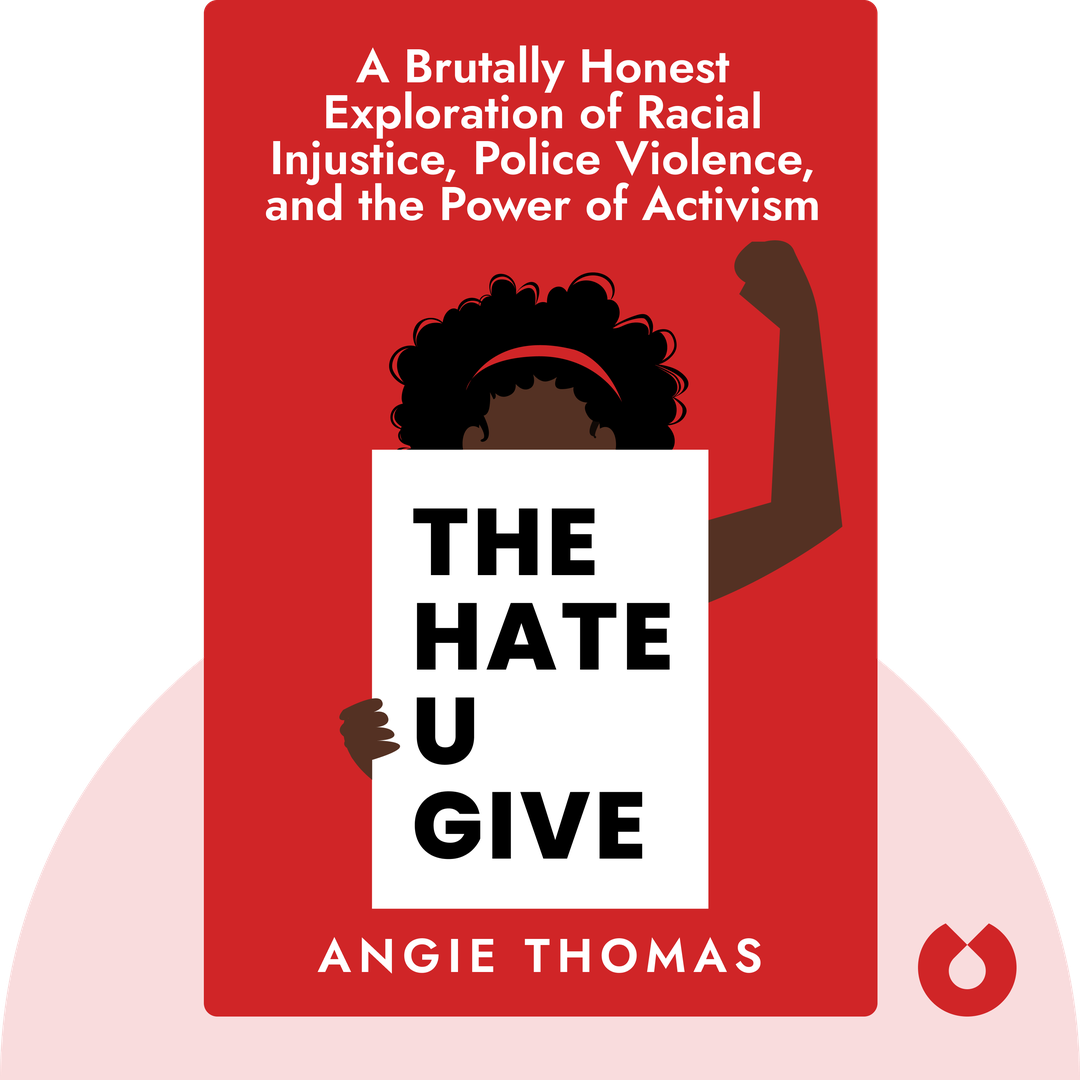
The Hate U Give audiobook cover - A Brutally Honest Exploration of Racial Injustice, Police Violence, and the Power of Activism

The Hate U Give

A Brutally Honest Exploration of Racial Injustice, Police Violence, and the Power of Activism

Angie Thomas

★ 4.4 / 5(1,047,323 ratings on Goodreads)
Start Listening

Listen to The Hate U Give — Cinematic Audio Edition

Loading player...
What you'll learn

Key Takeaways from The Hate U Give

  1. 01

    Navigating the stark divide between an impoverished neighborhood and an affluent prep school forces Black adolescents to suppress their authentic identities to avoid racist stereotypes.

  2. 02

    The media frequently frames victims of police violence through a lens of criminality, stripping them of their humanity and dictating whether their lives are deemed 'grievable.'

  3. 03

    Tupac’s 'Thug Life' acronym vividly encapsulates how society's failure to provide adequate education and opportunities to marginalized youth ultimately fuels cyclical, systemic destruction.

  4. 04

    Publicly mourning and insisting on the value of a life that society refuses to recognize is a profound political act that disrupts deep-rooted systems of oppression.

  5. 05

    While the trauma of racial injustice breeds dangerous, unchanneled rage, true societal change begins when individuals bravely bear witness and use their voices to demand accountability.

If You're Curious About These Questions...

You should listen to this audiobook

Learning Tools

Reinforce what you learned from The Hate U Give

Mind Map

The Hate U Give
Dual Identities & Worlds+
The Shooting of Khalil+
Media Framing & Grievability+
T.H.U.G. L.I.F.E. & Systemic Racism+
Activism & Bearing Witness+

Quiz — Test Your Understanding

Question 1 of 7
What was the primary focus of the crucial 'talk' Starr's parents gave her when she was 12?
  • A. How to navigate the wealthy, predominantly white environment of her new prep school.
  • B. What to do and how to behave when stopped by the police.
  • C. The dangers of getting involved with gangs in Garden Heights.
  • D. The financial struggles of running a family-owned grocery store.
Question 2 of 7
How does Starr alter her behavior when attending Williamson, her prep school?
  • A. She constantly speaks out about the injustices happening in Garden Heights.
  • B. She pretends her family is wealthy to fit in with her classmates.
  • C. She flips a switch, avoids using slang, and holds her tongue to avoid being labeled 'ghetto.'
  • D. She isolates herself completely and refuses to make friends with white students.
Question 3 of 7
During the fatal traffic stop, what action does Khalil take that angers Officer One-Fifteen?
  • A. He refuses to hand over his papers and license.
  • B. He reaches under the seat for a weapon.
  • C. He tries to run away from the vehicle.
  • D. He talks back and suggests the officer just write him a ticket for the tail light.
Question 4 of 7
According to the analysis involving philosopher Judith Butler, why are lives like Khalil's often treated as 'ungrievable' by the media and society?
  • A. Because society and social norms fail to originally recognize and value their lives.
  • B. Because their families prefer to mourn in private rather than publicly.
  • C. Because the legal system strictly prohibits public mourning before a grand jury verdict.
  • D. Because the media lacks the resources to cover stories outside of wealthy suburbs.
Question 5 of 7
In the context of the novel, what does Tupac's acronym 'Thug Life' ultimately represent to Starr and her father?
  • A. A celebration of the violent, do-or-die gangster lifestyle.
  • B. The systemic cycle of racism, lack of opportunity, and systemic oppression that harms society.
  • C. The inevitable rise of gang violence in neighborhoods that lack police presence.
  • D. A media conspiracy to frame young Black men as criminals.
Question 6 of 7
What specifically motivates Starr to finally speak out publicly and testify before the grand jury?
  • A. She is offered a plea deal by the police to keep her father out of prison.
  • B. Her friend Kenya calls her out for not publicly defending Khalil.
  • C. She wants to become famous and secure a book deal about the incident.
  • D. Her Williamson classmates pressure her into becoming an activist.
Question 7 of 7
When Starr addresses the crowd through a bullhorn during the protests, what does she emphasize as the most important point about Khalil?
  • A. The specific details of how Officer One-Fifteen shot him.
  • B. The fact that he was forced to sell drugs to support his family.
  • C. The fact that he lived and that his life mattered.
  • D. The need to burn down the neighborhood to get the media's attention.

The Hate U Give — Full Chapter Overview

The Hate U Give Summary & Overview

The Hate U Give (2017) is a critically acclaimed coming-of-age tale set against the backdrop of racism and police brutality. It follows 16-year-old Starr Carter as she navigates two contrasting worlds: the poor Black neighborhood where she lives and the white prep school where she studies. Starr's attempt to strike a balance between these two worlds is shattered when she witnesses the shooting of her childhood friend, Khalil, by a police officer.

Who Should Listen to The Hate U Give?

  • Social justice advocates and activists
  • Young adults exploring identity and inequality
  • Anyone interested in compelling contemporary fiction

About the Author: Angie Thomas

Angie Thomas was born and raised in Jackson, Mississippi. She studied creative writing at Belhaven University and was the first winner of the Walter Dean Myers Grant 2015 – an award issued by We Need Diverse Books. The Hate U Give is her first novel.

🎧
Listen in the AppOffline playback & background play
Get App