If You're Curious About These Questions...
You should listen to this audiobook
- Have you ever wondered why our brains seem more interested in our survival than our actual happiness?
- What if the secret to modern contentment lies in understanding how our ancestors’ environments still shape our moods today?
- Did you know that your quest for immediate gratification might actually be sabotaging your long-term sense of meaning?
Listen to The Happiness Cure — Free Audiobook
Loading player...
Key Takeaways from The Happiness Cure
- Discover why modern comforts fail to bring lasting happiness by exploring the mismatch between our ancient biological wiring and contemporary lifestyles.
- Understand that your brain was engineered for survival and reproduction, not happiness, explaining why prehistoric threat vigilance manifests as modern anxiety.
- Learn how the brain generates feelings as vital survival tools, and discover why your sense of satisfaction is biologically designed to be temporary.
- Explore the deep evolutionary rationale behind depression, revealing why it functions as an 'energy-saving mode' triggered by prolonged stress rather than a simple chemical imbalance.
- Master the ability to navigate complex emotions by reframing your stress, joy, and despair as ancient survival adaptations rather than modern psychological failures.
Learning Tools
Reinforce what you learned from The Happiness Cure
Mind Map
The Happiness Cure
Evolutionary Biology & Mental Health+
The Purpose of Feelings+
Evolutionary Rationale for Depression+
Exercise as a Mental Health Tool+
Redefining Happiness+
Quiz — Test Your Understanding
Question 1 of 5
According to the evolutionary perspective presented in the book, why do modern humans experience high rates of anxiety and stress despite living in relatively safe environments?
Question 2 of 5
From an evolutionary standpoint, why are feelings of satisfaction and wellbeing designed to be temporary?
Question 3 of 5
What surprising evolutionary rationale does the author suggest for the historical prevalence of depression?
Question 4 of 5
How does regular physical exercise biologically help prevent depression, according to the text?
Question 5 of 5
Why does actively pursuing happiness often make it harder to achieve?
The Happiness Cure — Full Chapter Overview
- 1Recommendation
- 2Our bodies evolved for survival and reproduction, not for health
- 3Feelings help ensure survival
- 4Depression has a strong evolutionary rationale
- 5Exercise can lower our risk of becoming depressed
- 6The less we chase happiness, the better our chance of truly finding it
The Happiness Cure Summary & Overview
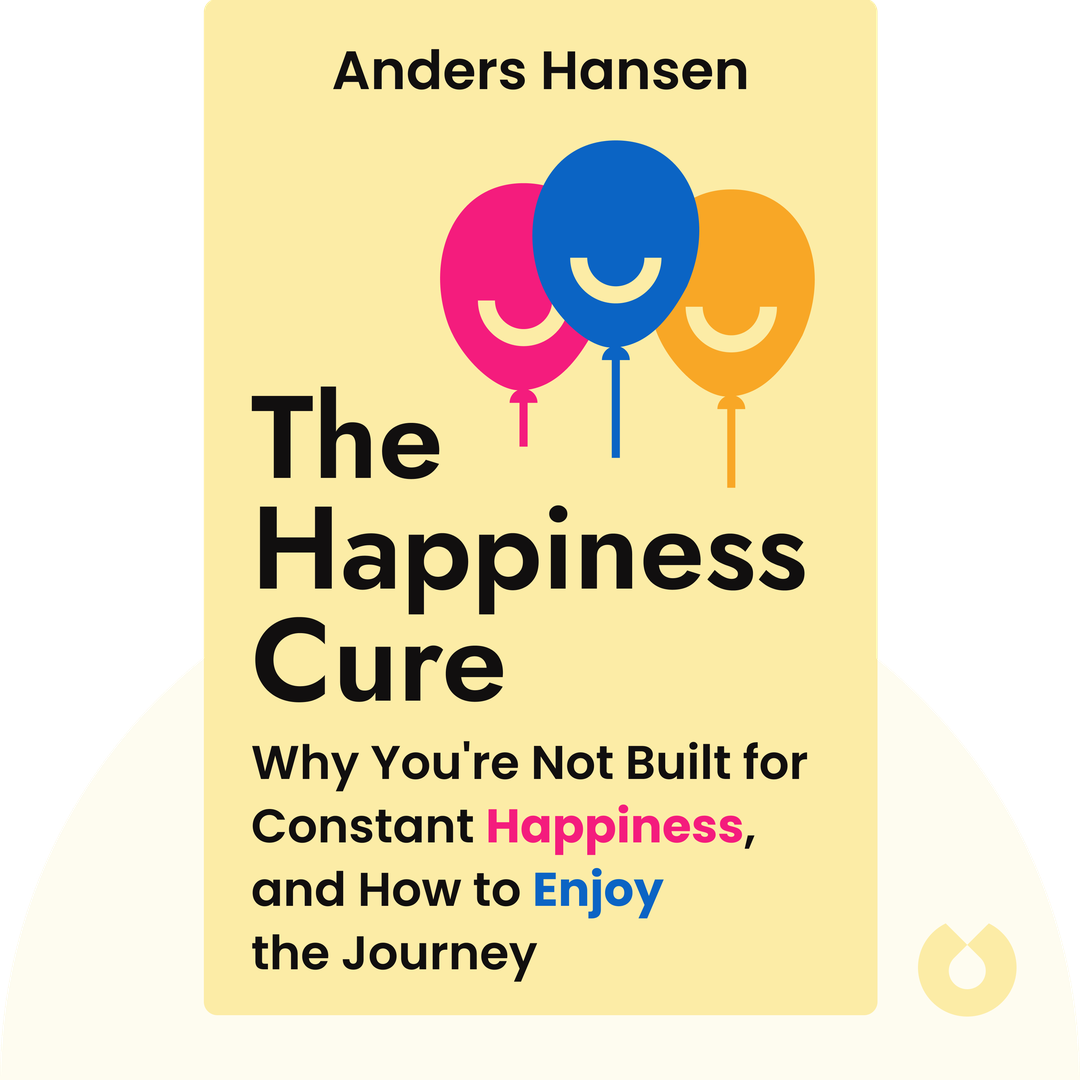
The Happiness Cure (2023) explores how adopting an evolutionary perspective on life can fundamentally shift our understanding of happiness. Drawing on the latest neuroscientific research, it shows that true contentment comes from resetting our expectations and focusing on longer-term meaning rather than immediate gratification. It suggests that understanding our biological and psychological wiring can help us better navigate our quest for happiness in a modern world that differs vastly from the environments our ancestors adapted to.
Who Should Listen to The Happiness Cure?
- Individuals curious about neuroscience and psychology
- People who seek long-term happiness
- Readers interested in evolutionary biology’s impact on behavior
Books Similar to The Happiness Cure
Readers who enjoyed this also liked these titles.