If You're Curious About These Questions...
You should listen to this audiobook
- Did you know that throughout the history of civilization, the only forces truly capable of closing the gap between the rich and the poor have been mass-scale catastrophes?
- Have you ever wondered why long periods of peace and stability almost always lead to a massive surge in economic inequality?
- What’s the secret connection between global disasters and social fairness, and is it actually possible to achieve equality without the threat of violence?
Listen to The Great Leveler — Cinematic Audio Edition
Loading player...
Key Takeaways from The Great Leveler
- Understand why widely praised systems like democracy and capitalism have historically failed to eliminate inequality compared to the effects of massive disasters.
- Discover how the end of the ice age and the shift toward agricultural food surpluses first introduced a hierarchical divide between the rich and the poor.
- Learn how the privatization of once-egalitarian land systems allowed early elites to consolidate wealth through predatory loans and property hoarding.
- Find out why catastrophic events, such as the political collapse of the Roman Empire and the Black Death, were ironically the most effective mechanisms for raising lower-class wages and closing the wealth gap.
- Explore how massive, violent conflicts like World War II acted as powerful societal levelers to forcibly reset highly imbalanced nations like Japan.
Learning Tools
Reinforce what you learned from The Great Leveler
Mind Map
The Great Leveler
Core Thesis+
Origins of Inequality+
Historical Forces of Leveling+
Ineffectiveness of Politics+
Future Solutions+
Quiz — Test Your Understanding
Question 1 of 9
According to the book, what has historically been the most effective force in reducing societal inequality?
Question 2 of 9
How did the transition to the Holocene period and the advent of agriculture impact human society?
Question 3 of 9
What does the example of the Chumash tribe's development of deep-sea canoes illustrate?
Question 4 of 9
Counterintuitively, how did the Black Death affect the wealth gap in Europe?
Question 5 of 9
Why did social inequality decline in Japan during World War II?
Question 6 of 9
How did the 1917 Russian Revolution address the issue of inequality?
Question 7 of 9
Why does the author argue that the collapse of the Somalian state in 1991 led to improved living conditions for the poor?
Question 8 of 9
What did researchers conclude about the relationship between modern political systems and inequality, based on studies from 1960-2010 and 1916-2000?
Question 9 of 9
According to British economist Anthony Atkinson, what is a proposed modern alternative to using violent disasters to tackle inequality?
The Great Leveler — Full Chapter Overview
- 1Recommendation
- 2A higher quality of life bred inequality, and later technological progress made it even worse.
- 3In the beginning, land was shared equally, yet in some circles property soon concentrated heavily.
- 4Across Europe’s history, inequality was checked by state collapse and devastating plague during turbulent periods of war and crisis.
- 5Inequality plagued Japan, but this shifted dramatically during WWII itself.
- 6Russia’s 1917 revolution reduced inequality through coordinated and violent measures and widespread seizures.
- 7Although Somalia’s state collapsed in 1991, the ensuing poverty paradoxically left the country in better condition than before overall.
- 8Democracy or left-wing governments cannot ultimately solve inequality alone.
- 9Economic reforms have been proposed to curb inequality, but they have still not undergone feasibility testing in practice.
The Great Leveler Summary & Overview
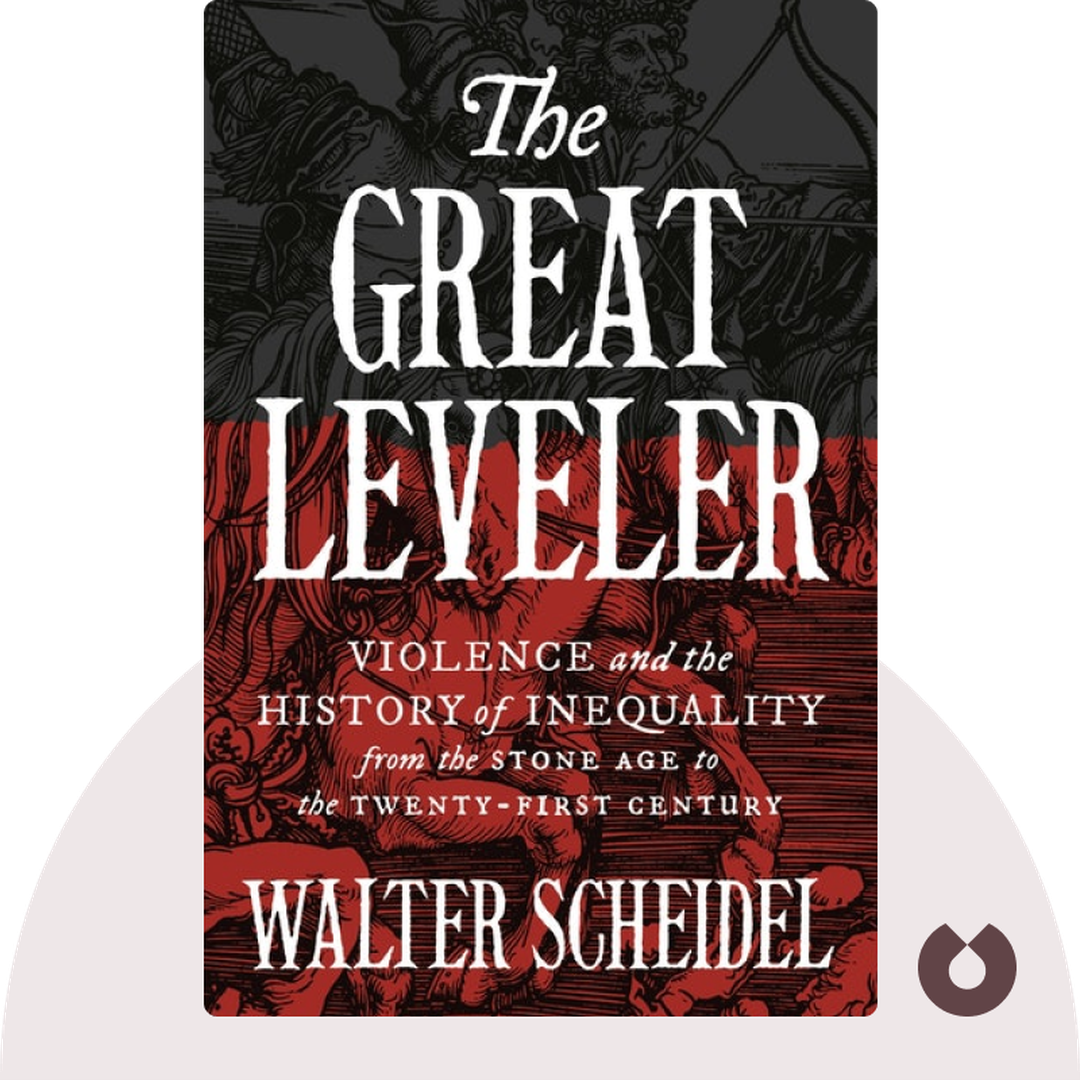
The Great Leveler (2017) takes a look at the inequality faced by different societies throughout history. It highlights war, plague and other major catastrophes as a leveler of the unequal distribution of power and property, prompting the question: can equality be achieved in a non-violent manner?
Who Should Listen to The Great Leveler?
- People interested in the history of inequality
- Students of politics
- Those who enjoy learning about different societies
Books Similar to The Great Leveler
Readers who enjoyed this also liked these titles.