If You're Curious About These Questions...
You should listen to this audiobook
- Did you know that the French Revolution was less a sequence of political dates and more a vivid, spiritual explosion that forever changed how we document human history?
- Have you ever wondered what truly happens when the social fabric of a nation unravels, and what symbolic forces drive a civilization toward total collapse?
- Are you curious about how a unique, 'prophetic' style of storytelling can make the chaos of the 18th century feel as urgent and dramatic as a modern-day thriller?
Listen to The French Revolution — Free Audiobook
Loading player...
Key Takeaways from The French Revolution
- Understand how Thomas Carlyle's vivid retelling frames the French Revolution not as mere politics, but as a terrifying moral reckoning against a corrupt elite.
- Discover why public adoration for the monarchy deteriorated under Louis XV, demonstrating how extreme wealth inequality and a parasitic ruling class inevitably ignite societal collapse.
- Learn how the commoners of the Third Estate claimed their power through the Tennis Court Oath, proving that unified, unwavering defiance can successfully dismantle entrenched political hierarchies.
- Find out how King Louis XVI's decision to surround Paris with troops disastrously backfired, revealing that oppressive intimidation tactics often serve to weaponize and unite a rebellion.
- Uncover the pivotal role everyday women played in the revolution by marching on Versailles for bread, highlighting how basic human desperation can mobilize an unstoppable political force.
Learning Tools
Reinforce what you learned from The French Revolution
Mind Map
The French Revolution
Carlyle's Perspective+
Decay of the Old Regime+
Rise of the Commons+
Power of the Crowd+
Fall of the Monarchy+
The Reign of Terror+
The Military Conclusion+
Quiz — Test Your Understanding
Question 1 of 7
How does Thomas Carlyle distinctively portray the French Revolution in his historical account?
Question 2 of 7
According to the text, what characterized the 'new nobility' that emerged during the later years of Louis XV's reign?
Question 3 of 7
What prompted the Commons to declare themselves the National Assembly and take the Tennis Court Oath?
Question 4 of 7
What was the primary outcome of the women's march on Versailles in October 1789?
Question 5 of 7
How did moderate leaders attempt to manage the political fallout after the royal family's failed escape attempt to Montmédi?
Question 6 of 7
What was Maximilien Robespierre's underlying justification for the Reign of Terror?
Question 7 of 7
What fundamental shift in revolutionary politics was marked by Napoleon Bonaparte's 'whiff of grapeshot'?
The French Revolution — Full Chapter Overview
- 1Recommendation
- 2Louis the Beloved
- 3Democracy declares itself
- 4The women rise up
- 5Not a revolt, but a revolution
- 6The sea-green incorruptible
- 7Whiff of grapeshot
The French Revolution Summary & Overview
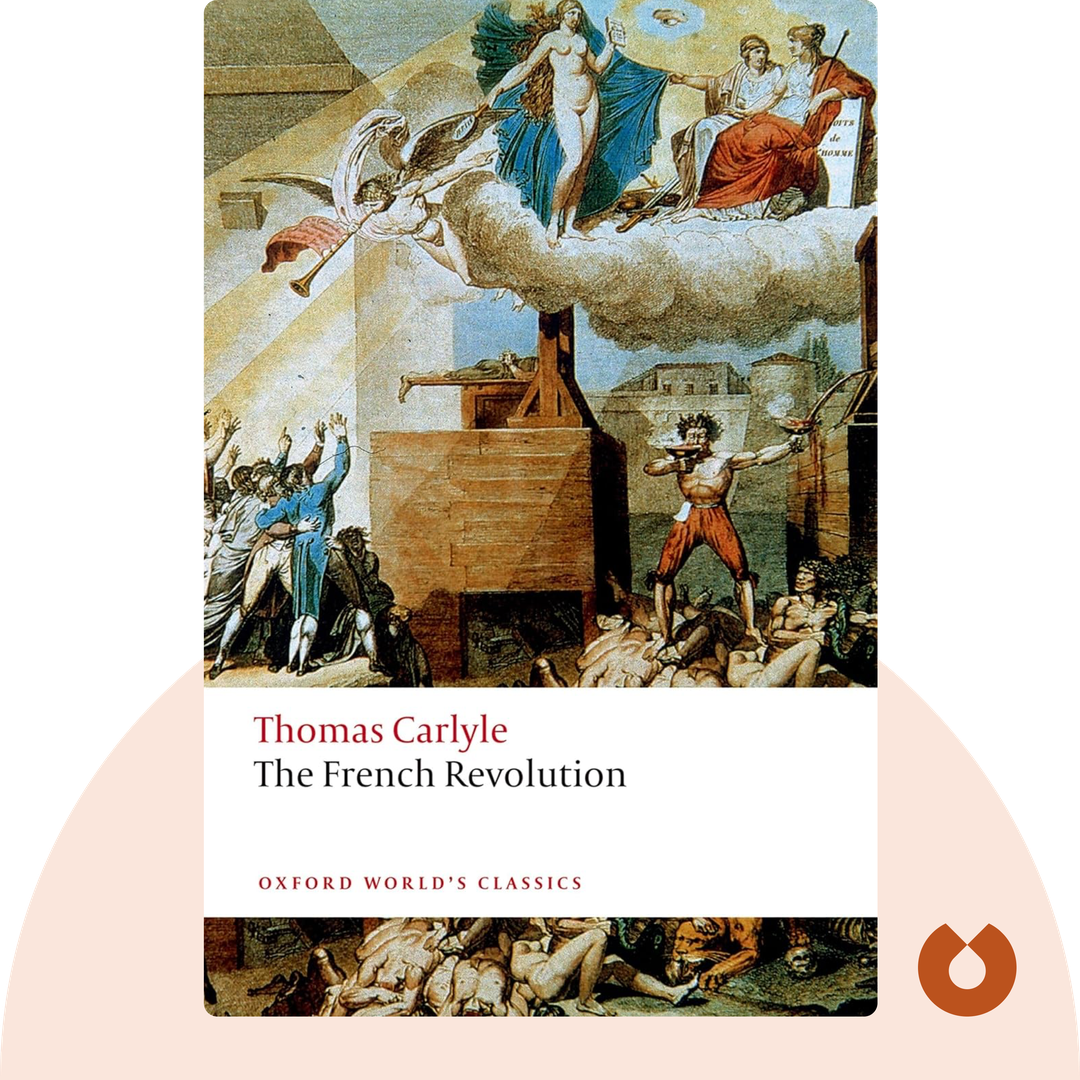
The French Revolution (1837) is a seminal work that presents the revolutionary period as a series of dramatic episodes told in vivid, often chaotic prose. Through its unconventional style and prophetic tone, it established a new approach to historical writing that emphasized the spiritual and symbolic dimensions of political upheaval, rather than merely documenting events.
Who Should Listen to The French Revolution?
- History buffs who love a story with extra flair and drama
- Political philosophers interested in frameworks for understanding societal collapse
- Literature lovers curious about Carlyle’s unique and dramatic storytelling techniques
Books Similar to The French Revolution
Readers who enjoyed this also liked these titles.