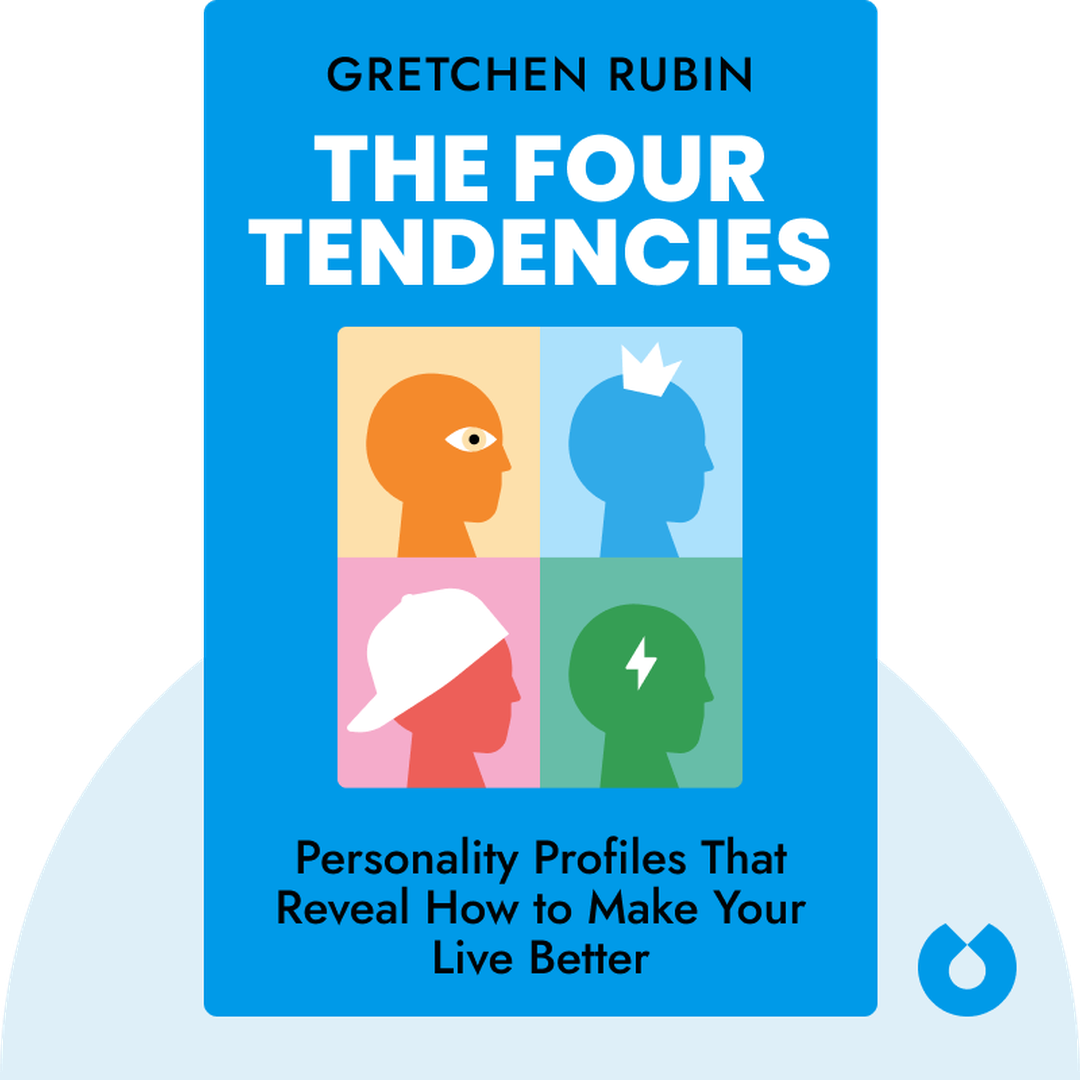
If You're Curious About These Questions...
You should listen to this audiobook
- Have you ever wondered why you can easily meet a deadline for your boss, yet struggle to keep a simple promise to yourself?
- What if you could identify the single personality trait that dictates how you—and everyone around you—reacts to rules and expectations?
- Are you curious about the secret to motivating a person who seems to resist both outside pressure and their own inner resolutions?
Listen to The Four Tendencies — Cinematic Audio Edition
Loading player...
Key Takeaways from The Four Tendencies
- Discover how the Four Tendencies—Upholders, Questioners, Obligers, and Rebels—reveal how you respond to inner and outer expectations, allowing you to maximize your personal potential.
- Learn why Obligers easily meet outside demands but struggle with personal goals, and understand why external accountability is the key to their productivity.
- Master the best way to manage Upholders by providing them with clear, precise instructions while avoiding sudden, spontaneous changes to their established routines.
- Recognize the unique challenge of 'tightening' in Upholders, a phenomenon where casually starting a new healthy habit can eventually become rigid and overly controlling of their lives.
- Understand why Questioners resist external rules until they make logical sense, and find out how to harness their skepticism to spot inefficiencies and improve organizational procedures.
Learning Tools
Reinforce what you learned from The Four Tendencies
Mind Map
The Four Tendencies
Core Concept+
Upholders+
Questioners+
Obligers+
Rebels+
Application & Takeaways+
Quiz — Test Your Understanding
Question 1 of 10
What is the primary basis for the Four Tendencies framework?
Question 2 of 10
Which of the following is a common challenge faced by Upholders?
Question 3 of 10
What is the best approach for a manager to take when assigning a task to an Upholder?
Question 4 of 10
Why might a Questioner be seen as not being a 'team player' in some organizations?
Question 5 of 10
What is a surprisingly effective way to communicate with a Questioner without insulting them?
Question 6 of 10
What is the most effective strategy for an Obliger who wants to start exercising regularly?
Question 7 of 10
What triggers the phenomenon known as 'Obliger-rebellion'?
Question 8 of 10
How can a Rebel effectively trick themselves into meeting their own inner expectations, like paying bills?
Question 9 of 10
If you need a Rebel to complete a task, which approach is most likely to succeed?
Question 10 of 10
According to the author, which of the Four Tendencies makes the best business leader?
The Four Tendencies — Full Chapter Overview
- 1Recommendation
- 2The Four Tendencies reveal our nature and how we react to expectations.
- 3Upholders are dependable people who look after themselves, but they also encounter difficulties.
- 4Upholders need straightforward directions, and their irritation is best met with empathy.
- 5Questioners hesitate to fulfill the demands of others, and their nature can help or hinder.
- 6Questioners demand solid reasons, dislike being challenged and should steer clear of certain complex roles.
- 7Obligers find it hard to honor their own goals, but outside accountability can fix this.
- 8Obligers might have the hardest time, so they can gain the most from knowing the Four Tendencies.
- 9Rebels refuse to follow any expectations or be ordered about.
- 10Rebels can annoy themselves, but they can still achieve their own aims.
- 11Whatever your tendency, deeper self-knowledge can help you thrive in life and at work.
The Four Tendencies Summary & Overview
The Four Tendencies (2017) reveals the four personality types that dictate how people react to the expectations in their daily lives. Expanding on the first chapter to her book on habit Better Than Before, Rubin provides insight and advice to help you understand your own tendencies, as well as those of the people you live and work with.
Who Should Listen to The Four Tendencies?
- Parents and teachers who want to have better communication skills
- Managers and supervisors hoping to improve employee relations
- Anyone who wants to live a more productive, happier life
Books Similar to The Four Tendencies
Readers who enjoyed this also liked these titles.