If You're Curious About These Questions...
You should listen to this audiobook
- How does the cultural difference between being 'confrontational' and 'emotionally expressive' explain why a shouting match in Paris might just be a friendly debate?
- Why might an employee from a 'principles-first' culture become profoundly frustrated when given clear, practical instructions by an 'applications-first' manager?
- How can a business culture be strictly hierarchical yet heavily rely on a slow, consensus-based decision-making process like the Japanese ringi system?
Listen to The Culture Map — Free Audiobook
Loading player...
Key Takeaways from The Culture Map
- Discover how to read the air by identifying whether your colleagues come from low-context cultures that value explicit communication or high-context cultures that rely on subtle, unspoken cues.
- Adopt a low-context, highly specific communication style when working with diverse, multicultural teams to safely minimize the risk of misunderstandings.
- Learn how to deliver negative feedback without causing offense by tailoring your approach to a culture's preference for direct, public criticism or gentle, private correction.
- Understand how to successfully persuade international audiences by blending principles-first reasoning that explains the why with applications-first reasoning that demonstrates the how.
- Adapt your leadership approach by recognizing whether your team's culture expects an egalitarian, flat organizational structure or relies on a strict, top-down hierarchy.
Learning Tools
Reinforce what you learned from The Culture Map
Mind Map
The Culture Map
Core Premise+
1. Communicating Scale+
2. Evaluating Scale+
3. Persuading Scale+
4. Leading Scale+
5. Deciding Scale+
6. Trusting Scale+
7. Disagreeing Scale+
8. Scheduling Scale+
Key Takeaways+
Quiz — Test Your Understanding
Question 1 of 10
When people from multiple cultures are working together on a team, what is the most effective communication style to use according to the text?
Question 2 of 10
How do indirect cultures like Japan or Indonesia typically deliver negative feedback?
Question 3 of 10
According to the persuading scale, why might a French employee become frustrated with an American boss's instructions?
Question 4 of 10
What historical factor explains why Sweden's leading style is highly egalitarian compared to France's hierarchical style?
Question 5 of 10
What is a characteristic of decision-making in top-down countries like China or India?
Question 6 of 10
The Japanese 'ringi' system demonstrates that an organizational structure can be:
Question 7 of 10
In relationship-based cultures like China and Brazil, how is trust primarily built in business?
Question 8 of 10
Although both Germany and France are considered confrontational cultures on the disagreeing scale, how do their styles differ?
Question 9 of 10
In linear-time cultures like Germany and Switzerland, how is answering a cell phone during a meeting generally perceived?
Question 10 of 10
Why is a Chinese business person unlikely to speak up voluntarily during a meeting?
The Culture Map — Full Chapter Overview
- 1Recommendation
- 2Sometimes, being a keen observer matters more than being an eloquent speaker indeed.
- 3Be cautious with feedback; it might easily cause offense.
- 4Noticing how other people express ideas will make your arguments far more persuasive.
- 5To lead successfully, you need to learn to adapt your style well.
- 6Grasping diverse decision-making processes is crucial for implementing ideas.
- 7Trust develops differently across cultures, yet it remains important for every one of us.
- 8There's a right way to disagree.
- 9Schedules must align with each culture’s unique, specific perception of time.
The Culture Map Summary & Overview
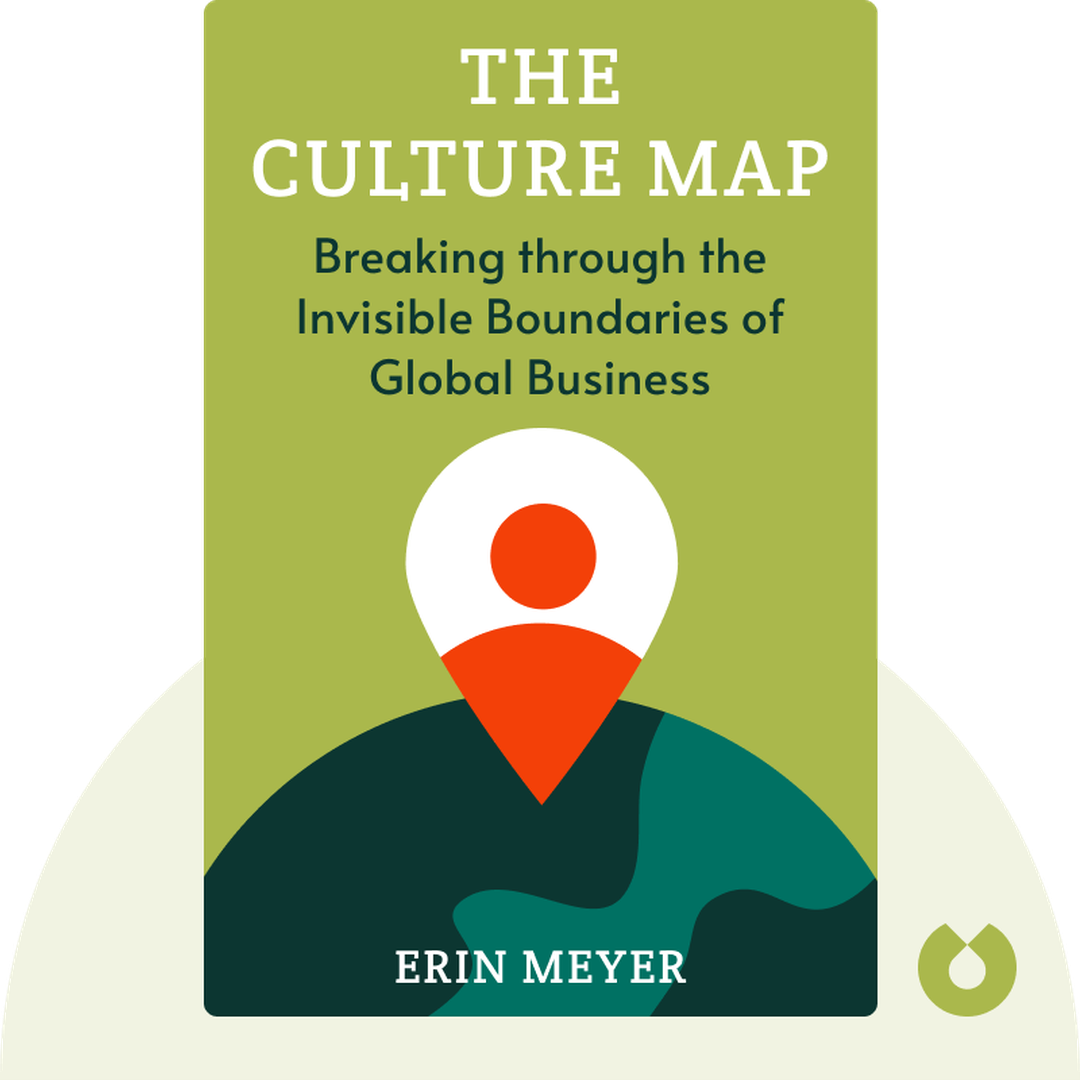
The Culture Map provides a framework for handling intercultural differences in business and illustrates how different cultures perceive the world. It helps us understand these differences, and in doing so improves our ability to react to certain behaviors that might have once seemed strange. With this knowledge, we can avoid misunderstandings and maintain conflict-free communication, regardless of where we are in the world.
Who Should Listen to The Culture Map?
- Anyone who’s interested in understanding cultural differences at work
- Anyone who wants to improve his or her communications skills
- Anyone who is leading an international team and is facing culture clashes
Books Similar to The Culture Map
Readers who enjoyed this also liked these titles.