If You're Curious About These Questions...
You should listen to this audiobook
- What if consciousness isn't just a byproduct of your brain's chemistry, but a fundamental building block of the entire universe?
- Have you ever wondered why physical processes in the brain give rise to rich, subjective experiences like the smell of a rose or the feeling of joy?
- Are you curious whether a machine could one day act exactly like a human while remaining completely "dark" inside, without any true conscious awareness?
Listen to The Conscious Mind — Cinematic Audio Edition
Loading player...
Key Takeaways from The Conscious Mind
- Discover why David Chalmers coined the 'hard problem of consciousness' to explain the deep mystery of how physical neurons create rich, subjective inner experiences.
- Understand the critical difference between the 'easy problems' of mapping brain functions and the truly difficult task of explaining phenomenal consciousness.
- Grasp the concept of the 'explanatory gap' to see why understanding the brain's physical hardware still cannot explain the origin of our vivid, felt sensations.
- Explore the 'philosophical zombie' thought experiment to learn why complex behavior and advanced artificial intelligence do not automatically produce a conscious inner life.
- Learn why widespread scientific theories like materialism and functionalism fail to decode the mind, proving that subjective consciousness cannot simply be reduced to physical matter.
Learning Tools
Reinforce what you learned from The Conscious Mind
Mind Map
The Conscious Mind
The Two Problems of Consciousness+
Limits of Traditional Theories+
Chalmers's Radical Framework+
Panpsychism+
A New Worldview+
Quiz — Test Your Understanding
Question 1 of 6
What is the 'hard problem' of consciousness according to David Chalmers?
Question 2 of 6
How does the text define the 'easy problems' of consciousness?
Question 3 of 6
What is the primary purpose of the 'philosophical zombies' thought experiment?
Question 4 of 6
Why does Chalmers argue that traditional materialism fails to explain consciousness?
Question 5 of 6
What is Chalmers's 'double aspect theory' of information?
Question 6 of 6
What radical philosophical view arises from treating consciousness as a fundamental property of reality?
The Conscious Mind — Full Chapter Overview
- 1Recommendation
- 2An easy and a hard problem
- 3The limits of our theories
- 4A new way forward
- 5A cosmos filled with consciousness
The Conscious Mind Summary & Overview
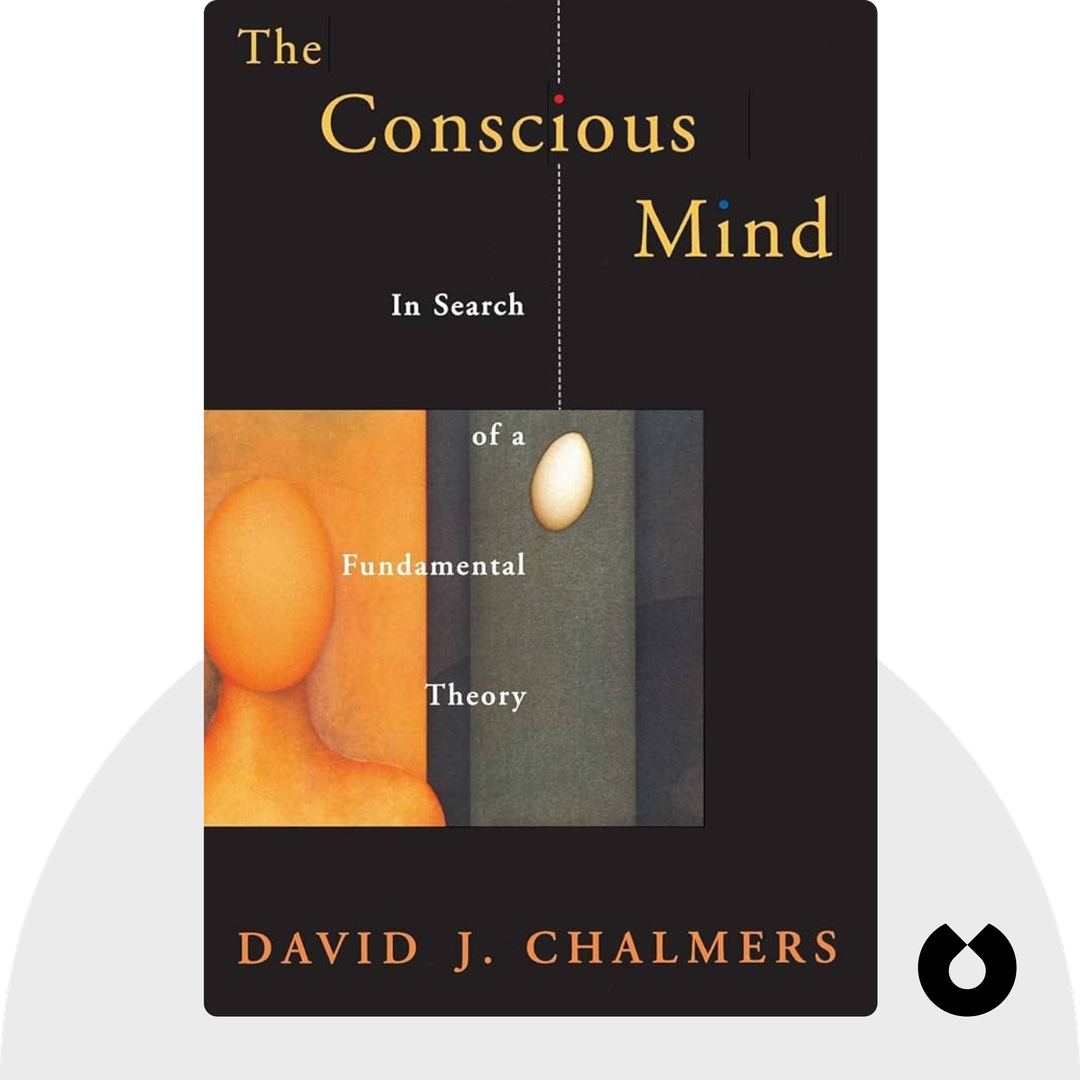
The Conscious Mind (1996) is a groundbreaking work analyzing why subjective experience has remained so resistant to conventional scientific explanations. It argues that consciousness must be considered a fundamental property woven into reality rather than an illusory emergent product of brain computations.
Who Should Listen to The Conscious Mind?
- Technologists and futurists contemplating machine consciousness
- Curious minds exploring the connections between science and spirit
- Anyone appreciating thought experiments that challenge fundamental assumptions about reality
Books Similar to The Conscious Mind
Readers who enjoyed this also liked these titles.