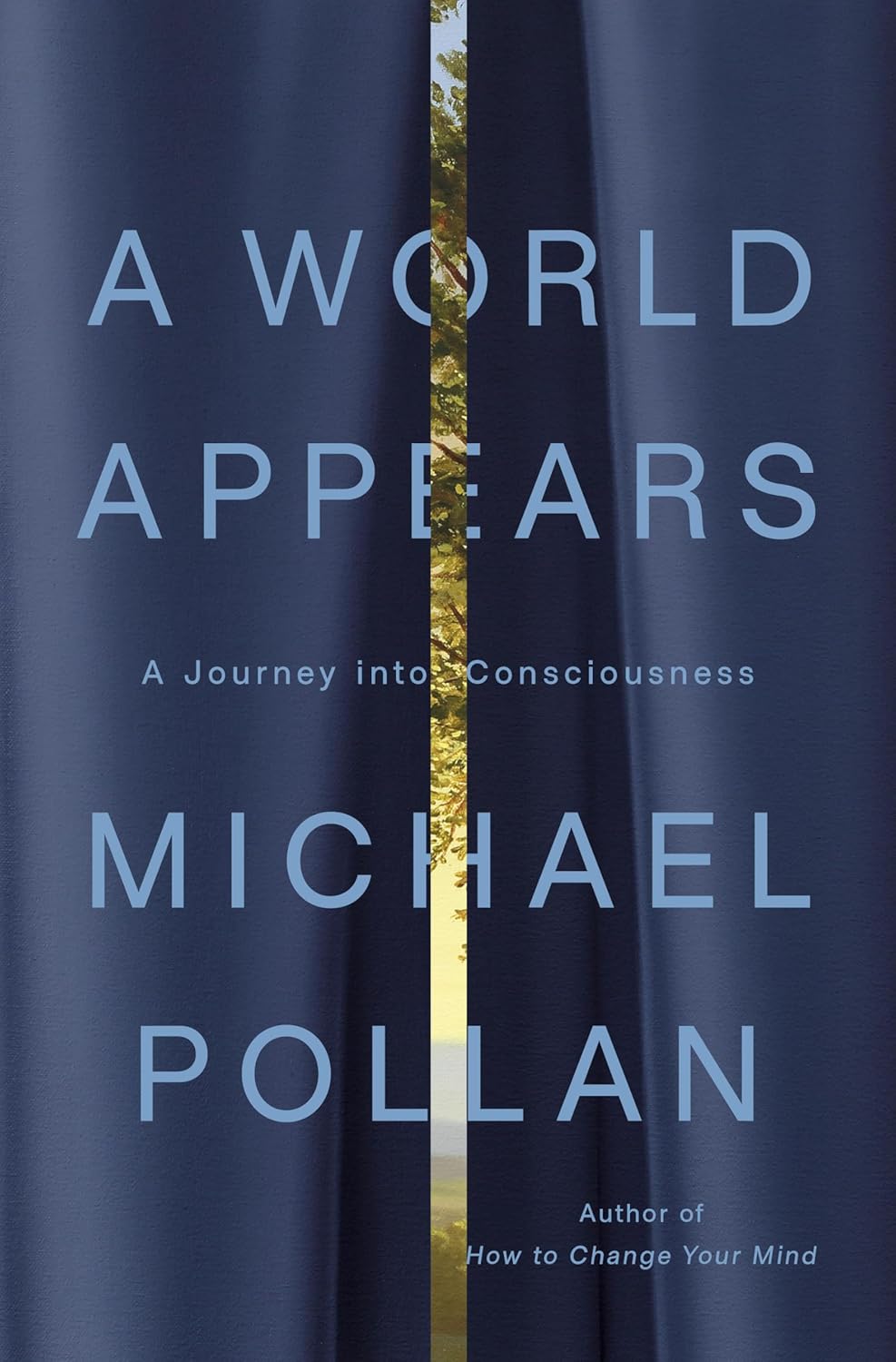
A World Appears audiobook cover - A decades-old bet about consciousness pulls Michael Pollan into a maze of neuroscience, philosophy, plants, psychedelics, AI, and meditation—until the biggest revelation isn’t a final theory, but a changed way of inhabiting experience itself.

A World Appears

A decades-old bet about consciousness pulls Michael Pollan into a maze of neuroscience, philosophy, plants, psychedelics, AI, and meditation—until the biggest revelation isn’t a final theory, but a changed way of inhabiting experience itself.

Michael Pollan

4.2 / 5(5 ratings)

If You're Curious About These Questions...

You should listen to this audiobook

Listen to A World Appears — Free Audiobook

Loading player...

Key Takeaways from A World Appears

Learning Tools

Reinforce what you learned from A World Appears

Mind Map

A World Appears
The Quest for Consciousness+
Sentience Without Brains+
The Physics of Sentience+
Feeling as the Hidden Spring+
AI and Synthetic Phenomenology+
The Nature of Thought+
The Illusion of Self & Transcendence+

Quiz — Test Your Understanding

Question 1 of 9
What is the core disagreement captured by the 1998 bet between Christof Koch and David Chalmers?
  • A. Whether consciousness is a useful field of scientific study at all.
  • B. Whether science could identify the brain's physical footprint of consciousness within 25 years.
  • C. Whether artificial intelligence could ever become sentient.
  • D. Whether animals other than humans experience subjective states.
Question 2 of 9
What is the fundamental difference between Integrated Information Theory (IIT) and Global Workspace Theory (GWT)?
  • A. IIT focuses on animals, while GWT focuses on artificial intelligence.
  • B. IIT believes consciousness is a property of all matter (panpsychism), while GWT restricts it to brains.
  • C. IIT claims consciousness IS integrated information, while GWT models consciousness as information that is 'broadcast' for global use.
  • D. IIT was developed by a philosopher (Chalmers), while GWT was developed by a neuroscientist (Koch).
Question 3 of 9
The book explores plant sentience to challenge a common assumption. What is the primary argument used to suggest plants might have a form of mind?
  • A. Pollan's psychedelic experience where he felt plants were awake and watchful.
  • B. Plants demonstrate complex behaviors like learning, memory, and goal-directed action without needing neurons.
  • C. Time-lapse photography proves that plants have intentions just like humans.
  • D. Ancient philosophies universally considered plants to be conscious beings.
Question 4 of 9
What key finding from Michael Levin's research on planaria (flatworms) challenges the brain-centric view of memory?
  • A. Planaria can be combined to form Xenobots, a new type of living machine.
  • B. A decapitated planarian can regenerate its head and retain memories it had before decapitation.
  • C. Planaria have the most complex bioelectric fields of any organism.
  • D. Planaria lose all memories if their DNA is altered, proving memory is genetic.
Question 5 of 9
According to Karl Friston's 'free-energy principle,' what is the fundamental purpose of mind-like behavior?
  • A. To maximize pleasure and social connection.
  • B. To create a metaphysical soul that can survive death.
  • C. To reduce uncertainty ('surprise') and maintain the system's existence against entropy.
  • D. To accurately model every detail of the external world.
Question 6 of 9
How does Antonio Damasio's theory relocate the origin of consciousness, departing from traditional views?
  • A. He argues consciousness arises from complex social interactions, not from individual brains.
  • B. He pinpoints the cortex's visual processing centers as the true seat of experience.
  • C. He grounds consciousness in ancient brainstem structures that monitor the body's internal state and generate feelings.
  • D. He suggests consciousness is not biological but an emergent property of quantum physics.
Question 7 of 9
Based on the book's discussion of artificial consciousness, what is considered a critical (and often overlooked) requirement for a machine to have genuine feelings?
  • A. A processor that is faster than the human brain.
  • B. Access to the entire internet for its knowledge base.
  • C. The ability to perfectly imitate human conversation and emotions.
  • D. A state of physical vulnerability, giving it a reason to 'care' about its well-being.
Question 8 of 9
What was a key takeaway from Pollan's experience with Descriptive Experience Sampling (DES), the method for capturing 'pristine inner experience'?
  • A. That most people's inner lives are dominated by a constant, verbal narrator.
  • B. That human thought is always logical and goal-oriented.
  • C. That 'thinking' is not a single activity but a diverse range of experiences (e.g., inner seeing, unsymbolized thought) that vary greatly between individuals.
  • D. That it is impossible to accurately report on inner experience without changing it.
Question 9 of 9
How does neuroscientist Anil Seth describe the 'self' from a predictive processing perspective?
  • A. As a non-physical soul that science cannot explain.
  • B. As the one stable, unchanging part of our identity.
  • C. As a 'controlled hallucination' the brain generates to model and regulate the body.
  • D. As the CEO or 'boss' located in the brain's frontal lobe.

A World Appears — Full Chapter Overview

A World Appears Summary & Overview

A World Appears is Michael Pollan’s guided expedition into the most intimate mystery: how subjective experience arises, why it feels like anything at all to be alive, and whether consciousness belongs only to brains. He begins with a famous wager between neuroscientist Christof Koch and philosopher David Chalmers, using it to frame the split between the “easy problems” science can measure and the “hard problem” of why experience exists at all.

From there, Pollan follows four escalating dimensions—sentience, feeling, thought, and self—meeting plant neurobiologists, brain researchers, philosophers, and contemplatives. Along the way he examines competing theories such as Integrated Information Theory and Global Workspace Theory, explores the possible sentience of plants, investigates whether feelings are the true foundation of consciousness, and asks what happens when AI starts to mimic inner life. The journey culminates in a confrontation with the “self,” the fragile story that stitches experience into an “I,” and closes by shifting from explanation to practice: becoming more conscious, even without solving the mystery.

Who Should Listen to A World Appears?

  • Listeners curious about consciousness who want a clear, story-driven tour of the major scientific and philosophical debates.
  • Readers interested in psychedelics, meditation, AI ethics, and what these domains reveal about mind and self.
  • Fans of Michael Pollan’s reporting style—curious, grounded, and willing to sit with uncertainty while still extracting usable insights.

About the Author: Michael Pollan

Michael Pollan is a journalist and bestselling author known for exploring science, culture, and the natural world through immersive reporting. His books include The Omnivore’s Dilemma, The Botany of Desire, and How to Change Your Mind. He has taught writing at UC Berkeley and Harvard and has been recognized for bringing complex scientific topics to a wide audience.

🎧
Listen in the AppOffline playback & background play
Get App