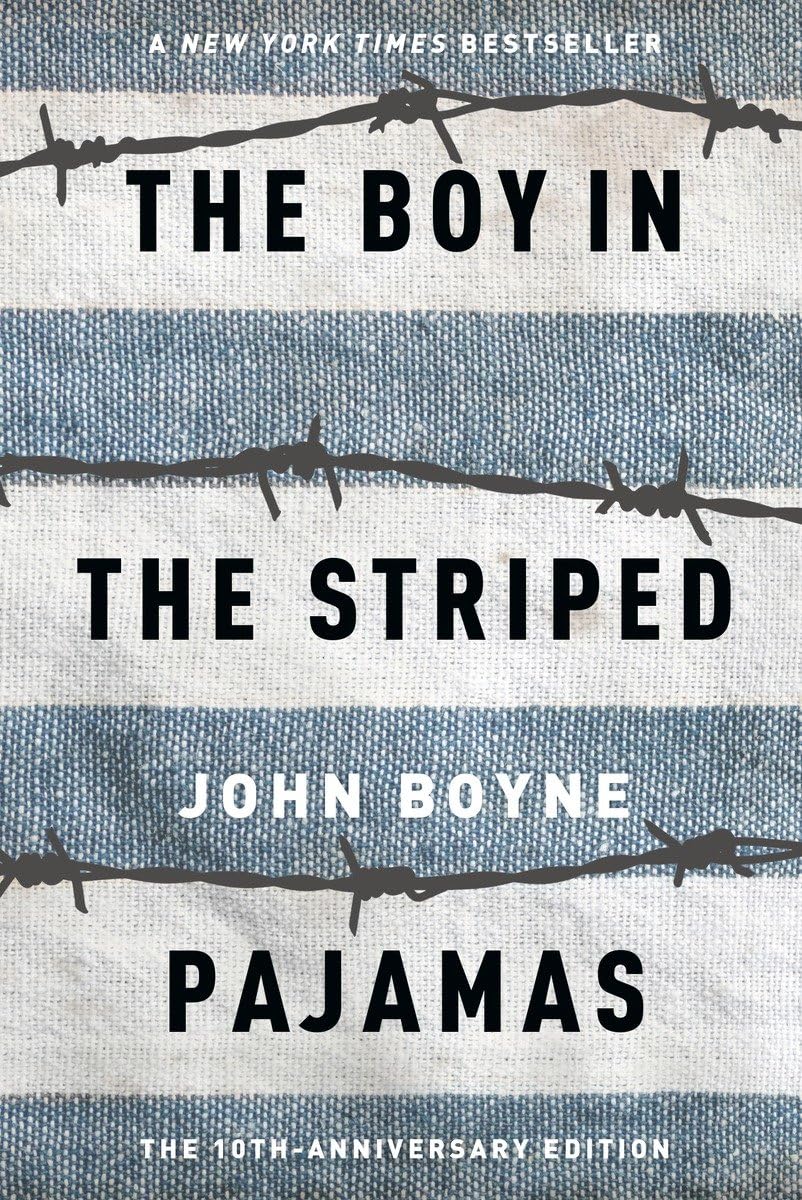
The Boy in the Striped Pajamas
Start ListeningDownload Listen to the full bookScan to hear it free in the app
Categories:
If You're Curious About These Questions...
You should listen to this audiobook
- Have you ever wondered how a child’s innocent perspective can completely mask a terrifying reality happening right in their own backyard?
- Are you curious about what happens when a forbidden friendship forms across a barbed-wire fence, between two boys who are told they should be enemies?
- Did you know that the small, everyday choices to look away from injustice can lead to a final, devastating price that no one is prepared to pay?
Listen to The Boy in the Striped Pajamas — Free Audiobook
Loading player...
Key Takeaways from The Boy in the Striped Pajamas
- Understand how the author uses a child's naive perspective to create powerful dramatic irony, highlighting the tragic realities of Auschwitz.
- Discover why framing this Holocaust story as a fable, rather than strict historical fiction, delivers a universally accessible message about human connection.
- Explore how the striking similarities between Bruno and Shmuel—including their shared birthday—expose the absurd and arbitrary nature of prejudice.
- Learn how childhood innocence contrasts sharply with adult cruelty, demonstrating that kids naturally look past societal divides to see our shared humanity.
- Recognize the profound importance of empathy by following an unlikely friendship forged across a barbed-wire fence, proving our deep need for companionship.
Learning Tools
Reinforce what you learned from The Boy in the Striped Pajamas
Mind Map
The Boy in the Striped Pajamas
Plot Summary+
Narrative Style+
Key Themes+
Controversy & Impact+
Quiz — Test Your Understanding
Question 1 of 6
How does the author's choice to tell the story from nine-year-old Bruno's perspective primarily affect the reader's experience?
Question 2 of 6
How does the author justify the historical inaccuracies and Bruno's extreme naivety regarding the Holocaust?
Question 3 of 6
What is the literary significance of Bruno and Shmuel sharing the exact same birthday?
Question 4 of 6
According to the text, what is a primary criticism regarding the historical accuracy of Bruno and Shmuel's friendship?
Question 5 of 6
What motivates Bruno to finally crawl under the fence and enter the concentration camp?
Question 6 of 6
What is the intended effect of the novel's final lines, which state that 'nothing like that could ever happen again'?
The Boy in the Striped Pajamas — Full Chapter Overview
- 1Recommendation
- 2Why this story still unsettles us today
- 3Packed boxes and a door that’s closing behind him
- 4Leaving Berlin and stepping into the cold
- 5Gretel’s theories and the name Bruno keeps saying wrong
- 6The fence that separates everyone and everything
- 7Rules, salutes, and an office door that never opens
- 8Maria’s past and how dangerous honesty can be
- 9A tyre swing and a bandage from forbidden hands
- 10A night of uniforms and a voice that refused to applaud
The Boy in the Striped Pajamas Summary & Overview
John Boyne’s modern classic follows Bruno, a German boy uprooted from his life in Berlin and brought to a place he calls Out-With. From his bedroom window he sees a fence, rows of huts, and people in striped clothes. Wandering along that fence, he meets Shmuel, a boy his exact age on the other side. Their secret friendship builds in small conversations and shared food, and leads to a final, terrible adventure. Told in plain language through a child’s limited understanding, the story explores innocence, complicity, and the quiet ways people look away—until it’s too late.
Who Should Listen to The Boy in the Striped Pajamas?
- Listeners who value short, emotionally powerful stories about war seen through a child’s eyes
- Book clubs and classrooms seeking a clear entry point into discussions about complicity and moral courage
- Fans of literary fiction that uses simple language to reveal devastating truths
Books Similar to The Boy in the Striped Pajamas
Readers who enjoyed this also liked these titles.