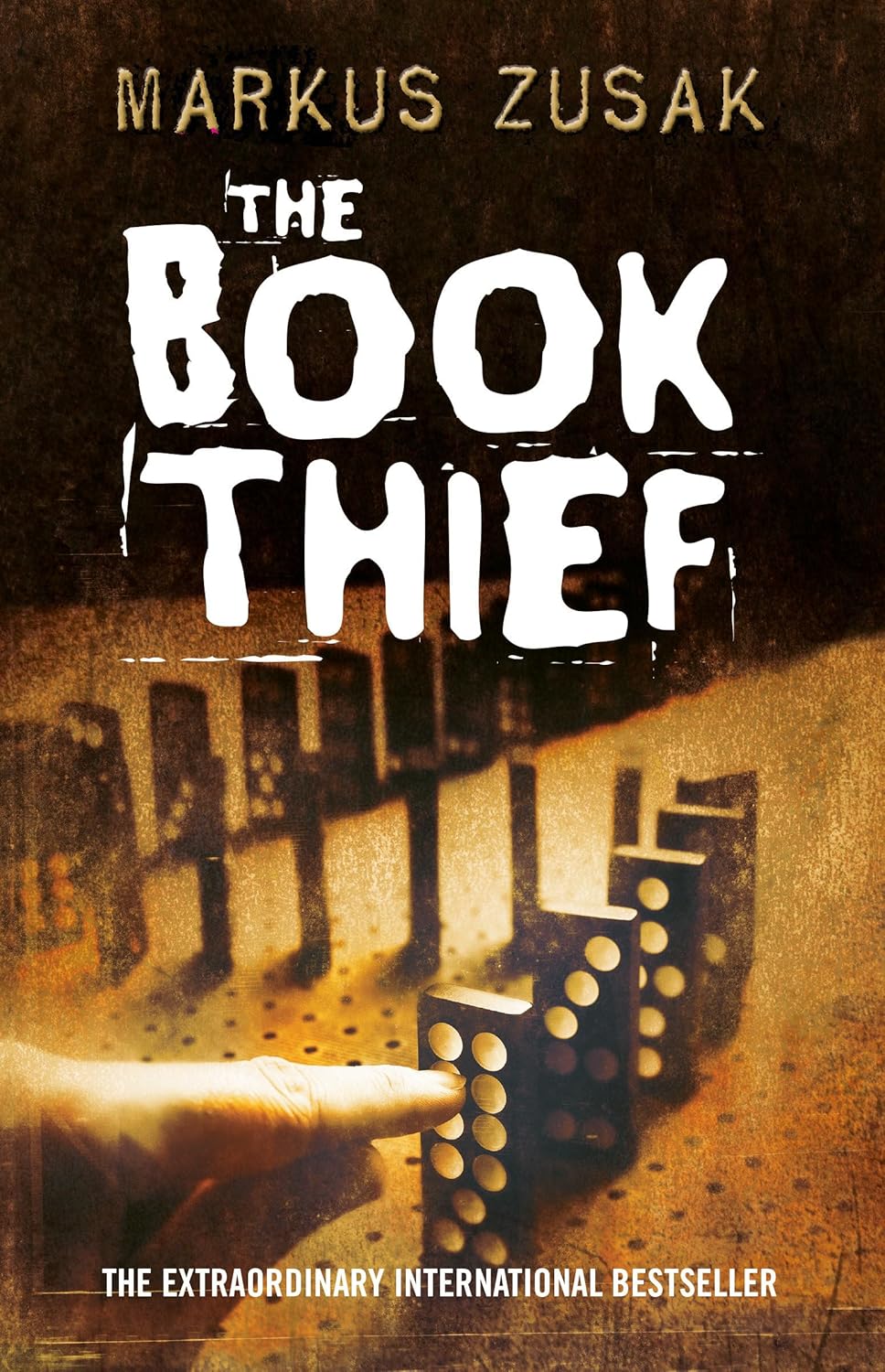
The Book Thief audiobook cover - A girl who steals words. A Jewish fist-fighter hiding in a basement. A boy who paints himself black to run like Jesse Owens. And Death, watching it all with tired eyes. This is a story about the power of language to destroy and to save—told in the warm, aching voice of the one who carries us away.

The Book Thief

A girl who steals words. A Jewish fist-fighter hiding in a basement. A boy who paints himself black to run like Jesse Owens. And Death, watching it all with tired eyes. This is a story about the power of language to destroy and to save—told in the warm, aching voice of the one who carries us away.

Markus Zusak

4.6 / 5(288 ratings)
Categories:

If You're Curious About These Questions...

You should listen to this audiobook

Listen to The Book Thief — Free Audiobook

Loading player...

Key Takeaways from The Book Thief

Learning Tools

Reinforce what you learned from The Book Thief

Mind Map

The Book Thief
Narrative Perspective+
Liesel's Journey+
Key Characters+
The Power of Words+
Courage & Complicity+
War, Fate & Mortality+

Quiz — Test Your Understanding

Question 1 of 9
Who is the narrator of 'The Book Thief', and what distracts this narrator from the humans left behind?
  • A. Liesel Memminger; the books she steals.
  • B. Death; the colors of the environment.
  • C. Max Vandenburg; the stories he writes.
  • D. Hans Hubermann; the music of his accordion.
Question 2 of 9
What is the primary significance of the first book Liesel steals, 'The Gravedigger’s Handbook'?
  • A. It teaches her how to fluently read and write in German.
  • B. It is a manual she uses to help Hans Hubermann with his painting job.
  • C. It serves as a talisman and her only connection to her dead brother and vanished mother.
  • D. It contains the hidden map that leads Max Vandenburg to her house.
Question 3 of 9
How does the novel illustrate the dual, ambiguous nature of words and literature?
  • A. By showing that books can only be afforded by the wealthy, while the poor must steal them to survive.
  • B. By contrasting Liesel's compassionate use of stories with the fear and hate spread by Hitler’s 'Mein Kampf'.
  • C. By demonstrating that reading makes Liesel smarter, but writing puts her in physical danger from the Nazis.
  • D. By revealing that Hans Hubermann uses books to hide his communist past and avoid arrest.
Question 4 of 9
Why does Hans Hubermann agree to shelter Max Vandenburg, placing his own family in grave danger?
  • A. He is secretly a high-ranking member of the Communist party resisting the Nazis.
  • B. He owes his life to Max’s father, Erik, who saved him during the First World War.
  • C. He is paid a large sum of money by Walter Kugler to hide Max in his basement.
  • D. He wants to rebel against his son, Hans Junior, who is a committed Nazi.
Question 5 of 9
How does Markus Zusak portray the Hubermanns' resistance to the Nazi regime?
  • A. As a straightforward, heroic rebellion where they openly defy the Nazi party at every turn.
  • B. As a complex mix of bravery and compliance, such as hanging a Nazi flag to avoid suspicion while hiding a Jew.
  • C. As a completely passive stance, only resisting when forced to by their anti-Nazi neighbors.
  • D. As a violent struggle, culminating in Hans joining a secret underground civilian militia.
Question 6 of 9
What compassionate action by Hans Hubermann inadvertently forces Max to leave his hiding place in the basement?
  • A. Hans gets into a public argument with a Nazi soldier over a stolen book.
  • B. Hans is caught painting over anti-Jewish slurs on local storefronts.
  • C. Hans offers a piece of bread to an elderly Jewish prisoner marching to Dachau.
  • D. Hans refuses to let his son, Hans Junior, read 'Mein Kampf' in the house.
Question 7 of 9
In the story 'The Wordshaker' that Max leaves for Liesel, what do the words grow into?
  • A. A forest of trees that not even soldiers can chop down.
  • B. A flock of birds that carry messages of hope to the concentration camps.
  • C. A massive wall that protects Himmel Strasse from the Allied bombs.
  • D. A river that washes away the ashes of the Nazi book burnings.
Question 8 of 9
How does Liesel survive the unexpected bombing of Himmel Strasse?
  • A. She is out stealing food with Rudy Steiner when the bombs fall.
  • B. She is hiding in the mayor's library reading a stolen dictionary.
  • C. She is in the basement secretly writing the manuscript of her life story.
  • D. She had already been evacuated to Stuttgart with the Hitler Youth.
Question 9 of 9
At the end of the novel, what final realization does Death have regarding humanity?
  • A. He realizes that humans are ultimately entirely evil and undeserving of his pity.
  • B. He cannot comprehend how humans can be simultaneously so glorious and so brutal.
  • C. He decides to stop carrying souls away because the sheer volume of war has overwhelmed him.
  • D. He concludes that the power of words is merely an illusion created by humans to cope with grief.

The Book Thief — Full Chapter Overview

The Book Thief Summary & Overview

Set in a small German town during World War II, The Book Thief is narrated by Death, who follows a young girl named Liesel Meminger as she learns to read, to steal, and to love amid the slow tightening of Nazi power. Plucked from her mother and delivered to foster parents Hans and Rosa Hubermann on gritty Himmel Street, Liesel discovers family in unlikely places: in Hans’s accordion songs and gentle midnight classes, in the fierce tenderness inside Rosa’s harsh tongue, in her golden-haired best friend Rudy, and in Max Vandenburg—the Jewish man hidden in the Hubermann’s basement.

Across stolen books and basement pages, air-raid sirens and bread tossed to marching prisoners, Liesel grows from shock and loneliness into a young woman who understands that words can be weapons—and lifelines. This story blends small domestic rituals with the vast machinery of war, weaving humor, sorrow, defiance, and forgiveness into a single, beating thread.

Who Should Listen to The Book Thief?

  • Fans of literary and historical fiction who loved All the Light We Cannot See or The Nightingale
  • Listeners who want a human, ground-level portrait of World War II
  • Readers drawn to stories about found family, language, and moral courage
  • Educators and book clubs seeking rich discussion on empathy and resistance

About the Author: Markus Zusak

Markus Zusak is an Australian author best known for The Book Thief, which became an international bestseller translated into dozens of languages. He grew up listening to his parents’ stories of World War II and turned those family memories into fiction that explores how ordinary people resist cruelty and cling to love. His other works include I Am the Messenger and the Wolfe Brothers series. Zusak’s writing is known for its lyrical voice, inventive narration, and tender focus on the lives lived in the margins of history.

🎧
Listen in the AppOffline playback & background play
Get App