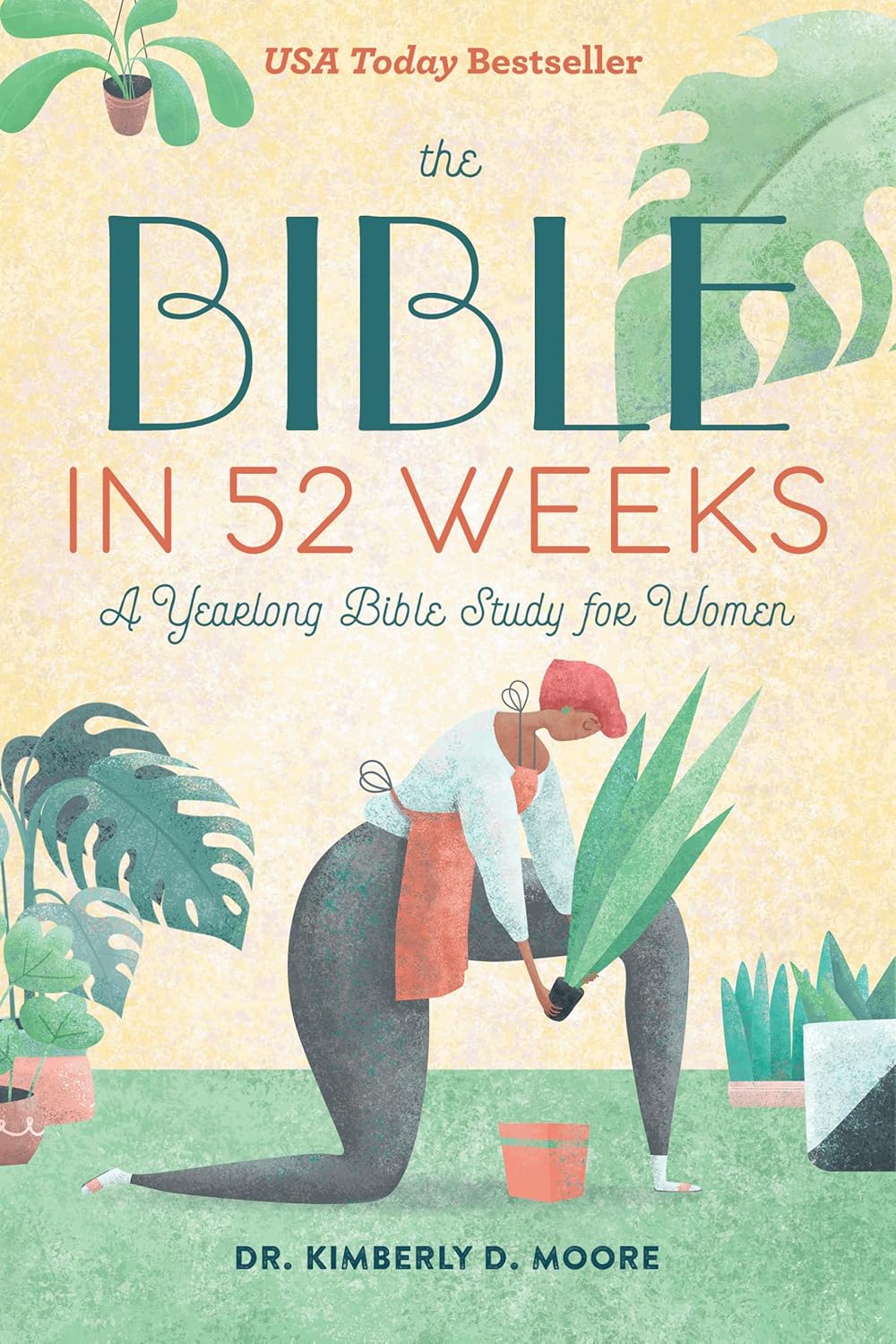
The Bible in 52 Weeks audiobook cover - A one-year Bible plan created to encourage the encourager—52 weekly themes, six days of manageable readings, and practical reflections that help women replace doubt with faith, endure delays, and live with purpose, prayer, and courage.

The Bible in 52 Weeks

A one-year Bible plan created to encourage the encourager—52 weekly themes, six days of manageable readings, and practical reflections that help women replace doubt with faith, endure delays, and live with purpose, prayer, and courage.

Dr. Kimberly D. Moore

4.3 / 5(8 ratings)
Start ListeningDownloadQR code that opens AudiobookHub on the App StoreTry free on iPhoneScan to start in 5 seconds

If You're Curious About These Questions...

You should listen to this audiobook

Listen to The Bible in 52 Weeks — Free Audiobook

Loading player...

Key Takeaways from The Bible in 52 Weeks

Learning Tools

Reinforce what you learned from The Bible in 52 Weeks

Mind Map

The Bible In 52 Weeks Dr Kimberly D Moore
Introduction & Foundation+
Faith, Delays & Purpose+
Spiritual Habits & Leadership+
Resilience & Decision-Making+
Internal Work & Corporate Strength+
Endurance Through Suffering+
Forward Motion & Expectant Prayer+
Identity, Grace & Final Access+

Quiz — Test Your Understanding

Question 1 of 9
What is the primary stated purpose of "The Bible in 52 Weeks," especially regarding its target audience?
  • A. To offer a strict, chronological reading plan that must be completed without falling behind.
  • B. To encourage 'the encourager,' particularly women who carry quiet burdens while supporting others.
  • C. To replace the Bible with a series of short, modern stories and narratives.
  • D. To focus on deep theological debates and the historical context of scripture.
Question 2 of 9
According to the lesson from Abraham and Sarah's story in Week 1, what is the key contrast presented to the reader?
  • A. Waiting with faith versus trying to force an outcome on one's own.
  • B. The importance of public declarations versus quiet, personal faith.
  • C. God's promises to men versus His promises to women.
  • D. The need for a large community versus the power of individual prayer.
Question 3 of 9
How does the workbook interpret the story of Israel's 40-year wilderness detour in Numbers 14?
  • A. As a permanent punishment and a sign that God had denied His promise.
  • B. As a random, unfortunate event with no specific purpose.
  • C. As a purposeful 'diversion' that was both disciplinary and preparatory for the Promised Land.
  • D. As an optional journey that the Israelites could have skipped at any time.
Question 4 of 9
What is the primary lesson drawn from Hannah's story about dealing with stress?
  • A. To confront those who are causing the stress before praying.
  • B. To redirect stress by pouring it out honestly to God in prayer.
  • C. To ignore the stress and pretend it doesn't exist.
  • D. To find a solution to the problem before seeking peace from God.
Question 5 of 9
Based on the analysis of Jesus' wilderness temptations, what is presented as the primary 'weapon' for believers?
  • A. The act of fasting for long periods.
  • B. The ability to reason and debate effectively.
  • C. The support of a strong community of friends.
  • D. The Word of God, memorized and correctly applied.
Question 6 of 9
What is the key takeaway from the story of Job regarding how to navigate suffering and God's silence?
  • A. To abandon faith if God does not provide an immediate explanation for the pain.
  • B. To demand answers from God and argue your case until He responds.
  • C. To hold a steady commitment to God's integrity even when emotions are volatile and answers are absent.
  • D. To listen only to the advice of friends and family during a crisis.
Question 7 of 9
What lesson about prayer is highlighted from the story of Peter's escape from prison in Acts 12?
  • A. Prayer is most effective when done in isolation.
  • B. The praying community struggled to believe their prayer had been answered, showing that prayer must be joined with expectancy.
  • C. The volume of the prayer is more important than the faith behind it.
  • D. Miraculous answers to prayer only happened in the early church.
Question 8 of 9
What 'mature faith lesson' does the book draw from Paul's 'thorn' in 2 Corinthians 12?
  • A. That all burdens will be removed if one has enough faith.
  • B. That a 'thorn' is always a consequence of a personal sin.
  • C. That strength can come from God's grace sustaining you *in* your pain, not just by removing it.
  • D. That one should stop asking for help and simply accept all suffering without question.
Question 9 of 9
In the book's final section, why was the church in Philadelphia praised and promised an 'open door'?
  • A. Because of its large size and powerful influence.
  • B. Because of its perfect doctrine and flawless members.
  • C. Because of its faithfulness and obedience, even with 'little strength'.
  • D. Because it had powerful human connections and networking.

The Bible in 52 Weeks — Full Chapter Overview

The Bible in 52 Weeks Summary & Overview

The Bible in 52 Weeks is a guided workbook designed to help readers complete the entire Bible in one year through short daily reading assignments (six days per week) plus a catch-up day. Each week includes a clear theme, a devotional-style commentary anchored in a Bible story or passage, and reflection prompts that connect scripture to everyday life.

Written from a pastoral perspective that especially uplifts women who carry heavy responsibilities, the book repeatedly emphasizes faith over fear, obedience over convenience, prayer as a first response, and resilience through hardship. Across the year, the reader moves from Genesis to Revelation while learning practical spiritual habits: speaking life, waiting wisely, maintaining integrity, using one’s gifts, and showing love through action.

Who Should Listen to The Bible in 52 Weeks?

  • Readers who want a structured, manageable plan to read the entire Bible in one year without feeling overwhelmed.
  • Women seeking encouragement, spiritual resilience, and practical application prompts for real-life stress, transitions, and leadership.
  • Small groups, women’s ministries, or church classes that want weekly discussion questions and a shared reading rhythm.

About the Author: Dr. Kimberly D. Moore

Dr. Kimberly D. Moore (DMin) is the senior pastor of Emmanuel Missionary Baptist Church in Gastonia, North Carolina, and founder of Kimberly Moore Ministries, a nonprofit outreach organization focused on empowerment through classes, mentoring, and scholarships. She holds master of divinity and doctor of ministry degrees from Gardner-Webb University School of Divinity.

🎧
Listen in the AppOffline playback & background play
Get App