Theme Song
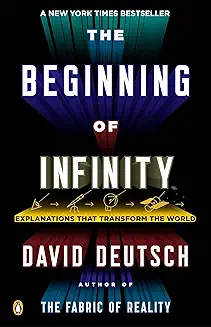
The Beginning of Infinity
Start ListeningDownload Try free on iPhoneScan to start in 5 seconds
Categories:
If You're Curious About These Questions...
You should listen to this audiobook
- Why can't your senses alone prove that the sun will rise tomorrow, and how does this challenge the traditional belief that all human knowledge is derived purely from experience?
- What do biological genes and an amusing joke have in common, and how do these 'replicators' dictate whether a culture remains stubbornly static or becomes dynamically progressive?
- Why did economist Kenneth Arrow win a Nobel Prize for mathematically proving that rational, democratic group decision-making is impossible, and what does this reveal about the true nature of solving problems?
Listen to The Beginning of Infinity — Free Audiobook
Loading player...
Key Takeaways from The Beginning of Infinity
- Understand why true human knowledge is derived from imaginative theories and conjectures, rather than relying solely on passive sensory experiences that can be deceptive.
- Discover how human ideas and biological genes both act as replicators that spread information, with the key difference being that ideas must be actively expressed to survive.
- Learn how cultural ideas, or 'memes,' dictate whether a society is static or dynamic, and why rational critical thinking is essential for driving progress.
- Find out how systems of knowledge develop incrementally until they make a sudden 'jump to universality,' dramatically increasing their reach and explanatory power.
- Grasp how the ongoing pursuit of good explanations forms the absolute foundation of science and unlocks the potential for boundless, infinite human progress.
Learning Tools
Reinforce what you learned from The Beginning of Infinity
Mind Map
The Beginning of Infinity
Creation & Evolution of Knowledge+
Replicators & Human Culture+
Decision Making & Optimism+
Humanity's Cosmic Significance+
Physics and Unforeseeable Futures+
Quiz — Test Your Understanding
Question 1 of 10
What is the primary flaw in the empiricist view of knowledge acquisition according to the text?
Question 2 of 10
What is the key difference between how genes and human knowledge replicate?
Question 3 of 10
What characterizes a static culture according to the text?
Question 4 of 10
How does the alphabet represent a 'jump to universality' compared to pictograms?
Question 5 of 10
What did economist Kenneth Arrow prove regarding group decision-making?
Question 6 of 10
Why was economist Thomas Malthus's 1789 prediction about the end of human progress incorrect?
Question 7 of 10
According to the text, what makes humanity significant in the cosmic scheme of things?
Question 8 of 10
How does quantum theory explain the concept of a multiverse?
Question 9 of 10
Why does the author argue that scientific discoveries are never final truths?
Question 10 of 10
How does the text define the optimistic way of thinking?
The Beginning of Infinity — Full Chapter Overview
- 1Recommendation
- 2Knowledge comes not only from experience but from theories as well.
- 3Genes and ideas both replicate themselves to spread.
- 4Cultures become static or dynamic depending on the memes that shape them.
- 5Systems of knowledge grow step by step until they leap to universality.
- 6Rational, democratic group decisions have been shown to be impossible.
- 7Because we can’t foresee discoveries, optimists think anything can be achieved.
- 8Knowledge gives humanity true significance in the cosmic order.
- 9Quantum theory suggests many universes with different histories make up reality.
- 10Scientific laws aren’t final truths, since future discoveries can’t be predicted.
The Beginning of Infinity Summary & Overview
Everyday, we benefit from huge advances in both scientific theory and practice. What triggered this progress? In The Beginning of Infinity (2011) – a journey through the fundamental fields of science and philosophy – physicist David Deutsch argues that all progress results from one single human activity: the quest for explanations. Human creativity opens up limitless opportunities for progress, making knowledge the “beginning of infinity.”
Who Should Listen to The Beginning of Infinity?
- Fans of science and philosophy
- Anyone fascinated by the power of knowledge and creativity
- Readers interested in the future of our species
Books Similar to The Beginning of Infinity
Readers who enjoyed this also liked these titles.