If You're Curious About These Questions...
You should listen to this audiobook
- Have you ever wondered why a universe destined for decay and disorder would ever produce something as complex as human consciousness and art?
- What if the secret to our deepest human traditions—like religion and storytelling—is actually found in the cold logic of biological evolution?
- Are you curious about what the cosmos will look like when the very last star goes out, and whether life stands any chance of reemerging in the infinite dark?
Listen to Until the End of Time — Free Audiobook
Loading player...
Key Takeaways from Until the End of Time
- Understand how the awareness of our own mortality acts as a hidden engine of progress, quietly driving us to build, love, and leave a lasting legacy.
- Discover why our deep human attraction to timeless natural laws and permanent monuments stems directly from the reality that our time is limited.
- Learn how the fear of finite time can trap you in a cycle of short-term busyness, and how to use that awareness to anchor yourself in the present instead.
- Find out why the absence of absolute answers in the universe means that true purpose is not something you wait to receive, but something you must actively shape.
- Master the practice of using impermanence as a doorway to gratitude, allowing the certainty of endings to make your relationships and daily milestones infinitely more precious.
Learning Tools
Reinforce what you learned from Until the End of Time
Mind Map
Until the End of Time
Fundamental Forces+
Cosmic Evolution+
Human Mind & Behavior+
Culture & Meaning+
The Ultimate Future+
Quiz — Test Your Understanding
Question 1 of 9
What is the role of entropy in the universe, according to the text?
Question 2 of 9
What catalyst does the text identify as the primary trigger for the Big Bang?
Question 3 of 9
What were the long-term consequences of Earth's early collision with the Mars-sized planet Theia?
Question 4 of 9
How does the text characterize the human experience of free will?
Question 5 of 9
According to the evolutionary theories presented, what was a primary early function of storytelling for human ancestors?
Question 6 of 9
From an evolutionary perspective, how did religion contribute to the success of early human species?
Question 7 of 9
Which of the following is an evolutionary theory mentioned in the text regarding why humans developed the arts?
Question 8 of 9
What is the predicted ultimate fate of all stars and planets in our universe?
Question 9 of 9
What did physicist Stephen Hawking discover about the nature of black holes?
Until the End of Time — Full Chapter Overview
- 1Recommendation
- 2Everything that has ever existed, from planet earth to your favorite sweater, exists thanks to entropy.
- 3Repulsive gravity sparked the big bang and led to the birth of stars, the universe’s first structures.
- 4The natural life cycle of stars forged the building blocks for planets and for life on Earth.
- 5Life developed consciousness, which follows natural laws rather than true free will.
- 6Humans evolved language and then storytelling, which gave our species a crucial advantage.
- 7Humans learned to draw comfort from religion, which strengthened social unity and eased our fear of death.
- 8When humans began creating and enjoying art, it deepened our social ties and sharpened our problem solving.
- 9Our best current view is that Earth, the sun, and all other stars and planets will one day fall into black holes.
- 10Long after black holes vanish, the fabric of space will shift – and life could one day appear again.
Until the End of Time Summary & Overview
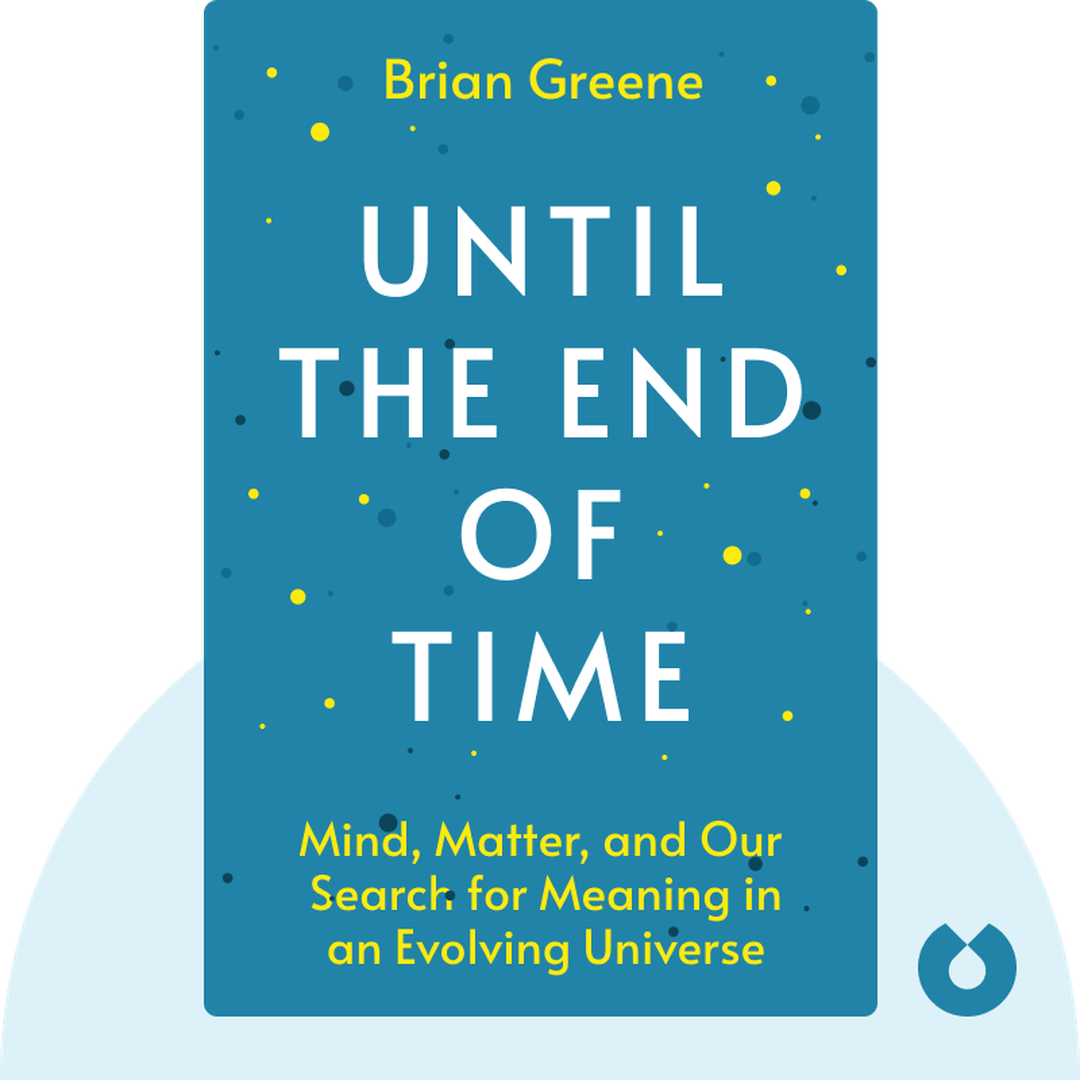
Until the End of Time (2020) is an accessible, informal look at the loftiest topics of all time: time, the universe, and humanity’s never ending quest for meaning. Physicist Brian Greene begins at the very beginning – the big bang that set off this whole crazy spectacle – then zooms in to examine the evolution of human culture, from religion, language, and the arts. Finally, he zooms back out to examine what might become of the universe, and whether there might ever be a reemergence of life.
Who Should Listen to Until the End of Time?
- Exploratory minds
- Science buffs with a poetic streak
- Far-futurists
Books Similar to Until the End of Time
Readers who enjoyed this also liked these titles.