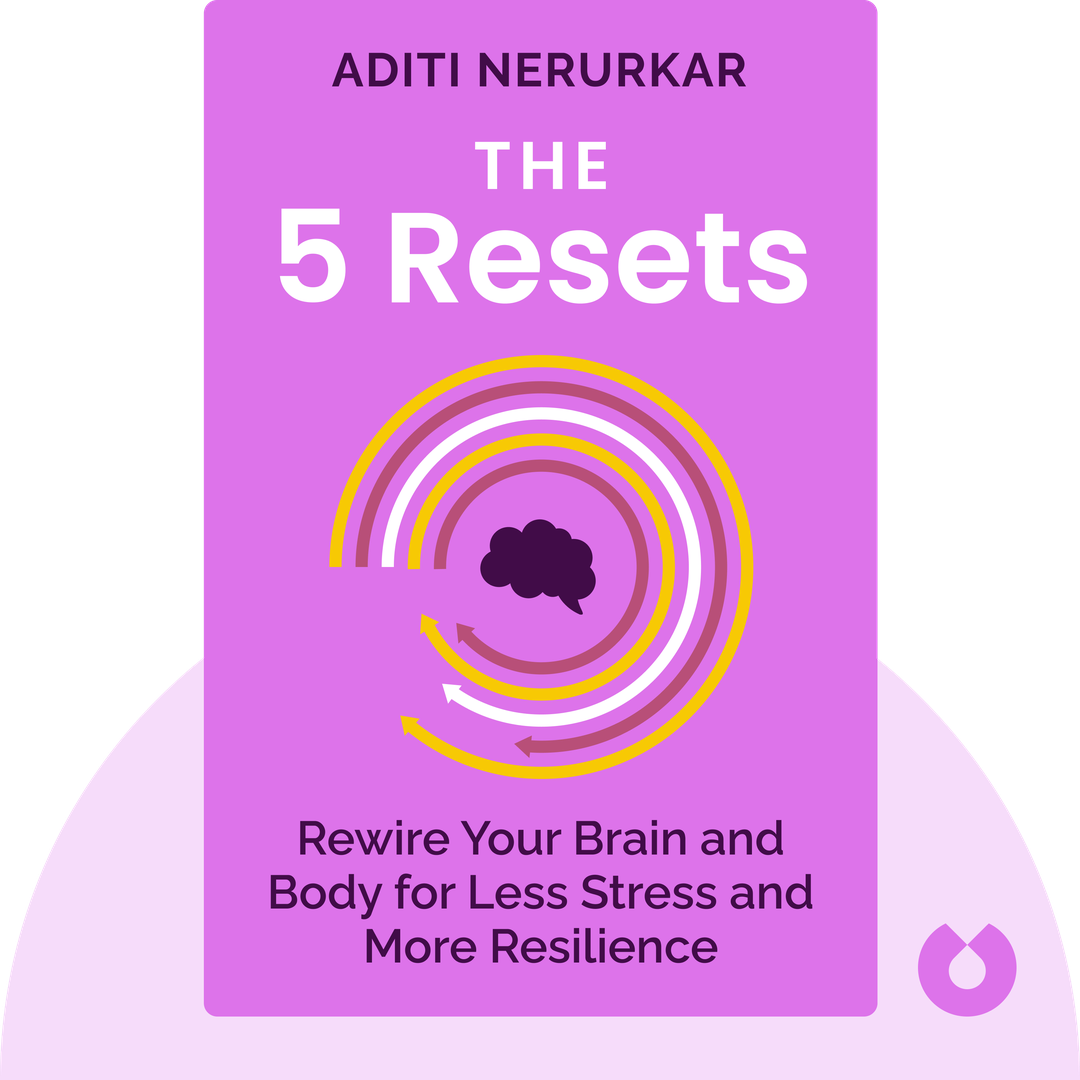
If You're Curious About These Questions...
You should listen to this audiobook
- Did you know that overcoming burnout doesn’t require a total life overhaul, but rather five small, science-backed 'resets' that can rewire your brain’s response to stress?
- Have you ever wondered why traditional stress-management techniques often fail, and what a Harvard doctor discovered is the true biological key to lasting resilience?
- What if you could stop just surviving your busy schedule and start thriving by making manageable adjustments that bridge the gap between your mental and physical health?
Listen to The 5 Resets — Cinematic Audio Edition
Loading player...
Key Takeaways from The 5 Resets
- Discover why physical stress symptoms are actually crucial messages from your body telling you to pause, reflect, and address neglected self-care or emotional issues.
- Understand how modern pressures hijack your brain's amygdala into a constant fight-or-flight state, and learn how the 5 Resets shift control back to your calm, decision-making prefrontal cortex.
- Learn how to define what matters most by setting a MOST goal—Motivating, Objective, Small, and Timely—and planning backward to turn overwhelming aspirations into manageable actions.
- Find out how navigating the fear, learning, and growth zones of stress adaptation can help you rediscover your inner strength and build resilience through joyful past hobbies.
- Master the art of muting digital noise to cure 'popcorn brain' by establishing intentional device boundaries, reclaiming your mental focus, and protecting your restorative deep sleep.
Learning Tools
Reinforce what you learned from The 5 Resets
Mind Map
The 5 Resets
Understanding Stress+
Reset 1: Get Clear on What Matters Most+
Reset 2: Find Quiet in a Noisy World+
Reset 3: Sync Your Brain and Your Body+
Reset 4: Come Up for Air+
Reset 5: Bring Your Best Self Forward+
Quiz — Test Your Understanding
Question 1 of 7
According to the text, what happens in the brain when a person experiences prolonged stress?
Question 2 of 7
In the First Reset ('Get Clear on What Matters Most'), Dr. Nerurkar recommends setting a 'MOST' goal. What does the acronym MOST stand for?
Question 3 of 7
What term does the author use to describe the state of constant disruption and fractured concentration caused by continuous digital stimulation?
Question 4 of 7
Which technique is suggested in the Third Reset ('Sync Your Brain and Your Body') to help individuals quickly recalibrate and refocus during everyday activities?
Question 5 of 7
How does diet relate to stress management according to the Third Reset?
Question 6 of 7
For individuals who work from home and struggle to separate their professional and personal lives, what strategy does the Fourth Reset ('Come Up for Air') recommend?
Question 7 of 7
In the Fifth Reset ('Bring Your Best Self Forward'), what daily practice is recommended to quiet the inner critic and shift focus from lack to abundance?
The 5 Resets — Full Chapter Overview
- 1Recommendation
- 2Stress, Your Body, Your Brain, and the Five Resets
- 3The First Reset: Define What Matters Most to You
- 4The Second Reset: Find Serenity Amid Chaos
- 5The Third Reset: Harmonize Your Mind, Body, and Diet
- 6The Fourth Reset: Make Time to Breathe Amid Modern-Life Chaos
- 7The Fifth Reset: Embrace Transformation to Reveal a Better You
- 8Final summary
The 5 Resets Summary & Overview
The 5 Resets (2024), is a comprehensive guide to how we can better manage stress with the help of five key life-enhancing strategies. Brought to life by the stories of a Harvard doctor and her patients, it focuses on making manageable lifestyle adjustments to improve mental and physical health, fostering resilience and balance in the process.
Who Should Listen to The 5 Resets?
- Professionals facing workplace stress and burnout
- Busy parents and caregivers seeking a better work-life balance
- Entrepreneurs managing stress and growth
Books Similar to The 5 Resets
Readers who enjoyed this also liked these titles.