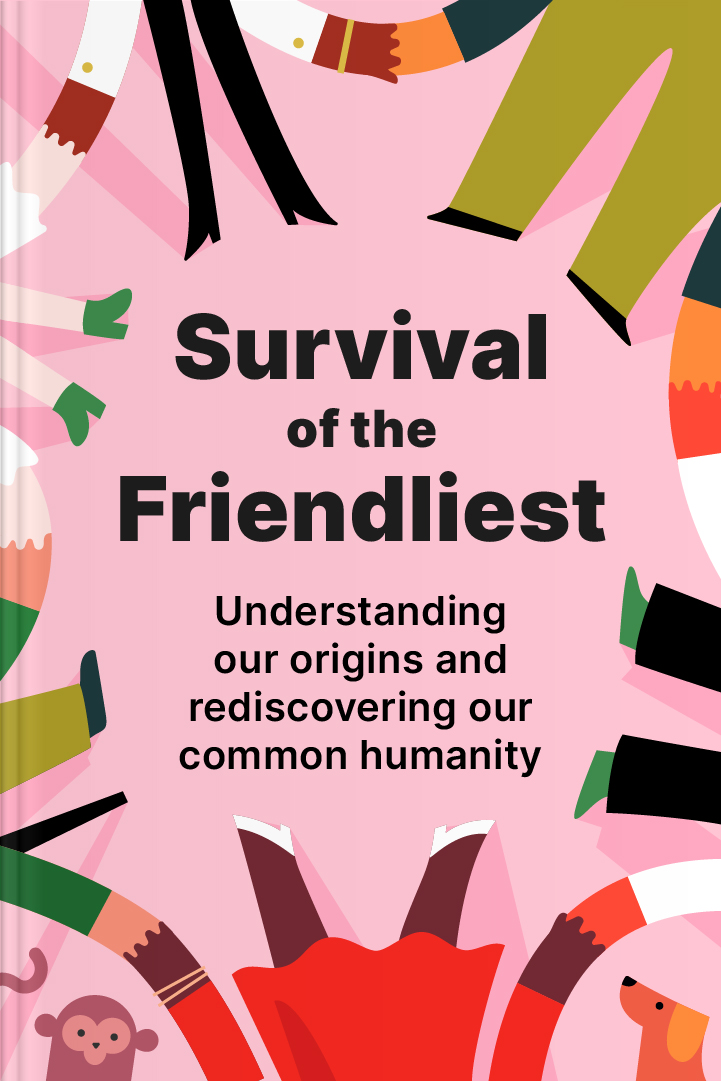
Survival of the Friendliest audiobook cover - Humanity didn’t rise to the top by being the strongest or the smartest, but by learning how to cooperate—so this gentle tour through evolution, psychology, and modern conflict offers practical ways to soften polarization and rebuild trust, one relationship at a time.

Survival of the Friendliest

Humanity didn’t rise to the top by being the strongest or the smartest, but by learning how to cooperate—so this gentle tour through evolution, psychology, and modern conflict offers practical ways to soften polarization and rebuild trust, one relationship at a time.

Brian Hare & Vanessa Woods

4.1 / 5(7 ratings)

If You're Curious About These Questions...

You should listen to this audiobook

Listen to Survival of the Friendliest — Free Audiobook

Loading player...

Key Takeaways from Survival of the Friendliest

Learning Tools

Reinforce what you learned from Survival of the Friendliest

Mind Map

+
+
+
+
+
+
+

Quiz — Test Your Understanding

Question 1 of 10
According to the book, why was the survival of Homo sapiens unlikely compared to species like Neanderthals?
  • A. Homo sapiens had smaller brains and were less innovative than Neanderthals.
  • B. Neanderthals were better adapted to the Ice Age, had larger brains, and were powerful hunters.
  • C. Homo sapiens were the first to master fire, but this made them a target for other species.
  • D. Homo sapiens refused to cooperate in groups, making them vulnerable.
Question 2 of 10
What is the significance of a human baby's ability to understand pointing?
  • A. It is the first sign of developing fine motor skills.
  • B. It is a learned skill that chimpanzees can also master with training.
  • C. It is a rare form of cooperative communication, indicating an attempt to share information to help another.
  • D. It proves that humans are the only species capable of understanding gestures.
Question 3 of 10
How does friendliness function as a survival strategy among bonobos?
  • A. Male bonobos form aggressive patrols to defend their territory from all outsiders.
  • B. Females tend to choose friendlier male partners, creating evolutionary pressure that favors cooperative traits.
  • C. The strongest alpha male uses friendliness to trick other groups and take their resources.
  • D. Bonobos are isolated, and friendliness is simply a byproduct of having no competition.
Question 4 of 10
What does the book suggest was the key factor in the 'cultural revolution' of Homo sapiens around 50,000 years ago?
  • A. The sudden tripling of human brain size.
  • B. The development of wider social networks, made possible by an increase in friendliness and cooperation.
  • C. The extinction of all competing human species, which freed up resources.
  • D. The discovery that neuron density was more important than brain size.
Question 5 of 10
What is the 'dark side of friendliness' as described in the book?
  • A. Being too friendly makes an individual appear weak and vulnerable.
  • B. The same hormonal mechanisms (like oxytocin) that foster ingroup bonding can increase hostility toward outgroups under threat.
  • C. Friendliness is a trait exclusive to domesticated animals and is unnatural for humans.
  • D. Excessive friendliness can lead to the loss of individual identity within a group.
Question 6 of 10
According to the book, what was a key strategy of the 'Gingrich Revolution' that fueled political polarization?
  • A. Increasing the number of days Congress worked to force more debate.
  • B. Organizing bipartisan dinners and social events to find common ground.
  • C. Implementing strict financial penalties for using hate speech in politics.
  • D. Reducing opportunities for cross-party friendships and intentionally using dehumanizing language against opponents.
Question 7 of 10
What was the most consistent factor found among people who rescued Jews during World War II?
  • A. They were wealthier and more educated than the average person.
  • B. They shared a specific religious belief that commanded them to help.
  • C. They had prior, real-life relationships with Jewish people as friends, colleagues, or neighbors.
  • D. They lived in isolated rural areas, far from Nazi propaganda.
Question 8 of 10
The 'jigsaw' method in education is an example of fostering tolerance through what condition?
  • A. Intense competition where students are ranked against each other.
  • B. Imaginary contact with characters from diverse books and movies.
  • C. Safe, non-competitive contact where students must depend on one another to succeed.
  • D. Separating students by background to study their own cultures.
Question 9 of 10
What is the impact of dehumanizing language, according to the experiment by psychologist Albert Bandura?
  • A. It has no significant effect on people's behavior in a controlled setting.
  • B. It makes people more likely to question authority.
  • C. It increases people's willingness to inflict harm or punishment on others.
  • D. It temporarily increases empathy as people feel sorry for the targeted group.
Question 10 of 10
Which of the following is recommended as a practical, small action to practice friendliness and reduce polarization?
  • A. Avoiding anyone who disagrees with you to protect your own views.
  • B. Engaging in competitive games to prove your group is superior.
  • C. Creating 'polarization-free zones' to focus on shared interests like art, music, or nature.
  • D. Focusing only on large-scale political activism, as small actions are trivial.

Survival of the Friendliest — Full Chapter Overview

Survival of the Friendliest Summary & Overview

This narration explores a surprising idea: that Homo sapiens may have survived not because of superior strength or early intelligence, but because our species gradually became better at friendliness—especially the kind that supports cooperation in larger groups. Along the way, it compares humans to wolves, dogs, bonobos, chimpanzees, and other animals to reveal how “self-domestication” can shape behavior, bodies, and societies.

The journey then turns toward modern life, where the same forces that help groups bond can also fuel hostility toward outsiders. By understanding how dehumanization spreads, and why safe contact across differences can restore empathy, listeners are guided toward practical steps for strengthening communities and reducing polarization.

Who Should Listen to Survival of the Friendliest?

  • People who want a calmer, more hopeful way to understand conflict, polarization, and “us versus them” thinking—without blame or shame.
  • Listeners interested in how evolution and social psychology connect to everyday relationships, teamwork, and community life.
  • Anyone looking for simple, realistic practices to build tolerance and cooperation at home, work, school, or online.

About the Author: Brian Hare & Vanessa Woods

Brian Hare is an evolutionary anthropologist known for research on dog cognition and the social roots of cooperation. Vanessa Woods is a researcher and writer who collaborates on work exploring the evolutionary and psychological foundations of human behavior, especially the role of social connection and friendliness in survival.

🎧
Listen in the AppOffline playback & background play
Get App