If You're Curious About These Questions...
You should listen to this audiobook
- Have you ever wondered what a group of school teachers and professional sumo wrestlers could possibly have in common when it comes to the hidden power of incentives?
- Did you know that your real estate agent may actually be incentivized to sell your house for less than it’s worth, and do you know the secret reason why?
- Are you curious about the real reason why crime rates plummeted in the 1990s, and why the conventional wisdom about better policing was completely wrong?
Listen to Freakonomics — Cinematic Audio Edition
Loading player...
Key Takeaways from Freakonomics
- Discover how hidden economic, social, and moral incentives act as the invisible forces that drive everyday human behavior and decision-making.
- Learn why poorly designed incentives can actually backfire, just like a small financial penalty for late parents that inadvertently increased tardiness at daycares.
- Understand how experts use information hoarding and fear tactics to manipulate consumers, and how making secret information public can instantly destroy their leverage.
- Find out why 'conventional wisdom' often relies on intentionally exaggerated or false statistics to manipulate public awareness and artificially drive societal interest.
- Explore the tournament-style structure of certain economies to understand why people willingly endure underpaid, high-risk jobs for the slim chance of reaching the top.
Learning Tools
Reinforce what you learned from Freakonomics
Mind Map
Freakonomics
Incentives+
Information Asymmetry+
Biases in Risk & Causality+
Quiz — Test Your Understanding
Question 1 of 10
According to the book, what are the three general categories of incentives?
Question 2 of 10
Why did the introduction of a $3 fine at the Haifa day care centers result in an increase in late pick-ups?
Question 3 of 10
Based on Paul Feldman's bagel business data, what was the primary factor that influenced how honest customers were when paying?
Question 4 of 10
How do real estate agents typically handle the sale of their own homes compared to the homes of their clients?
Question 5 of 10
Why did the price of life insurance fall dramatically in the 1990s?
Question 6 of 10
According to the concept of information asymmetry, why does a new car lose a significant portion of its value immediately after being purchased?
Question 7 of 10
What two factors cause people to worry disproportionately about certain risks, like plane crashes or gun violence, over statistically more likely dangers like swimming pool accidents?
Question 8 of 10
What does the data reveal about the relationship between campaign spending and political election outcomes?
Question 9 of 10
According to the book, what was the most significant, yet remote, cause for the dramatic drop in crime in the United States during the early 1990s?
Question 10 of 10
How do experts in face-to-face situations, such as funeral directors, exploit laypeople?
Freakonomics — Full Chapter Overview
- 1Recommendation
- 2Introducing incentives can sometimes have unintended effects on people’s behavior.
- 3Incentives depend on context: what works in sunshine may not work in the rain.
- 4Experts can exploit their informational advantage over laypeople for financial gain.
- 5Experts can use fear and anxiety to take advantage of laypeople.
- 6The Internet has greatly reduced experts’ informational advantage.
- 7When sellers omit information, customers often assume the worst and penalize them.
- 8People worry too much about risks that are highly visible or beyond their control.
- 9We often wrongly assume that when two things happen together, one causes the other.
- 10When assigning causality, we often favor immediate causes and overlook more distant ones.
- 11Final summary
Freakonomics Summary & Overview
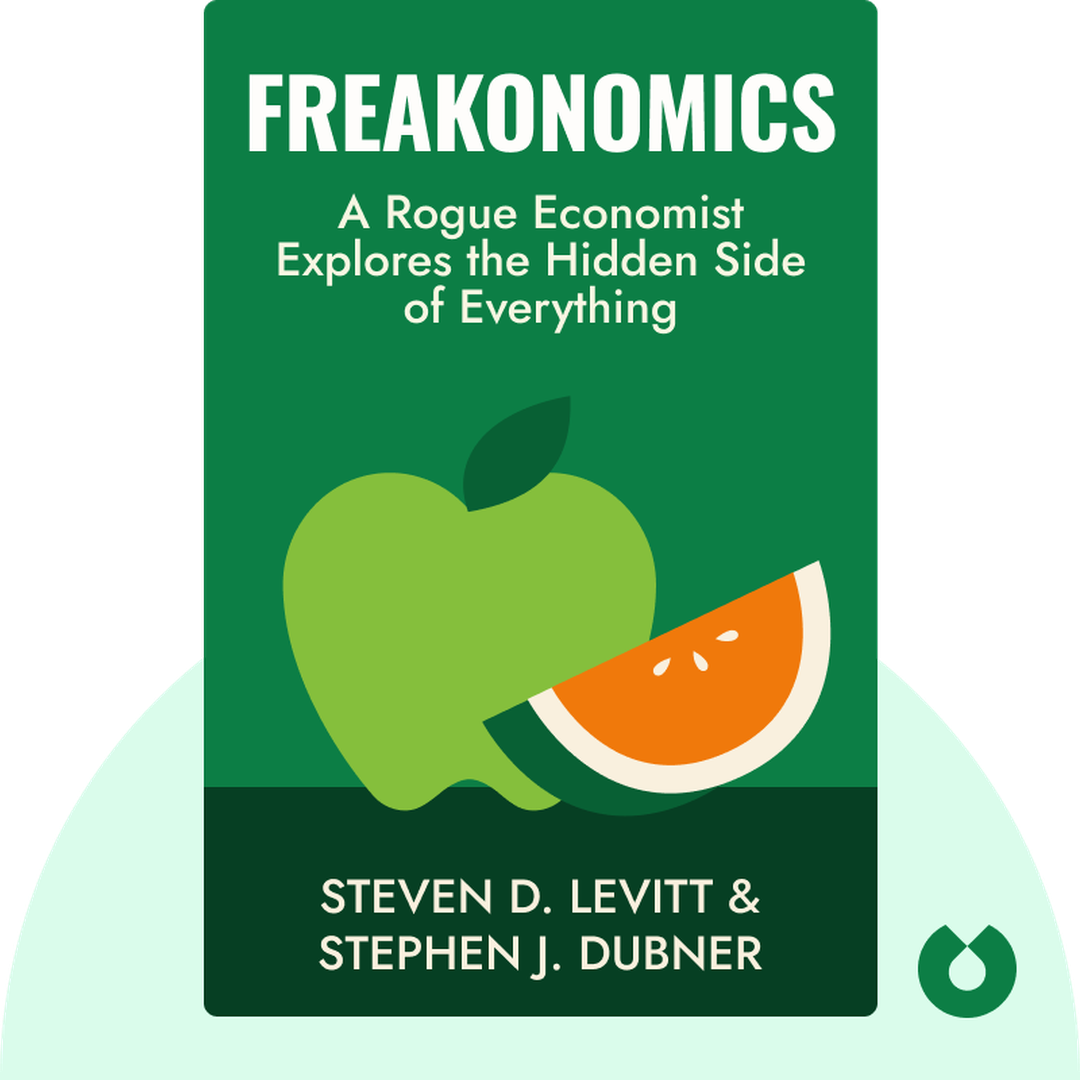
Freakonomics (2005) applies rational economic analysis to everyday situations, from online dating to buying a house. The book reveals why the way we make decisions is often irrational, why conventional wisdom is frequently wrong, and how and why we are incentivized to do what we do.
Who Should Listen to Freakonomics?
- Anyone interested in human decision-making.
- Managers with an interest in the impact of incentives and risk analysis
- Economists looking for a more creative approach to using the tools of economics
Books Similar to Freakonomics
Readers who enjoyed this also liked these titles.