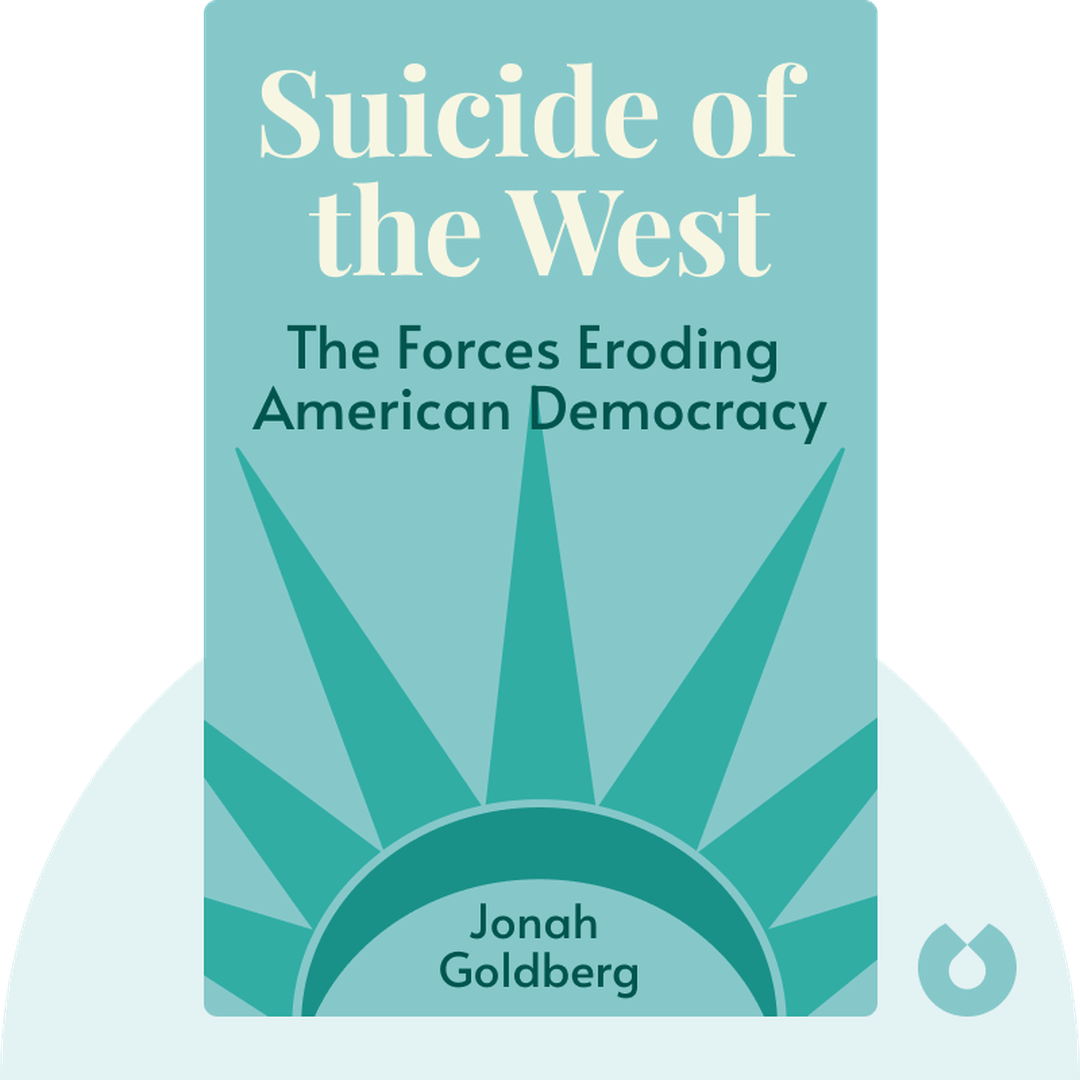
Suicide of the West audiobook cover - How the Rebirth of Tribalism, Populism, Nationalism, and Identity Politics is Destroying American Democracy

Suicide of the West

How the Rebirth of Tribalism, Populism, Nationalism, and Identity Politics is Destroying American Democracy

Jonah Goldberg

4.1 / 5(86 ratings)
Start ListeningDownloadQR code that opens AudiobookHub on the App StoreTry free on iPhoneScan to start in 5 seconds
Categories:

If You're Curious About These Questions...

You should listen to this audiobook

Listen to Suicide of the West — Free Audiobook

Loading player...

Key Takeaways from Suicide of the West

Learning Tools

Reinforce what you learned from Suicide of the West

Mind Map

Suicide of the West
The Miracle of Modernity+
England's Unique Soil+
Overcoming Human Nature+
Enlightenment Divide+
Aristocracy & Limits+
The Administrative State+
Identity Politics+
Saving the West+

Quiz — Test Your Understanding

Question 1 of 8
What does the author identify as the 'miracle' that occurred in the late seventeenth century?
  • A. The invention of agriculture, which allowed nomadic apes to form the first recognizable human societies.
  • B. The emergence of enlightened, liberal institutions that repressed humanity's tribalistic side and drastically increased wealth.
  • C. The complete eradication of poverty and violence across continental Europe due to the French Revolution.
  • D. The discovery of new continents that provided unlimited resources and eliminated the need for human conflict.
Question 2 of 8
According to the text, why was England uniquely suited to foster this 'miracle' compared to the rest of Europe?
  • A. It utilized a civil law system that gave monarchs absolute power to seize property for the public good.
  • B. Its massive standing army ensured total domestic peace and obedience to the crown.
  • C. Its common law system protected property rights, and its island geography made it less militaristic.
  • D. It was the only European country that completely rejected the concept of aristocracy and meritocracy.
Question 3 of 8
What do the cited studies by Paul Bloom and Napoleon Chagnon suggest about human nature?
  • A. Humans are born as blank slates with no innate morality, learning violence entirely from modern institutions.
  • B. Humans possess an innate moral compass but are also naturally tribal and highly prone to violence without modern institutions.
  • C. Traditional societies that resist modernity are naturally peaceful, egalitarian, and free of violence.
  • D. Human cruelty is a purely modern invention caused by the rise of capitalism and the Industrial Revolution.
Question 4 of 8
How did the philosophies of John Locke and Jean-Jacques Rousseau differ regarding the role of the state?
  • A. Locke believed the state should protect individual property rights, while Rousseau argued it should safeguard the collective 'General Will.'
  • B. Locke argued for an absolute monarchy to control human nature, while Rousseau championed a system of checks and balances.
  • C. Locke believed humans were inherently good but corrupted by society, while Rousseau believed humans were naturally violent.
  • D. Locke focused on the collective interests of society, while Rousseau's focus on individual property deeply influenced the American Declaration of Independence.
Question 5 of 8
What lesson does the text draw from the historical example of the Republic of Venice?
  • A. Meritocracies always fail because true excellence cannot be accurately measured by a government.
  • B. Elites are inherently evil and must be entirely eradicated to maintain a free and prosperous society.
  • C. Aristocracies can be beneficial, but they become destructive without strict checks and balances to prevent hereditary rule.
  • D. A society ruled exclusively by merchants will inevitably lead to a communist revolution.
Question 6 of 8
Why does the author argue that the 'administrative state' is causing the West's demise?
  • A. It relies too heavily on military force to enact its domestic social policies.
  • B. It empowers unelected bureaucrats who operate above the law and stifle innovation through excessive occupational licensing.
  • C. It completely abolished the guild system, leading to a dangerous lack of regulation in the modern workforce.
  • D. It forces the executive and judicial branches to merge, directly violating the First Amendment.
Question 7 of 8
According to the book, what is a major negative consequence of modern left-wing identity politics?
  • A. It promotes strict color blindness, which ignores the historical realities of systemic racism.
  • B. It essentializes identity and encourages a reactionary tribalism, such as white identity politics among disenfranchised voters.
  • C. It forces too many workers to obtain expensive government licenses to perform basic jobs like hair-braiding.
  • D. It relies too heavily on the individualistic philosophies of John Locke and the American Founding Fathers.
Question 8 of 8
What does the author identify as the 'first line of defense' against the darker, tribalistic sides of human nature?
  • A. The administrative state
  • B. The judicial branch
  • C. The family
  • D. The public education system

Suicide of the West — Full Chapter Overview

Suicide of the West Summary & Overview

Suicide of the West (2018) answers two vitally important questions: what made the triumph of Western civilization possible and how can we preserve its achievements. Tribalism, Goldberg argues, might be deeply rooted in human nature, but it can be held in check. If we want to discover how that can be done, we need to look at the two greatest examples of what he calls the “miracle” – the revolutions that put England and, later, America on the path to liberty and greatness. And the stakes couldn’t be higher. If we fail to learn history’s lessons, we’ll end up contributing to nothing less than the suicide of the West.

Who Should Listen to Suicide of the West?

  • Politics buffs of all stripes
  • Anyone who’s perplexed by the rise of tribalism and populism
  • Anyone interested in the foundations of liberalism

About the Author: Jonah Goldberg

Jonah Goldberg is an American conservative writer and pundit. He is a regular contributor to the Los Angeles Times and the senior editor of the National Review. Goldberg is known for his book Liberal Fascism, a blistering attack on left-wing authoritarianism which reached number one on the New York Times best-seller list in 2008.

🎧
Listen in the AppOffline playback & background play
Get App