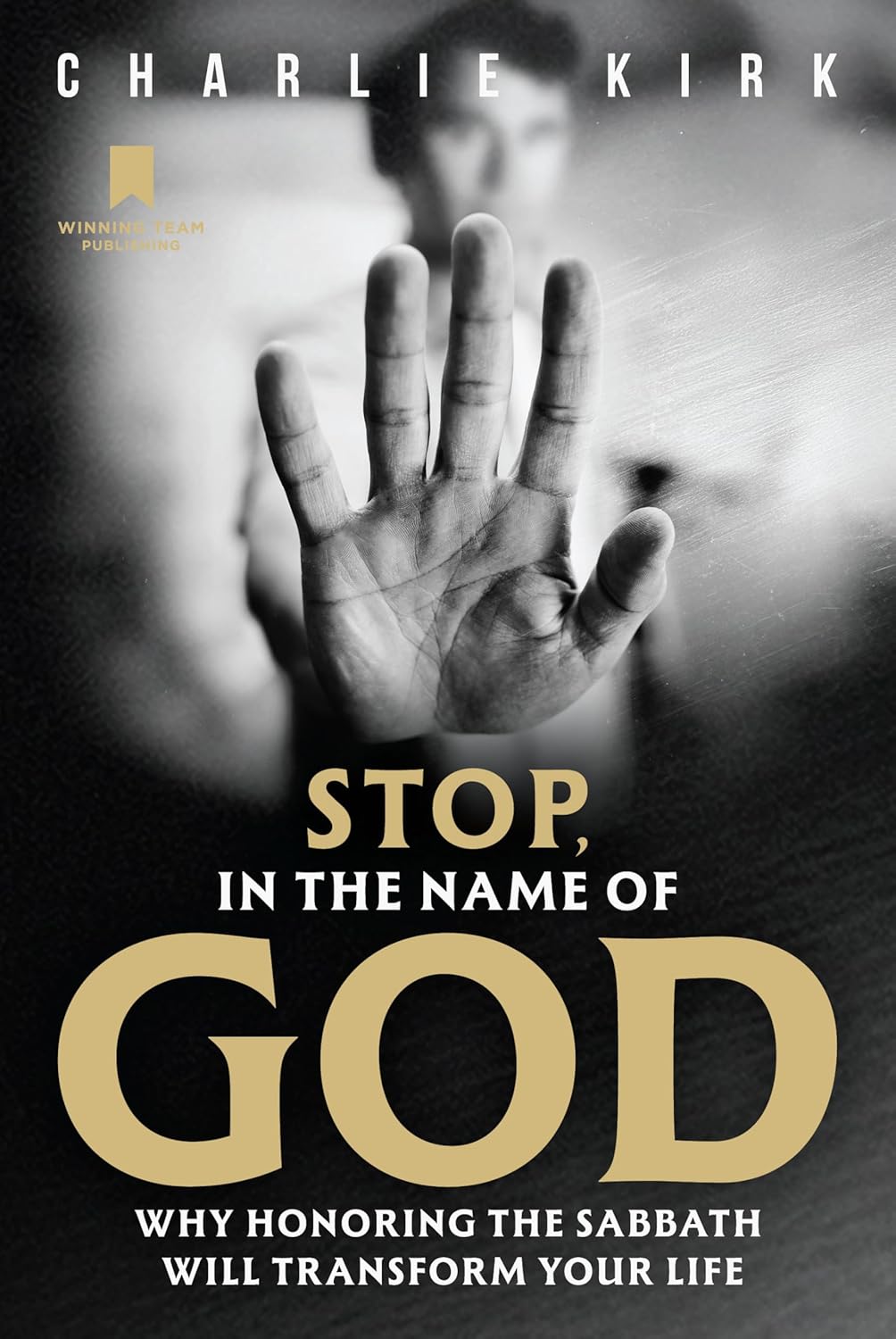
Stop in the Name of God: Why Honoring the Sabbath Will Change the World audiobook cover - A provocative faith-and-culture argument that says the modern world isn’t dying from a lack of information—but from a lack of holy stopping, where Sabbath becomes a spiritual reset, a social justice practice, and a blueprint for human freedom.

Stop in the Name of God: Why Honoring the Sabbath Will Change the World

A provocative faith-and-culture argument that says the modern world isn’t dying from a lack of information—but from a lack of holy stopping, where Sabbath becomes a spiritual reset, a social justice practice, and a blueprint for human freedom.

Sharon Esther Lampert

4.3 / 5(4 ratings)
Start ListeningDownloadQR code that opens AudiobookHub on the App StoreTry free on iPhoneScan to start in 5 seconds

If You're Curious About These Questions...

You should listen to this audiobook

Listen to Stop in the Name of God: Why Honoring the Sabbath Will Change the World — Free Audiobook

Loading player...

Key Takeaways from Stop in the Name of God: Why Honoring the Sabbath Will Change the World

Learning Tools

Reinforce what you learned from Stop in the Name of God: Why Honoring the Sabbath Will Change the World

Mind Map

Stop In The Name Of God Charlie Kirk
The Modern Crisis & The Forgotten Command+
Creation and Redemption+
The Meaning of Ceasing & Egypt's Return+
Dedication and Countercultural Practice+
Israel, Covenant, and The Law Debate+
Scripture and Global Restoration+

Quiz — Test Your Understanding

Question 1 of 9
According to the book's opening premise, what is the primary societal consequence of forgetting the Sabbath?
  • A. Societies begin to rebuild systems of slavery with modern tools.
  • B. People become lazier and less productive, leading to economic collapse.
  • C. Communities become too focused on worship and detached from reality.
  • D. It causes minor psychological stress but has no larger civilizational impact.
Question 2 of 9
The book emphasizes that the Sabbath command appears twice in the Bible (Exodus 20 and Deuteronomy 5). What is the significance of this duplication?
  • A. It highlights a major contradiction in scripture that needs to be resolved.
  • B. It shows the command's two core dimensions: a link to God's creation and a reminder of redemption from slavery.
  • C. It proves that the command was only intended for ancient Israel and is no longer applicable.
  • D. It suggests the command in Exodus is for individuals, while the one in Deuteronomy is for governments.
Question 3 of 9
The book explains that 'Shabbat' comes from a Hebrew root meaning 'to cease'. How does this definition change the understanding of the Sabbath?
  • A. It reframes the Sabbath as a purposeful act of trust in God's sovereignty, not just passive relaxation.
  • B. It proves that the Sabbath is about doing absolutely nothing, including worship.
  • C. It makes the Sabbath an optional activity for those who feel tired.
  • D. It shifts the focus from a full day of rest to just a momentary pause in work.
Question 4 of 9
How does the author use the concept of 'Pharaoh' or 'Egypt' to critique modern Western culture?
  • A. By arguing the West has become polytheistic, similar to ancient Egypt.
  • B. By claiming the West functions like a new Egypt that measures human value by constant output.
  • C. By suggesting Western architecture is starting to resemble pyramids.
  • D. By stating that Westerners have a poor understanding of Old Testament history.
Question 5 of 9
What does the author mean by the exhortation to 'Dedicate a Day'?
  • A. It is a metaphor for maintaining a restful attitude throughout the week.
  • B. It refers to donating one day's wages to charity.
  • C. It is a call for a concrete, embodied practice of setting aside a full day for worship and rest.
  • D. It means to simply think about God for a few minutes on the Sabbath.
Question 6 of 9
What is the symbolic function of the story about Abraham Lampert's Shabbat candlesticks made in a detention camp?
  • A. To show that Sabbath practice is only for those who are suffering.
  • B. To argue that ritual items are more important than the act of resting.
  • C. To demonstrate that the Sabbath is tied to identity and hope, even in circumstances of hardship and displacement.
  • D. To prove that the Sabbath can only be truly observed by Jewish people in Israel.
Question 7 of 9
How does the book's 'Prove Me Wrong' section address the theological tension between Law and Grace?
  • A. It concludes that Grace makes all of God's commands obsolete for Christians.
  • B. It argues that the Law is more important than Grace for salvation.
  • C. It claims that the tension is false and that both Law and Grace are irrelevant today.
  • D. It challenges the idea that commands can be irrelevant by linking them to God's unchanging character.
Question 8 of 9
What is the author's purpose in highlighting Jewish foundational texts like the Tanakh and Pirkei Avot?
  • A. To provide an academic history of Jewish literature for scholars.
  • B. To argue that all Christians should convert to Judaism to be saved.
  • C. To hold up the robust Jewish tradition of textual memory as a mirror to Christian practice.
  • D. To prove that Jewish texts are morally superior to the New Testament.
Question 9 of 9
In the book's concluding argument, how does learning to 'stop' lead to social change?
  • A. It is primarily a personal act that increases individual happiness but has no social effect.
  • B. It allows people to work harder on the other six days, boosting the economy.
  • C. It restores the ability to remember and resist exploitation, enabling a reordering of society toward justice.
  • D. It automatically creates a perfect utopia without any further human effort.

Stop in the Name of God: Why Honoring the Sabbath Will Change the World — Full Chapter Overview

Stop in the Name of God: Why Honoring the Sabbath Will Change the World Summary & Overview

Stop in the Name of God is a religious and cultural manifesto built around one central claim: the Sabbath is not an optional tradition or a sentimental ritual, but a divine rhythm that anchors creation, protects human dignity, and re-teaches societies how to live free. Drawing heavily from the Hebrew Bible—especially the repeated Sabbath command in Exodus and Deuteronomy—the book frames Shabbat as both “creation” (a cosmic pattern woven into the world) and “redemption” (a weekly act of liberation and remembrance).

Using scripture chains, historical reflections, and commentary on contemporary Christian discourse—particularly “in his own words” remarks associated with Charlie Kirk—the author pushes readers to re-examine Law vs. Grace, Christianity’s relationship to Torah, and the moral consequences of nonstop modern life. The book blends biblical citations, Jewish textual references, and polemical challenges (“Prove Me Wrong!”) to argue that honoring Sabbath is a personal discipline with world-changing implications.

Who Should Listen to Stop in the Name of God: Why Honoring the Sabbath Will Change the World?

  • Christians wrestling with “Law vs. Grace” and curious about the Torah/Shabbat as a living command rather than a relic
  • Jewish and interfaith readers interested in how Shabbat is presented as a universal social and spiritual principle
  • Readers seeking a faith-based critique of burnout culture, constant productivity, and the loss of sacred boundaries

About the Author: Sharon Esther Lampert

Sharon Esther Lampert is a prolific author (the book materials claim 80+ published titles) who writes in an assertive, prophetic voice and focuses on God, scripture, and cultural commentary. The text presents her as a message-driven writer who aims to provoke debate and push readers toward spiritual and ethical action.

🎧
Listen in the AppOffline playback & background play
Get App