If You're Curious About These Questions...
You should listen to this audiobook
- Have you ever wondered why the human brain is hardwired to seek meaning, and what happens to our well-being when that sense of purpose starts to slip away?
- What if you could navigate today’s most unsettling times with a clear sense of direction, using the same psychological insights that have guided humanity for centuries?
- Are you curious about how our individual quest for a meaningful life actually dictates the way our entire political and social world functions?
Listen to Start Making Sense — Free Audiobook
Loading player...
Key Takeaways from Start Making Sense
- Discover how modern behavioral science backs up the uplifting philosophy of Existentialism, proving that embracing human frailty leads to a happier life.
- Understand why your identity is fundamentally relational, and how finding new frameworks of meaning can anchor you in today's anxiety-inducing world.
- Learn how to navigate 'the absurd'—the moment your life's narrative breaks down—by consciously building new frameworks rather than succumbing to depression.
- Recognize that your 'self' is simply an ongoing narrative made of the stories you tell yourself, giving you the ultimate power to rewrite your script.
- Master the art of embracing your own internal contradictions so you can overcome limiting beliefs and consciously shape the fulfilling life you desire.
Learning Tools
Reinforce what you learned from Start Making Sense
Mind Map
Start Making Sense
Existentialism & Psychology+
Identity & Meaning+
The Power of Stories+
The Trap of Familiarity+
Radical Responsibility+
Quiz — Test Your Understanding
Question 1 of 7
What misconception about Existentialism does the text aim to correct?
Question 2 of 7
According to the text, how do humans primarily understand who they are?
Question 3 of 7
In the context of Albert Camus's philosophy, when do humans experience 'the absurd'?
Question 4 of 7
How does the text explain the phenomenon of people supporting policies or systems that actively oppress them?
Question 5 of 7
What does the historical shift from Ptolemy’s to Copernicus’s view of the universe illustrate about human psychology?
Question 6 of 7
What is described as a 'rock bottom existentialist idea' championed by Jean Paul Sartre?
Question 7 of 7
What purpose does the character of Mersault from Camus' novel 'The Stranger' serve in the context of this book?
Start Making Sense — Full Chapter Overview
- 1Recommendation
- 2The meaning-making ape
- 3The power of narrative
- 4Fake it or make it
- 5Don't stay a stranger
Start Making Sense Summary & Overview
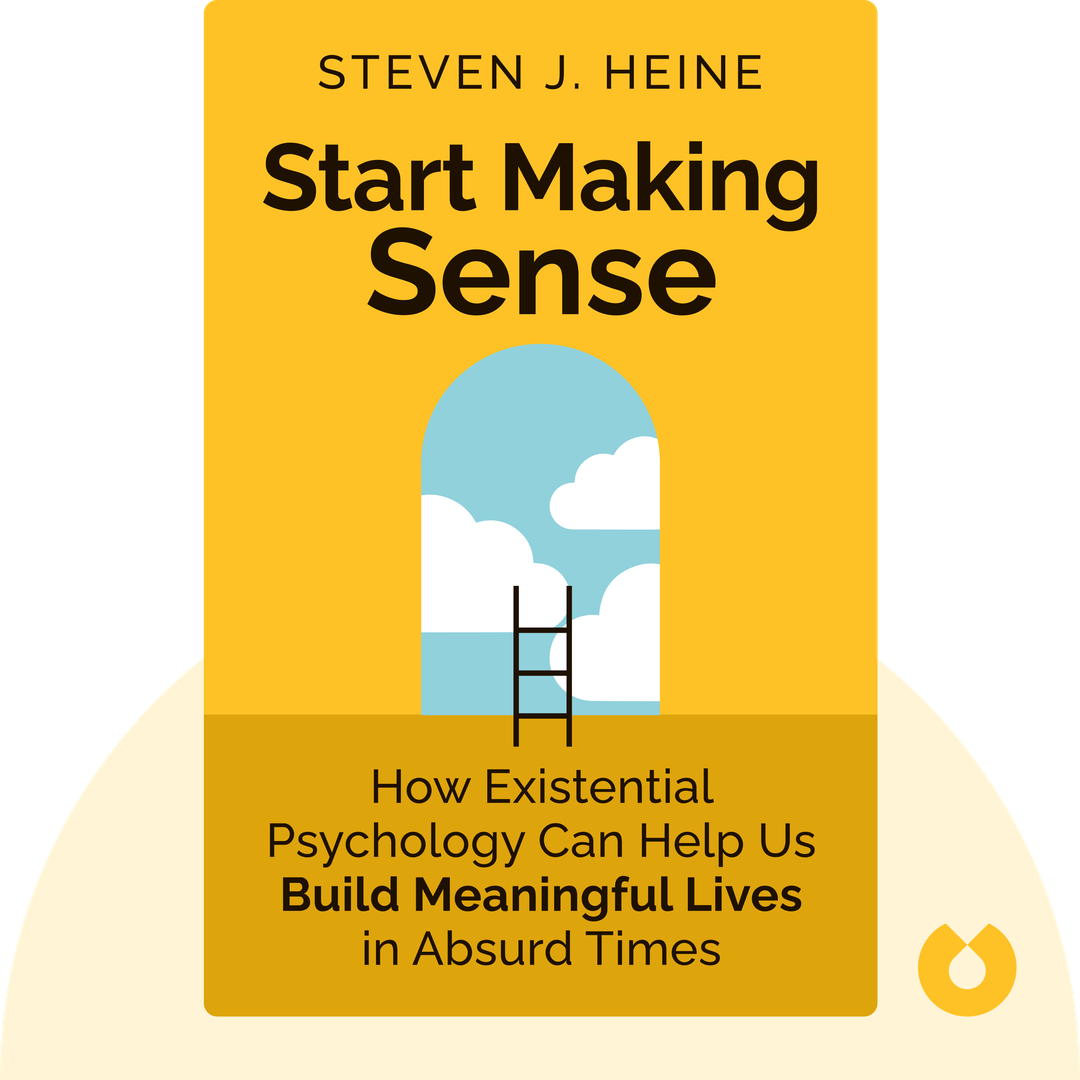
Start Making Sense (2025) explores the human need for meaning and purpose using cultural and social psychology to engage philosophical questions about the meaning of life. Weaving together history, literature, Existential psychology, and the history of science, it serves as a guide for crafting a meaningful life even in unsettling times.
Who Should Listen to Start Making Sense?
- Those anxious about the state of the world, or their place in it
- Psychology buffs looking for the origins of complex human behavior
- Anyone curious about how human behavior impacts political and social systems
Books Similar to Start Making Sense
Readers who enjoyed this also liked these titles.