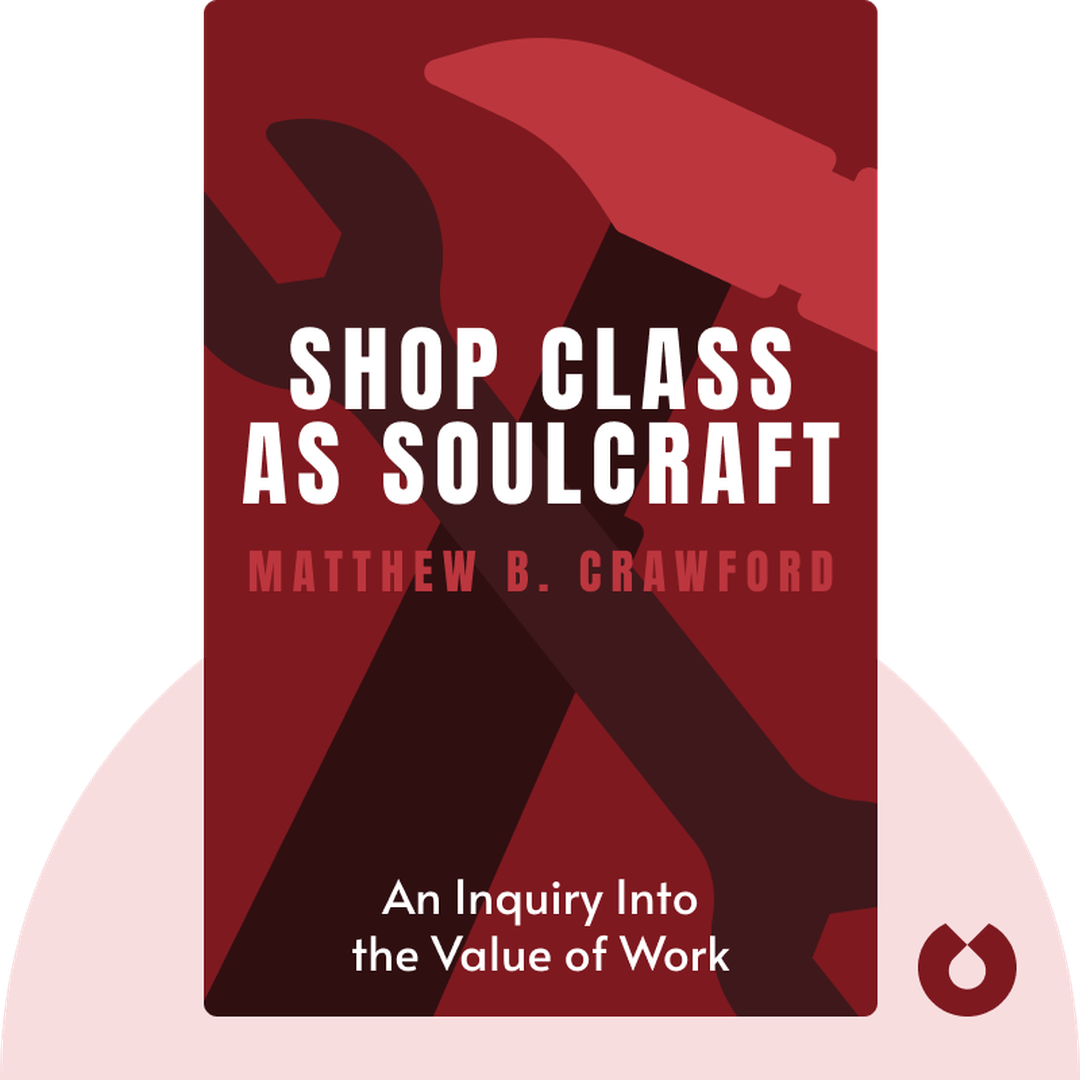
Shop Class as Soulcraft
Start ListeningDownload Try free on iPhoneScan to start in 5 seconds
Categories:
If You're Curious About These Questions...
You should listen to this audiobook
- Have you ever wondered why fixing a physical object often feels more intellectually rewarding than a whole day of 'knowledge work' in a cubicle?
- Did you know that the 'manual' labor of a skilled trade might actually require more complex problem-solving than many modern office jobs?
- What if the secret to escaping burnout and finding genuine happiness is hidden in the very trades we’ve been taught to overlook?
Listen to Shop Class as Soulcraft — Free Audiobook
Loading player...
Key Takeaways from Shop Class as Soulcraft
- Discover why a college degree no longer guarantees a stable career, and how skilled manual labor is becoming one of the most reliable paths to a good living.
- Understand how modern products are intentionally designed to discourage user repairs, sparking a renewed cultural desire for self-reliance and hands-on skills.
- Learn why the future job market favors roles requiring physical, in-person execution, protecting skilled trades from the growing threat of global outsourcing.
- Find out how the historical separation of thinking from doing has degraded both blue- and white-collar professions by reducing complex work to mind-numbing routines.
- Recognize the flaw in modern education systems that slash shop classes to push students toward knowledge work, often trapping them in unfulfilling cubicle jobs.
Learning Tools
Reinforce what you learned from Shop Class as Soulcraft
Mind Map
Shop Class as Soulcraft
The Illusion of the Knowledge Economy+
The Degradation of Work+
The Failure of Modern Education+
Teams vs. Crews+
Psychological Value of Trades+
Finding Meaningful Work+
Quiz — Test Your Understanding
Question 1 of 10
Why do many modern products discourage users from attempting to repair them?
Question 2 of 10
According to economist Alan Blinder, what will be the most crucial distinction in the future job market?
Question 3 of 10
How did Frederick Taylor's management model negatively affect the workforce?
Question 4 of 10
Why are some intellectually demanding knowledge jobs, like laboratory medical analysis, experiencing a decrease in required expertise and pay?
Question 5 of 10
According to the text, why do many modern schools actively discourage students from pursuing manual trades?
Question 6 of 10
Why do some managers of knowledge workers intentionally use extremely vague language, such as 'cross-marketing synergies'?
Question 7 of 10
What is a primary difference between working in a 'team' of knowledge workers versus working in a 'crew' of manual laborers?
Question 8 of 10
How does working with your hands help keep a worker's ego in check?
Question 9 of 10
Why does the author argue that manual trades are just as intellectually demanding as typical knowledge work?
Question 10 of 10
What actionable advice does the author give to students who are certain they want to go to college?
Shop Class as Soulcraft — Full Chapter Overview
- 1Recommendation
- 2Though we rarely fix or build things ourselves anymore, interest in hands-on manual work is steadily rising again today.
- 3A solid education no longer ensures a decent career.
- 4Separating thinking from doing severely harms both blue- and white-collar workers today.
- 5Today’s schools focus less on teaching, producing an increasingly disengaged workforce overall.
- 6Cubicle work and grating management methods alienate modern knowledge workers.
- 7Teamwork feels more confining than working within crews.
- 8Finding meaningful work truly pays off in spades.
- 9Working with your hands is satisfying and can strengthen your sense of self.
- 10Manual labor is mentally engaging and helps build autonomy.
Shop Class as Soulcraft Summary & Overview
Shop Class as Soulcraft (2009) is an eye-opening view into how working with your hands can transform your life. These blinks take a look at the changing nature of work, the value of manual labor and how choosing a trade, as opposed to a profession, might be your ticket to happiness.
Who Should Listen to Shop Class as Soulcraft ?
- Academics and students who aren’t sure if a life of theoretical work is for them
- Readers who want to learn more about the philosophy and psychology of manual work
- Anybody who’s fed up with working in a cubicle and wants a way out
Books Similar to Shop Class as Soulcraft
Readers who enjoyed this also liked these titles.