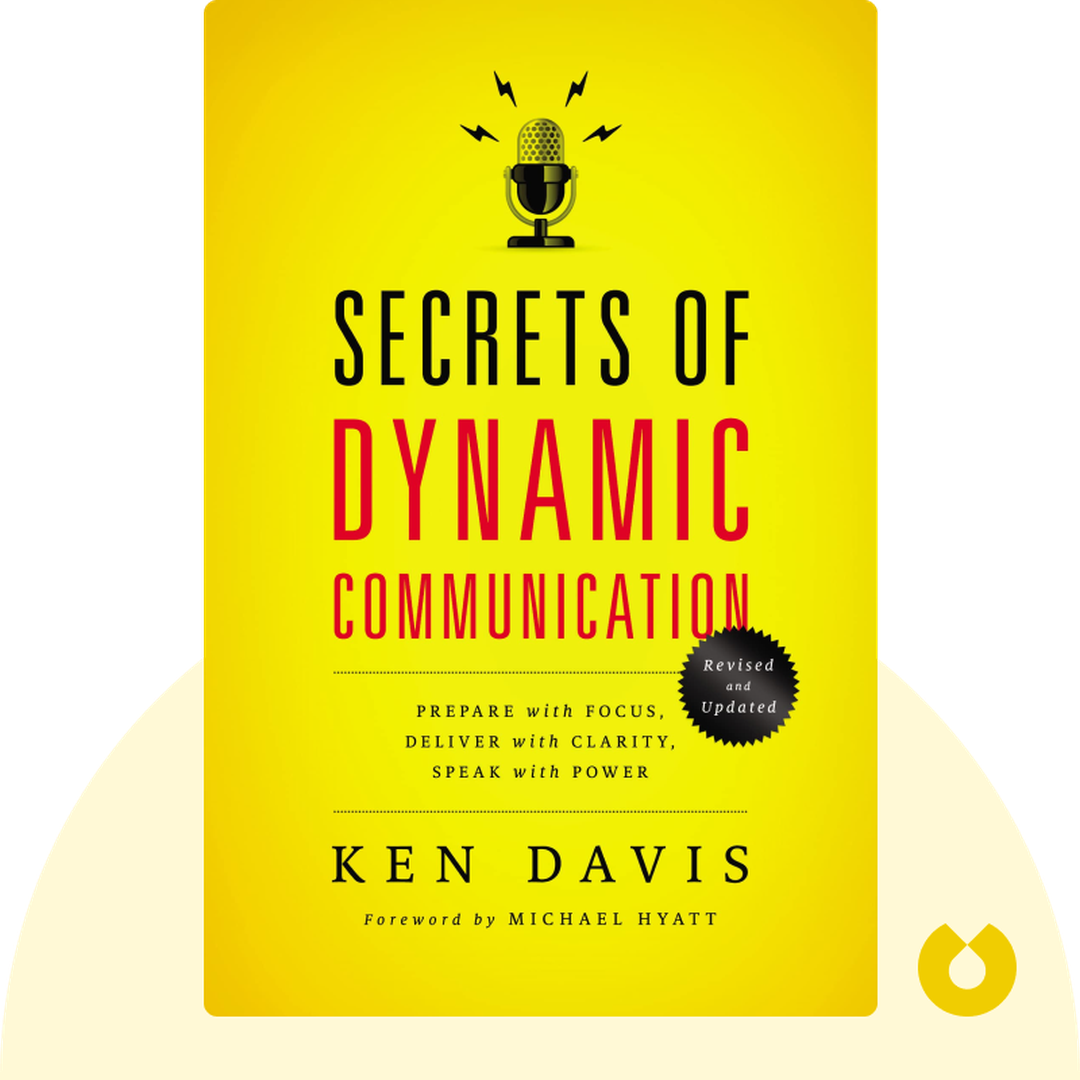
Secrets of Dynamic Communication
Start ListeningDownload Try free on iPhoneScan to start in 5 seconds
Categories:
If You're Curious About These Questions...
You should listen to this audiobook
- What if you could master a proven six-step framework that ensures every speech you give is clear, persuasive, and impossible to forget?
- Have you ever wondered why some speakers captivate an audience instantly while others struggle to keep people's attention?
- Are you curious about the secret method top communicators use to transform a scattered idea into a powerful, goal-oriented presentation?
Listen to Secrets of Dynamic Communication — Free Audiobook
Loading player...
Key Takeaways from Secrets of Dynamic Communication
- Discover why cramming a presentation with facts actually reduces audience retention, and learn why establishing a laser-like focus is the ultimate secret to a memorable speech.
- Master the SCORRE method to prevent rambling tangents by choosing a highly specific subject and central theme that shapes your presentation into a cohesive story.
- Learn how to distill your entire speech into a single objective sentence using a proposition, interrogative question, and key word to perfectly structure your message.
- Understand how to build a solid architectural foundation for your presentation by developing a rationale of logical, interconnected points that make your core argument highly credible.
- Find out how to breathe life into your structured speech by strategically using resources like humorous anecdotes and compelling stories to deeply captivate your listeners.
Learning Tools
Reinforce what you learned from Secrets of Dynamic Communication
Mind Map
Secrets of Dynamic Communication
Core Philosophy+
The SCORRE Method+
Speech Structure+
Preparation & Time+
Delivery & Engagement+
Emotional Connection+
Quiz — Test Your Understanding
Question 1 of 8
According to the author's study, what is the primary reason that 70 percent of audiences cannot recall the key messages of a presentation they just watched?
Question 2 of 8
In the SCORRE method, what is the primary purpose of selecting a specific 'subject' and 'central theme'?
Question 3 of 8
Which of the following elements are required to construct an effective 'objective sentence' according to the SCORRE method?
Question 4 of 8
If the objective sentence is the architectural plan of your speech, what role do 'resources' play in the SCORRE method?
Question 5 of 8
How does the author suggest a speaker should craft an impressionable conclusion?
Question 6 of 8
Why does the author mention a speaker presenting in front of a stunning snowy landscape in Alaska?
Question 7 of 8
According to the text, what is a specific psychological benefit of using humor in a presentation?
Question 8 of 8
What highly recommended time-management strategy does the author suggest for the evaluation phase of speechwriting?
Secrets of Dynamic Communication — Full Chapter Overview
- 1Recommendation
- 2Focus is the secret to a powerful speech.
- 3SCORRE method: To sharpen your speech's focus, choose a subject and a central theme to start.
- 4The SCORRE method: To define your speech's purpose and structure, craft a clear objective sentence first.
- 5The SCORRE method: Build a strong base for your speech with rationale, resources, and evaluation.
- 6Finalize your speech by crafting a compelling opening and a resonant conclusion.
- 7Invest time in your presentation and reap the rewards.
- 8Know your audience and use every tool to engage them: personal stories, body language, and the presentation space to advantage.
- 9Use every tool to reach your audience’s emotions, humor included as a powerful ally.
Secrets of Dynamic Communication Summary & Overview
Secrets of Dynamic Communication explains how to prepare and present a speech effectively. Through the author’s own SCORRE-method, we are guided through the six key components of a successful speech: subject, central theme, objective, rationale, resources and evaluation.
Who Should Listen to Secrets of Dynamic Communication?
- Students and teachers
- Pastors, executives and coaches
- Anyone who wants to master public speaking
Books Similar to Secrets of Dynamic Communication
Readers who enjoyed this also liked these titles.