If You're Curious About These Questions...
You should listen to this audiobook
- Did you know that the same relentless drive that propelled Richard Nixon from a humble, impoverished upbringing to the presidency also contained the seeds of his ultimate downfall?
- Have you ever wondered what hidden psychological complexities and personal demons led one of America’s most brilliant political strategists to risk everything in the Watergate scandal?
- Are you curious about the surprising, sentimental side of Richard Nixon that challenges the cold, calculating image most history books portray?
Listen to Richard Nixon — Free Audiobook
Loading player...
Key Takeaways from Richard Nixon
- Discover how Richard Nixon's poverty-stricken upbringing, family tragedies, and early career failures fueled an intense, lifelong drive to succeed.
- Learn how Nixon strategically leveraged his World War II naval service as a vital stepping stone to overcome his lack of political connections.
- Understand how Nixon established a ruthless 'win at all costs' mentality by using half-truths and stoking public fear of Communism to defeat his first political rival.
- Find out how relentless tenacity during the Alger Hiss espionage hearings transformed Nixon from an awkward, junior Congressman into a national political powerhouse.
- Uncover the profound historical irony of Nixon's early realization that 'the cover-up, not the crime' destroys careers, perfectly foreshadowing his own Watergate downfall.
Learning Tools
Reinforce what you learned from Richard Nixon
Mind Map
Richard Nixon
Early Life & Character+
Political Ascent (1946-1952)+
Defeat & Comeback (1960-1968)+
Presidential Policies+
Paranoia & Downfall+
Quiz — Test Your Understanding
Question 1 of 9
What primary tactic did Nixon use to defeat his early political opponents, Jerry Voorhis and Helen Gahagan Douglas?
Question 2 of 9
Nixon's relentless pursuit of Alger Hiss taught him a crucial political lesson that would ironically foreshadow his own downfall. What was it?
Question 3 of 9
How did Nixon manage to keep his spot as Dwight D. Eisenhower’s vice-presidential running mate amidst scandals about his campaign financing?
Question 4 of 9
According to the text, what was a significant factor in Nixon's loss to John F. Kennedy in the 1960 presidential election?
Question 5 of 9
What brazen, behind-the-scenes action did Nixon take to improve his chances of winning the 1968 presidential election?
Question 6 of 9
How does the book describe Nixon's underlying political philosophy during his presidency?
Question 7 of 9
Why was Richard Nixon uniquely positioned to successfully thaw relations with Communist China in 1972?
Question 8 of 9
What event in 1971 sent Nixon into a paranoid frenzy and led him to create a unit dedicated to underhanded tactics and stopping leaks?
Question 9 of 9
What was Richard Nixon's direct involvement in the initial Watergate break-in, according to the provided text?
Richard Nixon — Full Chapter Overview
- 1Recommendation
- 2Modesty
- 3Advancement
- 4Trickery
- 5Ambition
- 6Peacemaking
- 7Outlook
- 8Statecraft
- 9Fury
- 10Legacy
Richard Nixon Summary & Overview
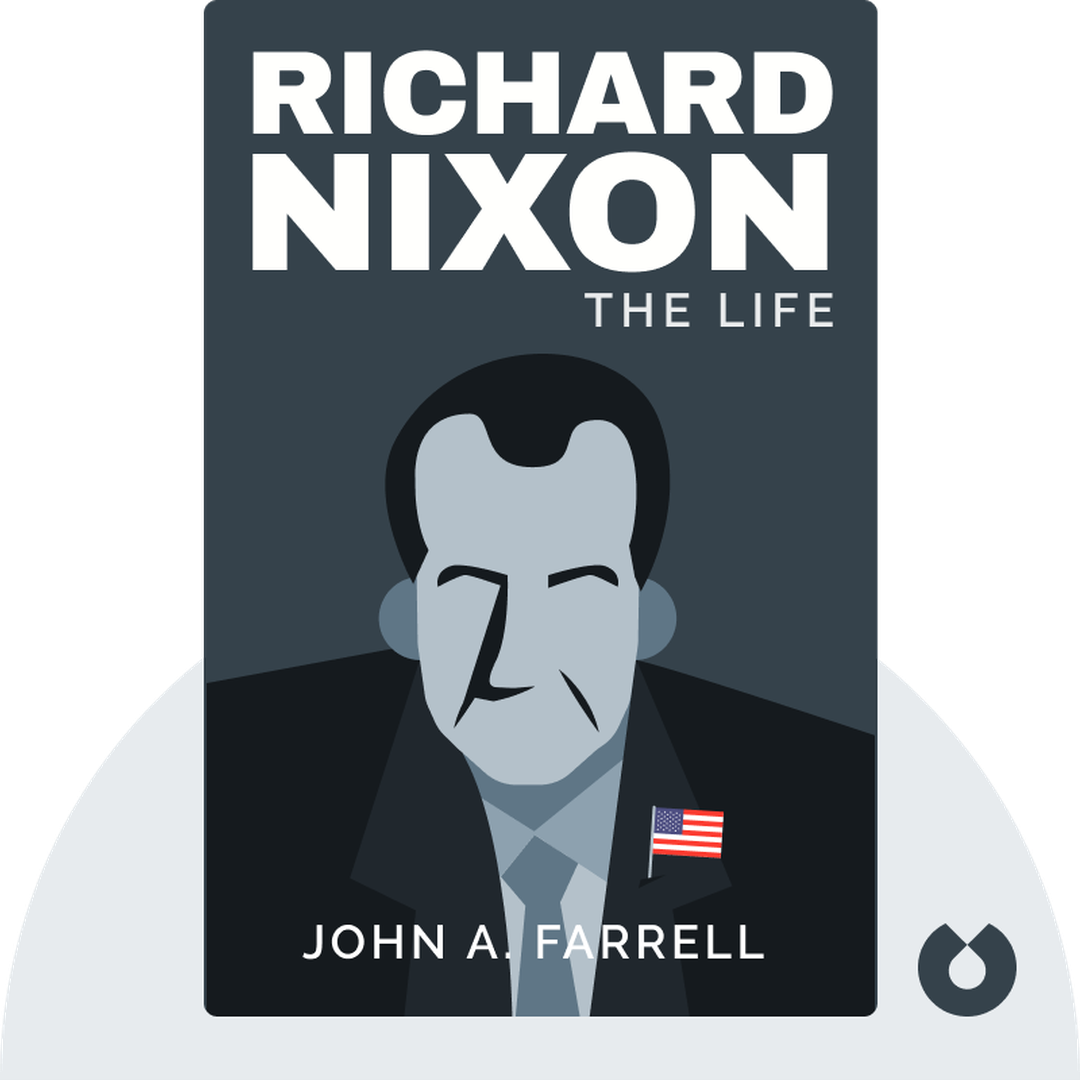
Richard Nixon: The Life (2017) is a thorough biography of one of the most controversial American presidents. Tracing Nixon’s life from his humble upbringing through his meteoric political ascent to his crashing downfall in the Watergate scandal, it reveals a complex, troubled, and sentimental man.
Who Should Listen to Richard Nixon?
- US-politics aficionados
- Biography enthusiasts who love a scandal
- People looking to deepen their knowledge of American history
Books Similar to Richard Nixon
Readers who enjoyed this also liked these titles.