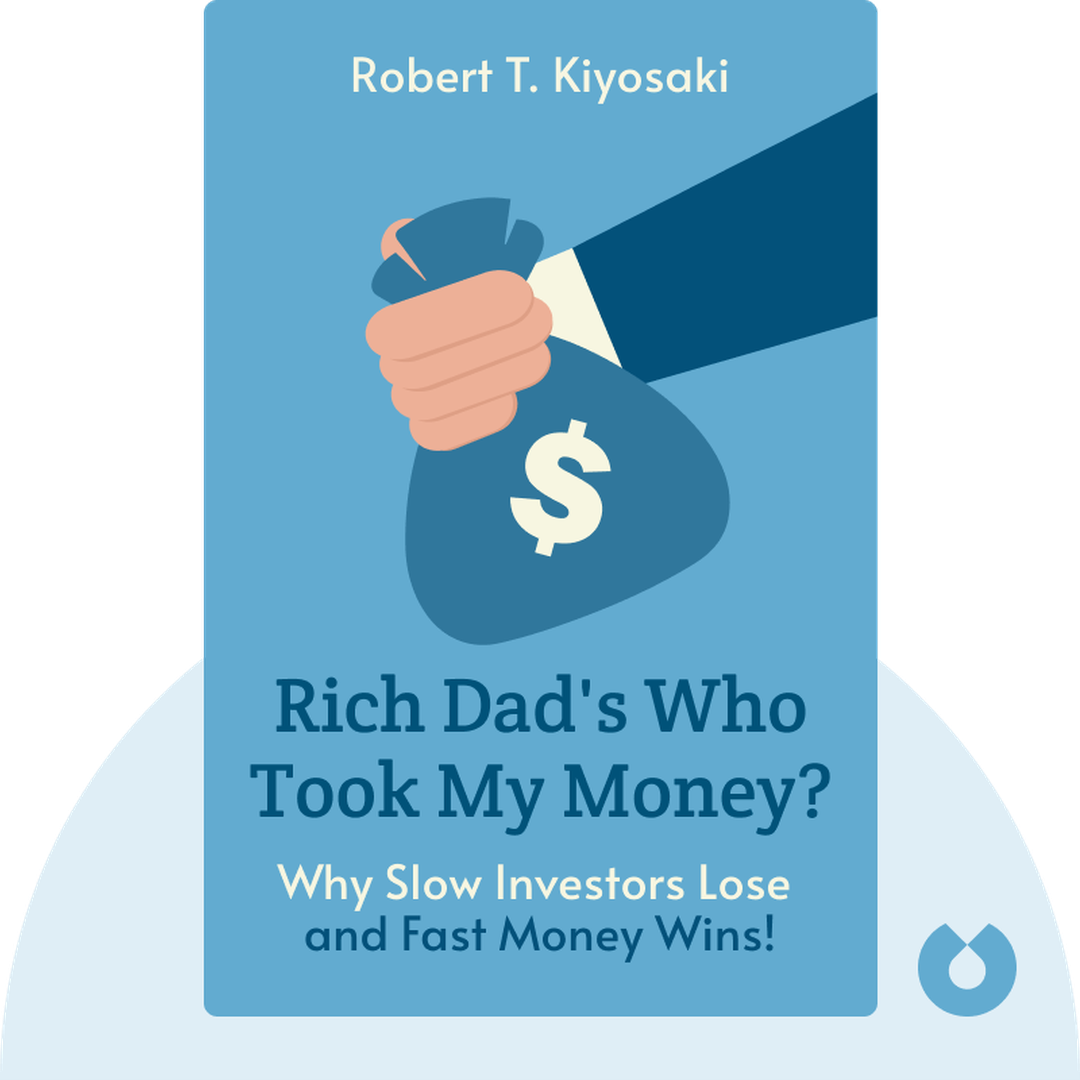
Rich Dad's Who Took My Money?
Start ListeningDownload Try free on iPhoneScan to start in 5 seconds
Categories:
If You're Curious About These Questions...
You should listen to this audiobook
- Did you know that the common strategy of saving and holding mutual funds for the long term could actually be working against your financial freedom?
- Have you ever wondered why some investors get rich at lightning speed while others spend decades waiting for a modest retirement?
- What if you could master the secret of combining different asset types to create a continuous, unstoppable flow of cash into your pocket?
Listen to Rich Dad's Who Took My Money? — Free Audiobook
Loading player...
Key Takeaways from Rich Dad's Who Took My Money?
- Understand why relying on traditional mutual funds for long-term savings is a slow and risky strategy that could leave you working into your old age.
- Discover the secret of 'power investing' by combining multiple asset classes—like business, real estate, and paper assets—to rapidly accelerate your wealth.
- Learn how to generate financial synergy by making different types of investments work together to create a total value far greater than the sum of their parts.
- Master the 'dairy farmer' investing approach by prioritizing continuous, lifelong cash flow from your assets instead of selling them off for one-time capital gains.
- Find out how to identify and acquire high-performing assets that will completely pay back their original cost within five years through rents, profits, or dividends.
Learning Tools
Reinforce what you learned from Rich Dad's Who Took My Money?
Mind Map
Rich Dad's Who Took My Money?
The Problem with Traditional Advice+
Power Investing Strategy+
Cash Flow over Capital Gains+
The Velocity of Money+
The Banker's Perspective+
Overcoming Financial Failure+
Actionable Advice+
Quiz — Test Your Understanding
Question 1 of 7
How does the author conceptualize our money-earning lives to emphasize the urgency of financial planning?
Question 2 of 7
According to the author, what does it mean to be a 'power investor'?
Question 3 of 7
What key investing principle does the 'dairy farmer vs. cattle rancher' analogy illustrate?
Question 4 of 7
What lesson should investors learn from a professional gambler?
Question 5 of 7
Why does the author recommend viewing potential investments from a 'banker's perspective'?
Question 6 of 7
According to the text, what is one of the four key reasons people fail to succeed financially?
Question 7 of 7
What actionable advice does the author give to help readers practice the secret to financial independence?
Rich Dad's Who Took My Money? — Full Chapter Overview
- 1Recommendation
- 2You must take action now to avoid living your old age in poverty.
- 3The surest path to becoming rich is practicing power investing.
- 4Skip capital gains; instead, invest with a focus on steady cash flow.
- 5Like a professional gambler, investors must pull their own money off the table as quickly as possible, every time.
- 6You must learn to view the world through a banker’s perspective.
- 7There are four main reasons people fail to succeed financially.
Rich Dad's Who Took My Money? Summary & Overview
Rich Dad’s Who Took My Money? (2004) explains why the time-honored strategy of saving money, investing in mutual funds, and holding on to paper assets for the long term is all wrong. Instead, if you want to get rich quick, you need to become a power investor who combines different asset types – like real estate, businesses, and stocks – to generate a continuous cash flow.
Who Should Listen to Rich Dad's Who Took My Money??
- Anyone worried about their financial future
- Investors and real estate professionals
- People looking to escape the daily grind
Books Similar to Rich Dad's Who Took My Money?
Readers who enjoyed this also liked these titles.