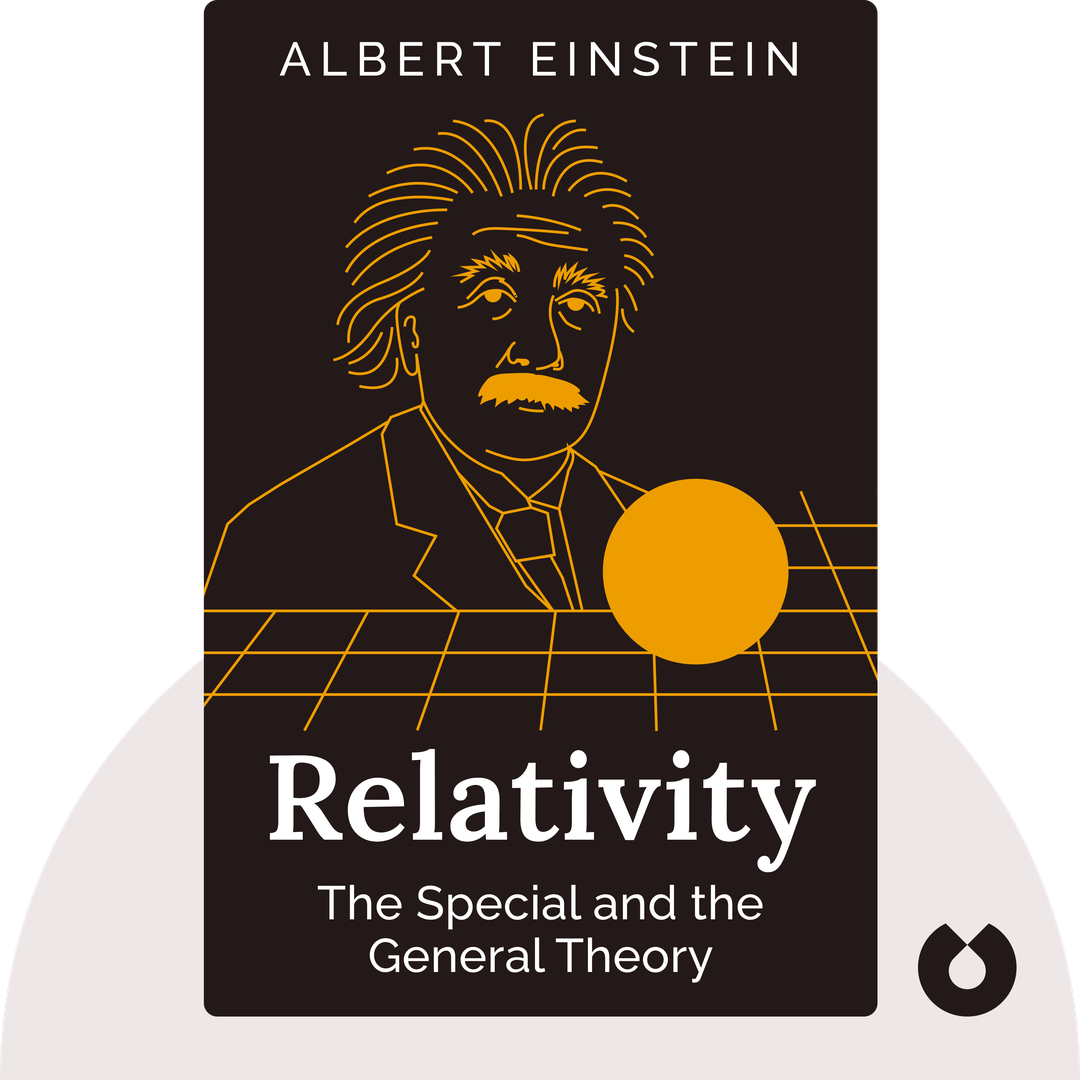
If You're Curious About These Questions...
You should listen to this audiobook
- Have you ever wondered why time actually ticks slower for someone in motion compared to someone standing still?
- What if the force of gravity isn't a "pull" at all, but rather a hidden curve in the very fabric of space and time?
- Did you know that two people can witness the exact same event at completely different times, and yet both of them are technically correct?
Listen to Relativity — Free Audiobook
Loading player...
Key Takeaways from Relativity
- Discover why the speed of light remains perfectly constant for all observers, defying everyday common sense and rewriting the rules of physics.
- Understand the mind-bending concept of time dilation, where time actually slows down for objects moving at incredibly high speeds compared to stationary ones.
- Learn how extreme velocity affects physical dimensions, causing fast-moving objects to appear visibly contracted or squished in their direction of motion.
- Explore the fascinating equivalence between gravity and acceleration, revealing why the sensation of being pulled to Earth feels exactly like being propelled upward in a spaceship.
- Find out how massive celestial bodies warp the fabric of spacetime to create gravity, a groundbreaking shift in perspective that solved the mystery of Mercury's orbit.
Learning Tools
Reinforce what you learned from Relativity
Mind Map
Relativity
Special Relativity & Light+
General Relativity & Gravity+
Geometry of the Cosmos+
Cosmology & Philosophy+
Quiz — Test Your Understanding
Question 1 of 7
How did Einstein explain the puzzling results of the Michelson-Morley experiment regarding the speed of light?
Question 2 of 7
According to the concept of time dilation, what happens to time for an object moving close to the speed of light compared to a stationary observer?
Question 3 of 7
What does Einstein's sealed elevator thought experiment demonstrate about the nature of gravity?
Question 4 of 7
How did Einstein's theory of general relativity successfully explain the peculiar wobble in Mercury's orbit?
Question 5 of 7
In the context of a curved universe, what is a 'geodesic'?
Question 6 of 7
How did Einstein conceptualize the size and boundaries of our universe?
Question 7 of 7
According to Einstein's cosmic philosophy, what determines whether the universe is flat, spherical, or saddle-shaped?
Relativity — Full Chapter Overview
- 1Recommendation
- 2Grasping the speed of light
- 3The subtle boundary between gravity and acceleration
- 4The universe’s bending and shape
- 5Einstein’s view of the cosmos
Relativity Summary & Overview
Relativity (1916) plunges you into the revolutionary world of physics, challenging your perceptions of space, time, and the cosmos. Dive deep into the groundbreaking ideas that reshaped our understanding of the universe. It's not just a scientific journey – it's a transformative experience that will redefine the reality you live in.
Who Should Listen to Relativity?
- Science enthusiasts curious about the universe's fundamentals
- Physics students seeking foundational knowledge
- Thinkers intrigued by groundbreaking ideas
Books Similar to Relativity
Readers who enjoyed this also liked these titles.