If You're Curious About These Questions...
You should listen to this audiobook
- Did you know that the "sharing economy" might actually be a Trojan horse that is quietly dismantling the global middle class?
- Have you ever wondered why the convenience of apps like Uber and Airbnb could be the very thing triggering the next major economic collapse?
- Are you curious about how the decline of traditional 9-to-5 jobs is putting your own financial future at risk, even if you don't work in the gig economy?
Listen to Raw Deal — Free Audiobook
Loading player...
Key Takeaways from Raw Deal
- Discover why the 'sharing economy' championed by companies like Airbnb and Uber is actually a dangerous form of raw capitalism that threatens the stability of the US economy.
- Learn how Airbnb evades local housing regulations and hotel taxes by posing as a mere booking agent, encouraging landlords to evict everyday tenants for higher profits.
- Understand how Uber exploits legal loopholes by misclassifying its drivers as independent contractors, avoiding taxes and dodging liability for passenger safety.
- Explore the dangerous rise of the '1099-economy,' where businesses save money by replacing full-time, salaried employees with completely unprotected gig workers.
- Find out why the lack of labor laws in the United States creates a trapped class of 'perma-temps' who perform the same work as regular employees but receive zero benefits or job security.
Learning Tools
Reinforce what you learned from Raw Deal
Mind Map
Raw Deal
Sharing Economy Illusion+
The 1099-Economy+
Corporate Loopholes & Risk+
True Threats to Labor+
Economic Singularity+
A New Social Contract+
Quiz — Test Your Understanding
Question 1 of 8
How do companies like Airbnb successfully avoid local regulations and hotel taxes, according to the text?
Question 2 of 8
What is a negative consequence of Uber drivers engaging in 'surge driving'?
Question 3 of 8
What is the defining characteristic of the '1099-economy' described in the book?
Question 4 of 8
How does the author characterize gig platforms like TaskRabbit?
Question 5 of 8
According to the text, why are middle- to high-skilled jobs more at risk from automation than blue-collar jobs?
Question 6 of 8
What fundamental economic principle did Henry Ford understand that the sharing economy currently threatens?
Question 7 of 8
What alternative solution do countries like Germany and Sweden use during tough economic times that the author suggests for the US?
Question 8 of 8
What does the author recommend as a positive, long-term alternative to the sharing economy?
Raw Deal — Full Chapter Overview
- 1Recommendation
- 2The sharing economy offers freedom but doesn’t deliver.
- 3By flouting rules and regulations, companies put clients in danger and create unhappy workers.
- 4Businesses in the sharing economy cut costs by dismissing staff and hiring unprotected contractors.
- 5The sharing economy leaves workers battling for scraps and turning to illegal labor.
- 6Automation is not as harmful to blue-collar jobs as the deregulation threat.
- 7Declining wages and a lack of job security are pushing the US economy toward the brink of collapse.
- 8We need a new social contract that safeguards both workers and businesses.
Raw Deal Summary & Overview
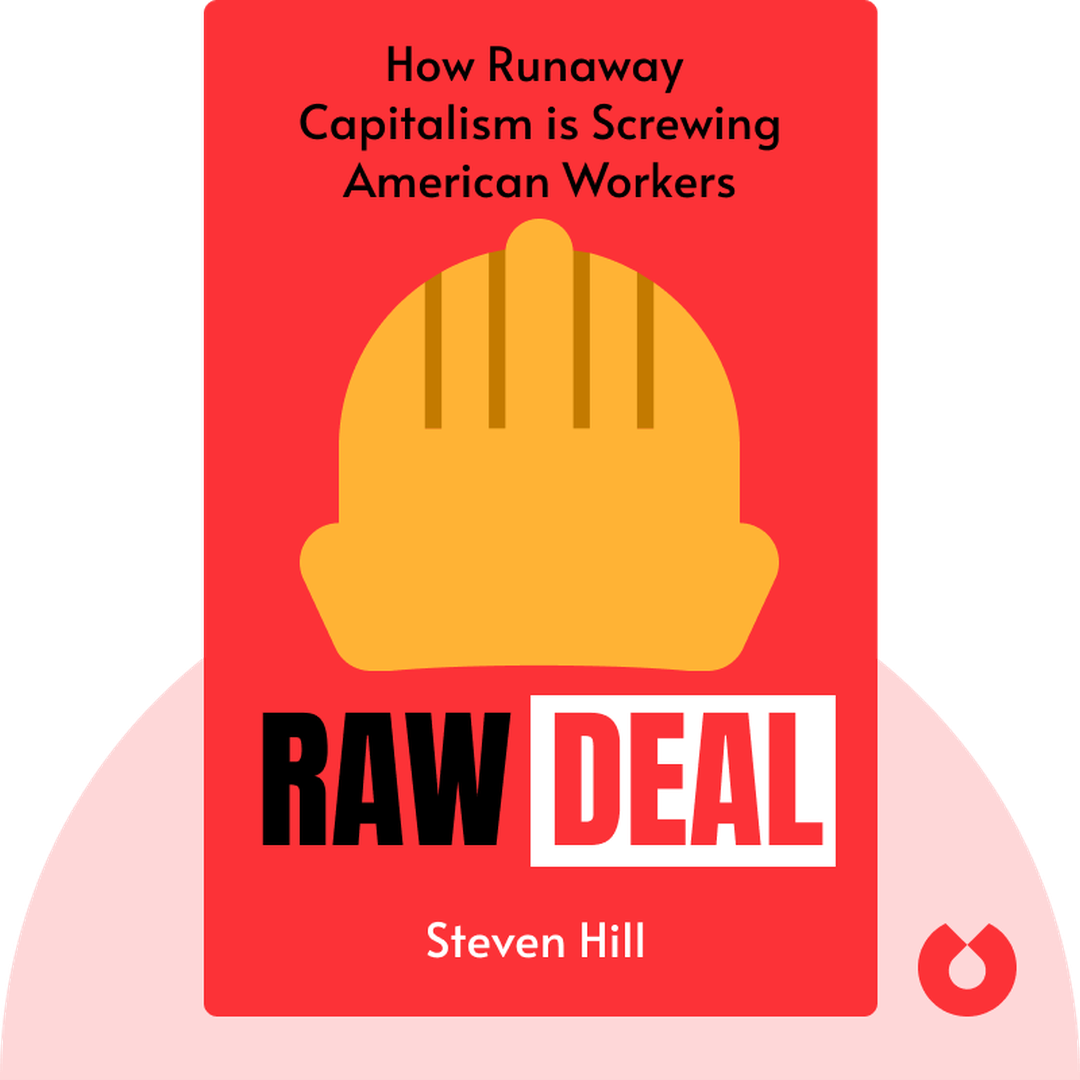
Raw Deal (2015) reveals the ugly truth behind the new sharing economy and the harm that companies like Uber or Airbnb are inflicting upon societies around the world. There’s a major crisis on the horizon, and it will affect not only these companies’ exploited employees. We’re all at risk, and we’ll need to choose our next steps wisely to prevent an economic collapse.
Who Should Listen to Raw Deal?
- Students of economics and politics
- Readers interested in the job market and labor regulations
- Employees worried about declining workplace standards
Books Similar to Raw Deal
Readers who enjoyed this also liked these titles.