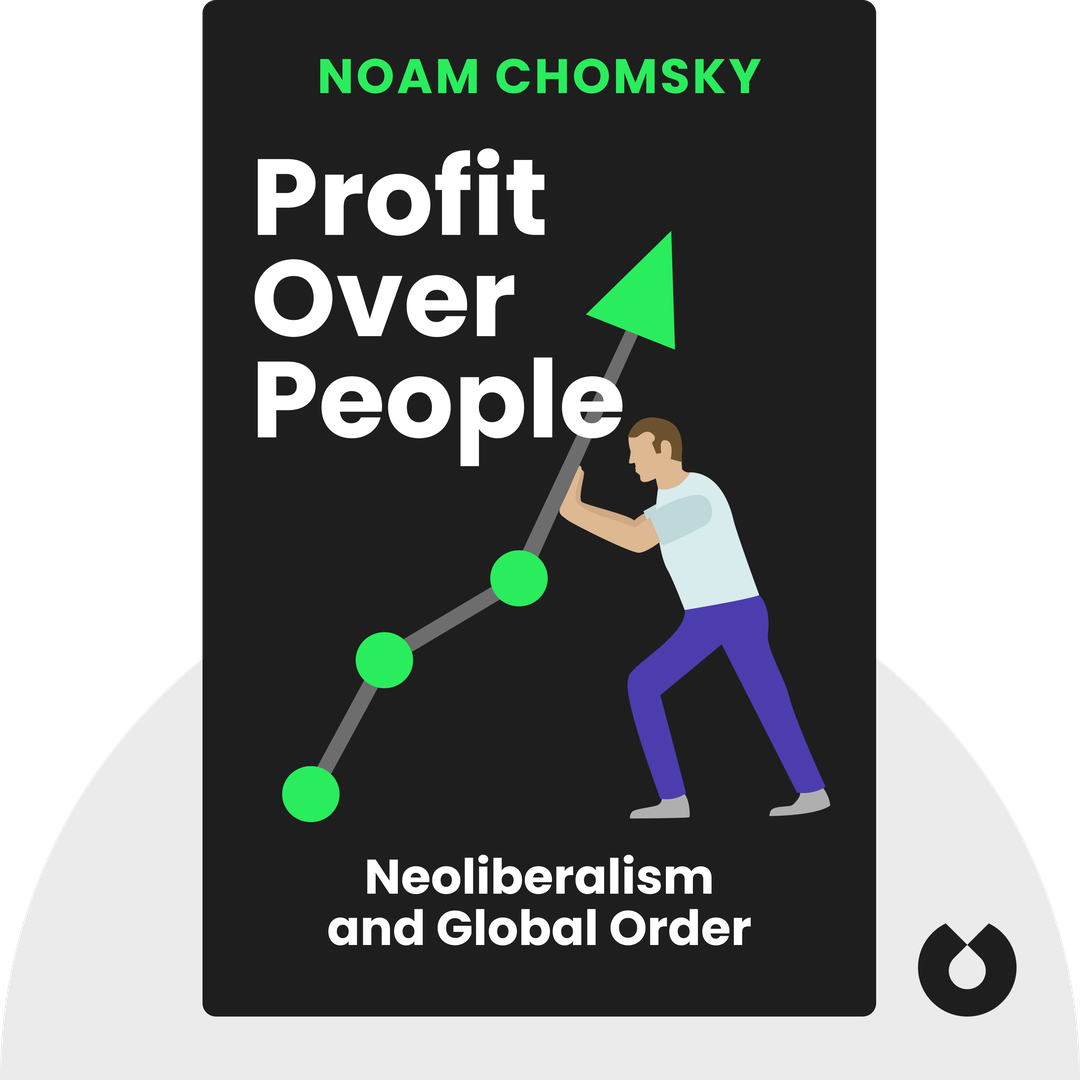
If You're Curious About These Questions...
You should listen to this audiobook
- Have you ever wondered why global economic policies often seem to prioritize corporate gains over the well-being of the general public?
- Did you know that the 'free market' might not be as free as we’re led to believe, but is instead shaped by hidden power structures?
- Are you curious about the real impact of neoliberalism on democracy and why certain policies are consistently geared toward the interests of the affluent?
Listen to Profit Over People — Free Audiobook
Loading player...
Key Takeaways from Profit Over People
- Understand how the 'Washington consensus' enforces unbridled free-market capitalism, prioritizing corporate profit and private investment over the well-being of developing nations.
- Discover why the United States historically backed coups in Latin American countries like Chile and Guatemala to protect private economic interests from nationalistic, pro-people policies.
- Learn how wealthy nations champion free-market doctrines to decimate foreign competition, just as Britain destroyed India's thriving iron industry while heavily protecting its own domestic markets.
- Find out why global superpowers shifted their primary influence from the United Nations to the World Trade Organization to leverage its strict dispute resolution mechanisms for global economic dominance.
- Uncover how seemingly fair international deals, like the WTO's telecommunications agreement, are weaponized to force vulnerable countries into surrendering control of their vital infrastructure to foreign corporations.
Learning Tools
Reinforce what you learned from Profit Over People
Mind Map
Profit Over People
Unmasking Neoliberalism+
Weaponizing the WTO+
American Exceptionalism+
Free-Trade Agreements (NAFTA)+
Quiz — Test Your Understanding
Question 1 of 8
According to the text, what was the primary effect of the 'Washington consensus' when imposed on developing nations?
Question 2 of 8
Why did the United States support coups and interventions in Latin American countries like Chile (1973) and Guatemala (1954)?
Question 3 of 8
How does the text describe Britain's approach to India's iron industry as an example of neoliberal practice?
Question 4 of 8
Why did the United States shift its preferred platform for international influence from the United Nations (UN) to the World Trade Organization (WTO)?
Question 5 of 8
What is a major long-term consequence of the WTO’s telecommunications agreement for developing countries, according to the text?
Question 6 of 8
How did the United States respond when the International Court of Justice (ICJ) ruled against its military actions in Nicaragua in the 1980s?
Question 7 of 8
What was a direct consequence of the North American Free Trade Agreement (NAFTA) for Mexico's agricultural sector?
Question 8 of 8
What was significant about the timing and methods of the 1994 Zapatista uprising in Chiapas, Mexico?
Profit Over People — Full Chapter Overview
- 1Recommendation
- 2Exposing neoliberal capitalism
- 3The WTO’s hidden power
- 4One set of rules for the US – and another for everyone else
- 5The reality behind free-trade agreements
- 6Final summary
Profit Over People Summary & Overview
Profit Over People (1999) is a deep dive into the often hidden world of neoliberalism, revealing how global power structures and US policies are influenced by corporate interests. You’ll be taken on a journey that uncovers an economic system geared toward the affluent, often to the detriment of the many.
Who Should Listen to Profit Over People?
- Students of economics or international relations
- Policymakers and businesspeople
- Curious minds interested in the way our world works
Books Similar to Profit Over People
Readers who enjoyed this also liked these titles.