If You're Curious About These Questions...
You should listen to this audiobook
- Did you know that your workplace might actually be closer to a communist dictatorship than the 'free enterprise' we’re taught to believe in?
- Have you ever wondered why we demand democratic rights in our politics, yet surrender almost all personal freedom the moment we clock into work?
- Are you curious about how modern companies gained the power to regulate your speech, your habits, and even your life outside the office?
Listen to Private Government — Free Audiobook
Loading player...
Key Takeaways from Private Government
- Discover why the traditional free-market view of employment as an equal, mutually beneficial contract is a hopelessly outdated illusion.
- Learn how modern corporate workplaces function similarly to communist dictatorships, complete with central planning and unelected leaders who control the means of production.
- Understand the alarming extent of an employer's dictatorial power, which can include invasive surveillance of your personal communications and threatening your livelihood to ensure compliance.
- Recognize how corporate governance resembles an oligarchy where workers have virtually no democratic recourse to elect their superiors or challenge management decisions.
- Find out why the freedom to simply quit your job is highly constrained by market scarcities, a lack of start-up capital, and restrictive non-compete clauses that hold your skills hostage.
Learning Tools
Reinforce what you learned from Private Government
Mind Map
Private Government
The Illusion of the Free Labor Market+
Workplaces as Communist Dictatorships+
Extreme Employer Power+
The Myth of Quitting+
Private vs. Public Government+
Democratizing the Workplace+
Quiz — Test Your Understanding
Question 1 of 9
Why does the author compare modern capitalist workplaces to 'communist dictatorships'?
Question 2 of 9
According to defenders of capitalism, workers are free because they can simply quit their jobs. Why does the author argue this 'freedom to quit' is highly constrained?
Question 3 of 9
Under 'at-will' employment in the United States, what is an employer generally legally permitted to do?
Question 4 of 9
How does the author redefine or clarify the word 'government' to apply it to the workplace?
Question 5 of 9
What specifically makes the government of a modern workplace a 'private' government rather than a 'public' one?
Question 6 of 9
What does the author suggest as the primary solution to the problem of private government in the workplace?
Question 7 of 9
Why does workplace authoritarianism often go ignored in academic and public discourse?
Question 8 of 9
Why did early capitalist thinkers, like those in the 17th and 18th centuries, view the free market as a force of human liberation?
Question 9 of 9
According to the text, how did the Industrial Revolution undermine Adam Smith's early promises of the capitalist market?
Private Government — Full Chapter Overview
- 1Recommendation
- 2Many modern workplaces have deeply authoritarian governance structures.
- 3Despite broad limits, employers still wield far-reaching dictatorial power over our lives.
- 4Workers retain the right to leave their jobs, yet their ability to do so is heavily constrained.
- 5The reach of an employer’s power is far greater than many of us realize.
- 6The problem with the modern workplace isn’t that it has government; it’s the exact sort of government it has.
- 7The problem with the modern workplace is that it’s ruled by private government rather than by a public one.
- 8The solution to the problem of private governance is to make workplaces more democratic.
- 9Workplace authoritarianism frequently gets ignored because of low levels of public awareness.
- 10Many of us still remain captivated by outdated notions about how labor markets work.
- 11The Industrial Revolution eroded the early promises of capitalism’s market system.
Private Government Summary & Overview
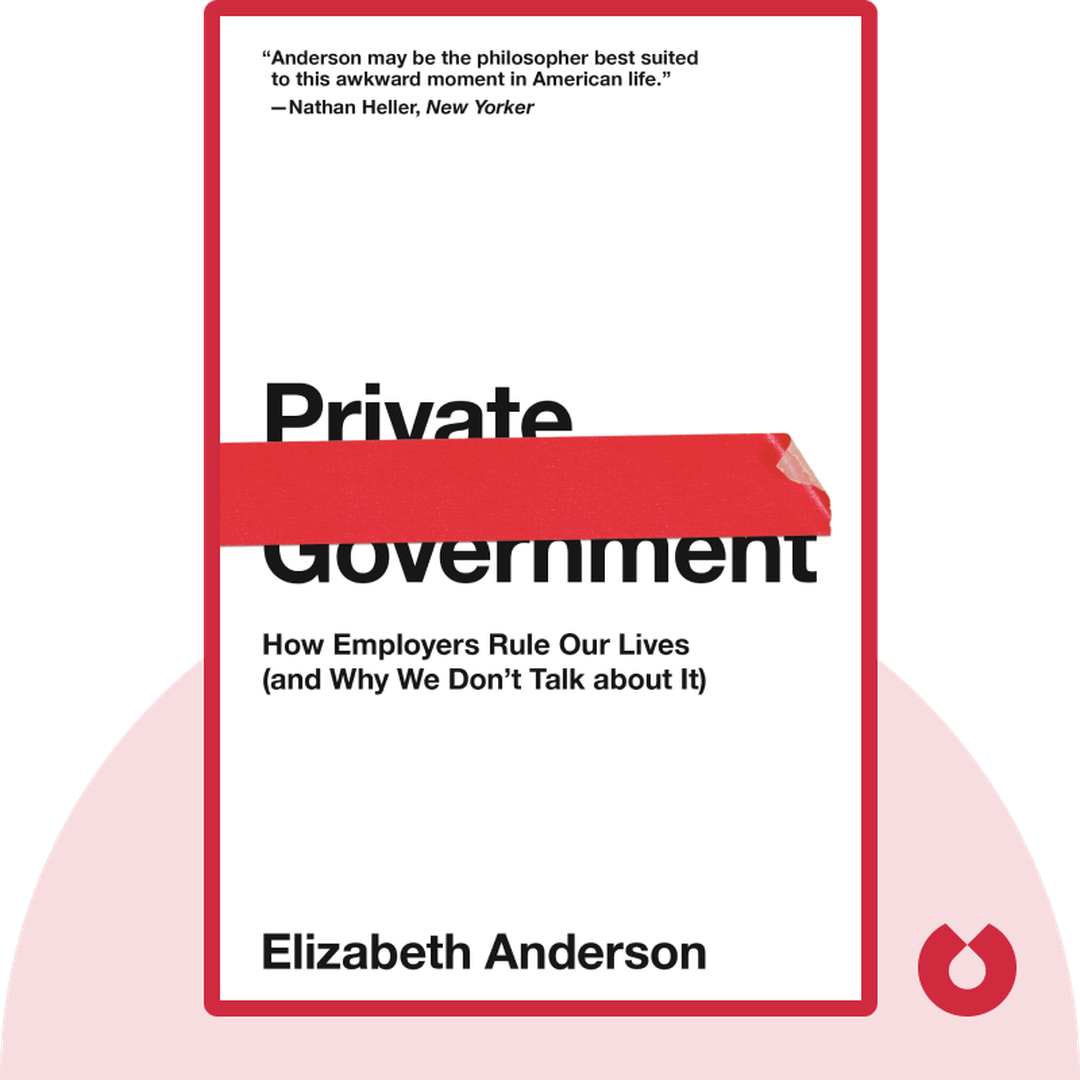
Private Government (2017) boldly asserts a provocative thesis: most modern companies are run more like communist dictatorships than the “free enterprises” their often libertarian-minded owners, managers, and defenders believe them to be. Drawing on a wide range of ideas, facts, and data from economics, political philosophy, and history, Private Government backs this thesis up with a strong, compelling argument that’s well worth reckoning with.
Who Should Listen to Private Government?
- Employees unhappy with their employment
- Employers wondering why their employees might be so unhappy
- Anyone else wanting to know what’s wrong with the modern workplace
Books Similar to Private Government
Readers who enjoyed this also liked these titles.