If You're Curious About These Questions...
You should listen to this audiobook
- What's the secret to rising to the top of a male-dominated industry, despite facing numerous obstacles and challenges?
- Are you curious about how a demanding and brilliant mother can shape the life and career of a powerful media mogul?
- How does one balance personal and professional life when holding a position of immense power and responsibility, and what can we learn from Katharine Graham's experiences?
Listen to Personal History — Free Audiobook
Loading player...
Key Takeaways from Personal History
- Discover how Katharine Graham navigated a fiercely competitive, male-dominated industry to become the first female head of a major American newspaper and break the Watergate scandal.
- Understand how an overbearing mother and impossibly high childhood expectations drove Graham's early academic success and shaped her drive for social recognition.
- Learn why pushing through early career doubts and a steep learning curve at the San Francisco News helped Graham develop a taste for independence and find her footing in journalism.
- Find out how Graham strategically navigated working for her father's newspaper, the Washington Post, by intentionally choosing a behind-the-scenes editorial role to avoid accusations of nepotism.
- Explore Graham's firsthand experiences capturing history in the making, from covering local moral crusades in San Francisco to reporting on presidential press conferences at the dawn of World War II.
Learning Tools
Reinforce what you learned from Personal History
Mind Map
Personal History
Early Life & Influences+
Early Career in Journalism+
Marriage & Stepping Back+
Taking the Helm (1963)+
Transforming the Post+
The Watergate Scandal+
Business Triumphs & Legacy+
Quiz — Test Your Understanding
Question 1 of 8
How did Katharine Graham's mother's impossibly high expectations affect Katharine during her youth?
Question 2 of 8
Why did Katharine Graham almost quit her first journalism job at the San Francisco News shortly after arriving?
Question 3 of 8
When Katharine Graham joined the Washington Post in 1939, why did she choose to work behind the scenes on the editorial staff rather than as a reporter?
Question 4 of 8
What tragic event led directly to Katharine Graham taking over as the publisher of the Washington Post in 1963?
Question 5 of 8
How did the hiring of Ben Bradlee as managing editor impact Katharine Graham's position at the Washington Post?
Question 6 of 8
What realization did Katharine Graham have in 1969 after reviewing an interview she had given to Women's Wear Daily?
Question 7 of 8
What major obstacle did the Washington Post face while breaking the Watergate scandal?
Question 8 of 8
What unconventional but highly successful financial advice did Warren Buffett give Katharine Graham in the 1970s?
Personal History — Full Chapter Overview
- 1Recommendation
- 2As a young woman, Katharine Graham had a strict mother and craved nothing more than fitting in.
- 3Her first job in newspapers had a steep learning curve, yet she soon enjoyed the work.
- 4At the decade’s end, Graham joined the Washington Post and began writing editorials.
- 5Graham’s husband entered the Post in 1946 and rapidly rose to the top.
- 6In 1963, Graham assumed control at the Post and became a sure-footed leader.
- 7Jetting to formal meetings with the Japanese emperor, and taking helicopter flights over the jungles of Vietnam, were standard fare in Graham’s new role.
- 8Graham’s influence grew as she started implementing her own changes to the way the Post worked.
- 9Despite all her achievements, Graham still faced prejudice and wrestled with her own insecurities.
- 10The Post’s reporting on a dubious 1972 burglary ultimately broke the Watergate scandal wide open.
- 11Under Graham, the Post continued to thrive right up to her retirement in 1991.
Personal History Summary & Overview
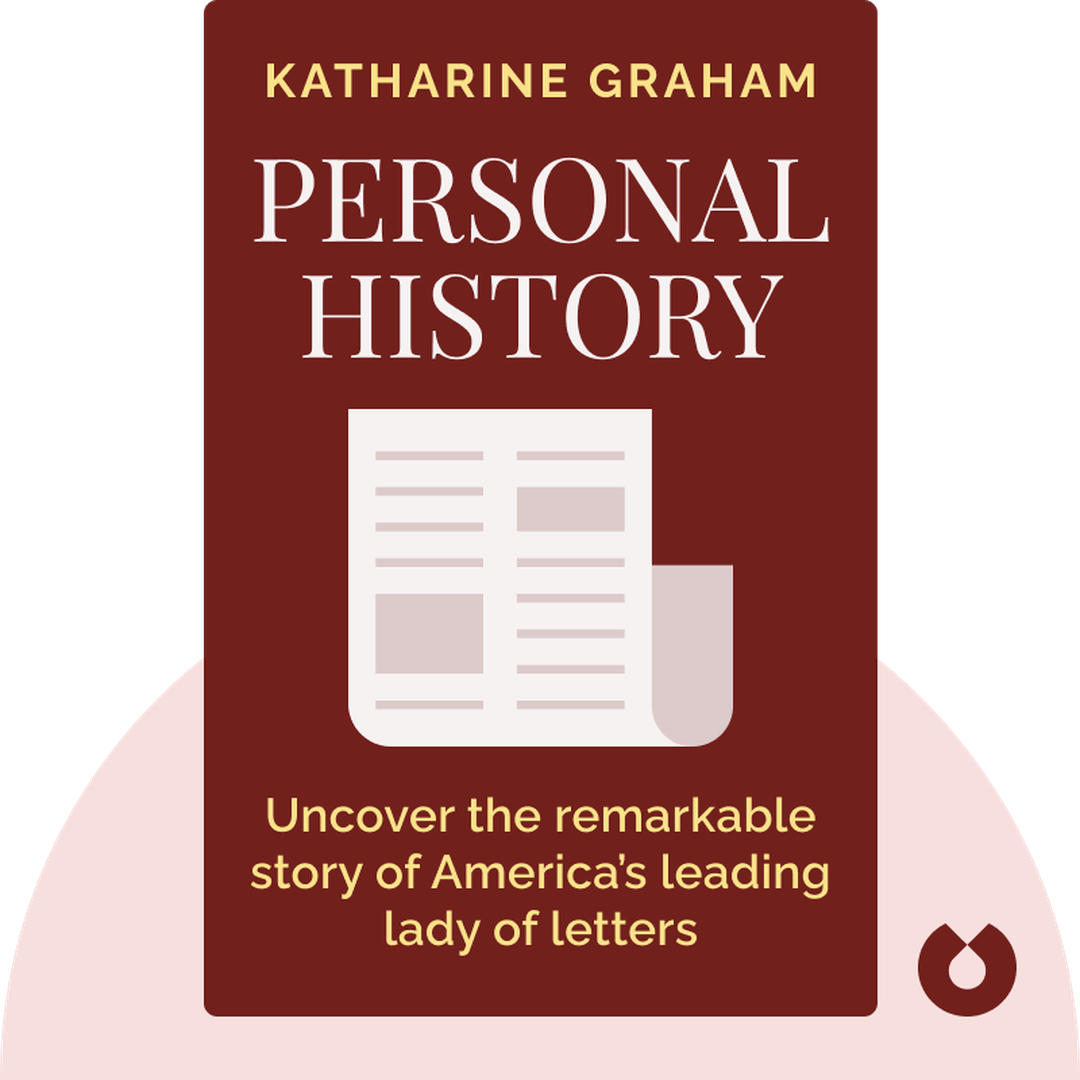
Katharine Graham’s autobiography Personal History (1997) is the illuminating inside story of one of the United States’ most powerful media moguls. Beginning with her at times difficult childhood, which was shaped by her demanding and brilliant mother, this Pulitzer Prize-winning memoir sheds light on Graham’s rise through the ranks of the journalistic profession, all the way to the top of the Washington Post’s hierarchy.
Who Should Listen to Personal History?
- History buffs
- Journalists
- Anyone who loves inspiring true stories
Books Similar to Personal History
Readers who enjoyed this also liked these titles.