If You're Curious About These Questions...
You should listen to this audiobook
- Did you know that the hierarchy of 'bad' words has completely flipped over the centuries, turning once-polite terms into our most forbidden taboos?
- Have you ever wondered why certain four-letter words have the power to trigger an actual physical response in the human brain while their synonyms do nothing at all?
- Are you curious about the secret history of how innocent language transforms into profanity, and which everyday words are currently on their way to becoming the next great taboos?
Listen to Nine Nasty Words — Free Audiobook
Loading player...
Key Takeaways from Nine Nasty Words
- Explore the curious evolution of profanity to understand how taboo words gained their cultural power and shock value over the centuries.
- Understand how 'damn' and 'hell' lost their serious religious gravity, transitioning from deeply sinful violations of the Second Commandment into mild, secular interjections.
- Learn how the 'f-word' evolved from an unremarkable part of medieval surnames into English's most versatile profanity, likely triumphing over archaic alternatives due to its punchy phonetics.
- Discover the surprising shared linguistic root between the words 'shit' and 'science,' tracing back to an ancient term meaning to slice or cut off.
- Find out how the Protestant Reformation and a rise in living standards transformed society's relationship with bodily functions, turning once-common words into shameful taboos.
Learning Tools
Reinforce what you learned from Nine Nasty Words
Mind Map
Nine Nasty Words
Religious Origins+
Bodily & Sexual Taboos+
Discriminatory Slurs+
Linguistic Evolution+
Quiz — Test Your Understanding
Question 1 of 8
Why were the words 'damn' and 'hell' considered highly provocative and sinful during the Middle Ages and Renaissance?
Question 2 of 8
Which of the following best describes the historical usage of the word 'fuck' in the Middle Ages, as evidenced by names like Simon Fuckbutter?
Question 3 of 8
What surprising linguistic connection do the words 'shit' and 'science' share?
Question 4 of 8
What historical shifts caused bodily functions, and the word 'shit,' to become highly stigmatized and taboo?
Question 5 of 8
Why is there a lack of neutral terms for reproductive organs in the English language, leaving speakers to choose between clinical, childish, or vulgar words?
Question 6 of 8
How did the N-word originally function when it was first brought into the English language in the 1500s?
Question 7 of 8
How did the f-slur, originally meaning a 'bundle of sticks,' evolve into a disparaging term for homosexual men in the United States?
Question 8 of 8
What does the evolution of the word 'bitch' best demonstrate about the nature of profanity?
Nine Nasty Words — Full Chapter Overview
- 1Recommendation
- 2Damn and hell shifted from sin to secular speech.
- 3The origins of 'fuck' as profanity remain cloaked in mystery.
- 4Taboos around shit closely mirror our society’s relationship with shame.
- 5Our anatomical terms are playful, prurient, or plainly prejudiced.
- 6The N-word occupies a particularly complex place in American culture.
- 7The f-word took a long, winding path to truly become the f-slur.
- 8The word bitch reveals the myriad ways profane words can evolve over time.
Nine Nasty Words Summary & Overview
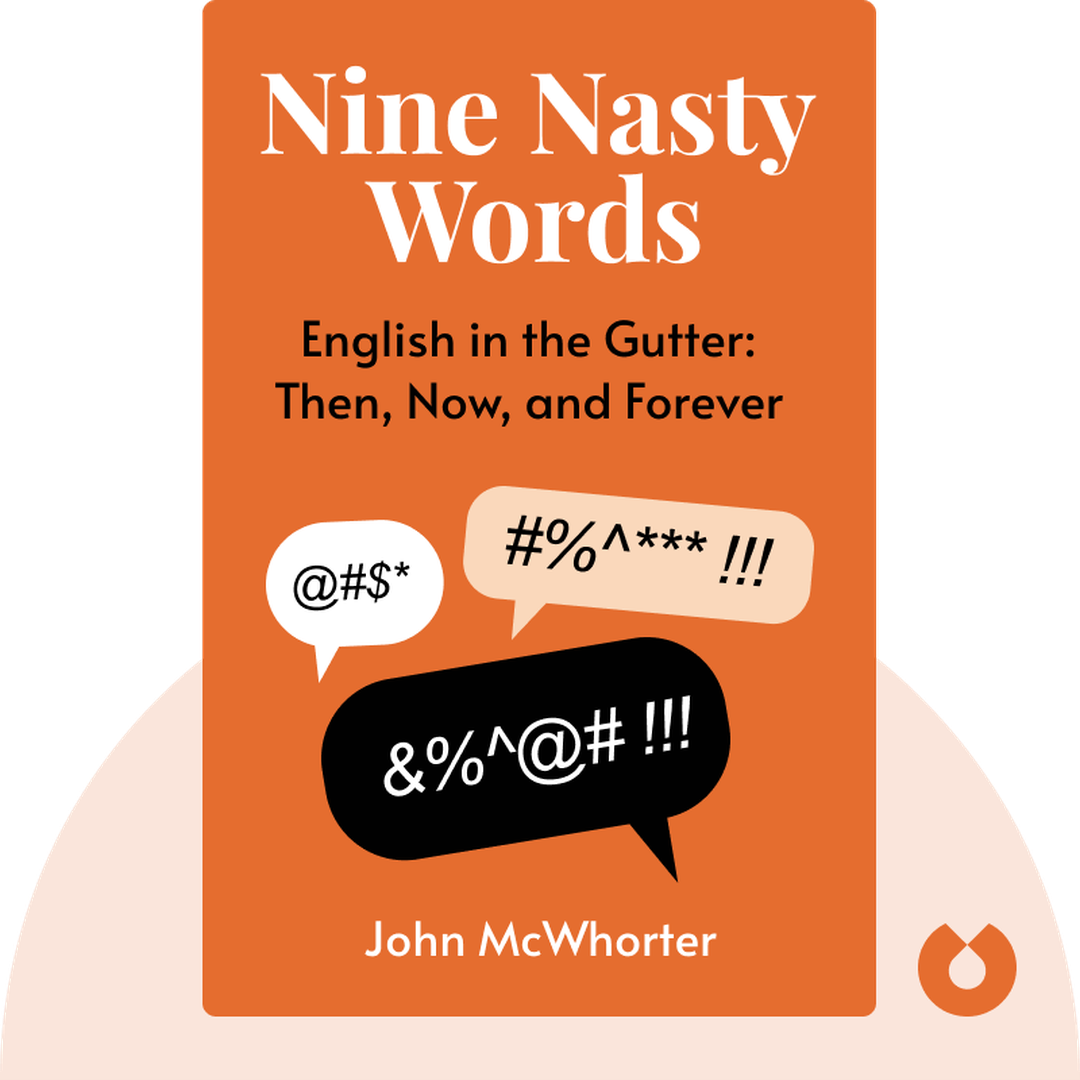
Nine Nasty Words (2021) is a foul-mouthed exploration of our linguistic taboos. This title picks apart exactly why some words come to be profane.
Who Should Listen to Nine Nasty Words?
- Language-lovers aiming to deepen their appreciation of words
- Salty talkers looking to pick up new profanity
- Anyone curious about the origin of taboos
Books Similar to Nine Nasty Words
Readers who enjoyed this also liked these titles.