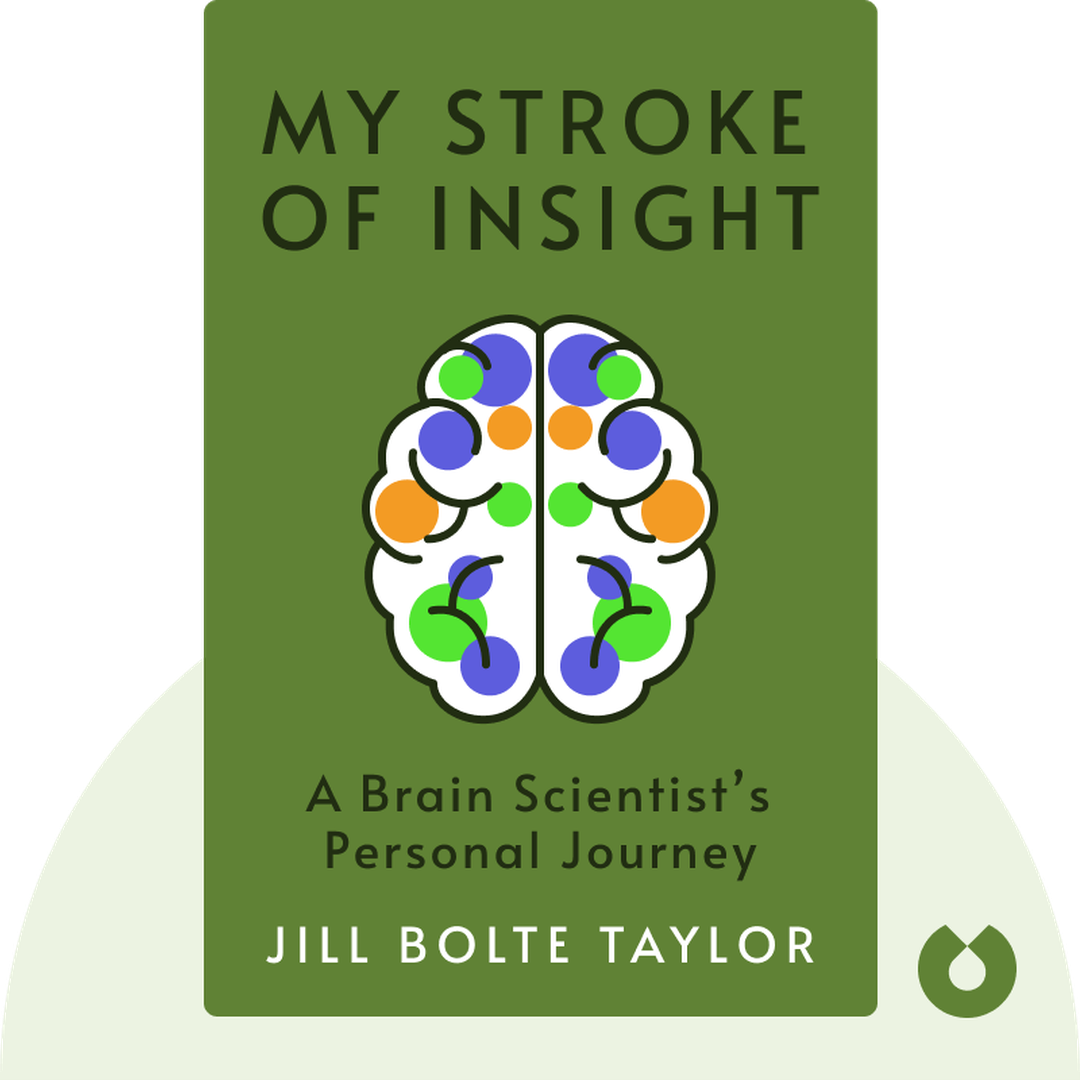
If You're Curious About These Questions...
You should listen to this audiobook
- What if you could witness your own brain shutting down from the perspective of a trained neuroscientist?
- Did you know that silencing the "logical" side of your brain could unlock an unexpected state of deep inner peace and euphoria?
- Are you curious about how the human brain can completely rewire itself to relearn everything from basic colors to the concept of identity?
Listen to My Stroke of Insight — Cinematic Audio Edition
Loading player...
Key Takeaways from My Stroke of Insight
- Discover how a personal connection to schizophrenia inspired the author to become a neuroanatomist and study the differing realities of the human brain.
- Understand the critical differences between ischemic and hemorrhagic strokes, including how a malformed capillary bed caused the author's own life-threatening hemorrhage.
- Explore the sensory-driven nature of the brain's right hemisphere, which anchors you in the present moment, processes nonverbal cues, and governs creative intuition.
- Learn how the brain's left hemisphere organizes fluid experiences into linear time, language, and logical sequences, working in tandem with the right brain to shape your reality.
- Find out what it actually feels like to suffer a brain hemorrhage, as the author details her firsthand experience of rapid cognitive decline coupled with an unexpected state of mental bliss.
Learning Tools
Reinforce what you learned from My Stroke of Insight
Mind Map
My Stroke of Insight
Author's Background+
Brain Hemispheres+
Stroke Science+
The Stroke Experience+
Recovery Process+
Key Epiphanies+
Quiz — Test Your Understanding
Question 1 of 7
What initially inspired Jill Bolte Taylor to pursue a career as a neuroanatomist?
Question 2 of 7
According to the text, what is the fundamental difference between an ischemic stroke and a hemorrhagic stroke?
Question 3 of 7
Based on the author's neuroanatomical insights, how do the left and right hemispheres of the brain differ in processing information?
Question 4 of 7
During the morning of her stroke, how did Bolte Taylor experience the gradual loss of her cognitive functions?
Question 5 of 7
What underlying physical condition caused Bolte Taylor's hemorrhagic stroke?
Question 6 of 7
What common medical notion did Bolte Taylor reject during her recovery process?
Question 7 of 7
What was a primary motivation that drove Bolte Taylor to endure the difficult process of recovery?
My Stroke of Insight — Full Chapter Overview
- 1Recommendation
- 2The author became a neuroanatomist to better understand her schizophrenic brother.
- 3There are two types of stroke – ischemic and hemorrhagic – and Bolte Taylor suffered the latter.
- 4The brain’s two hemispheres differ, but they work together.
- 5On the morning of her stroke, the author felt disconnected, briefly aware and blissful.
- 6The days after the stroke were difficult, but Bolte Taylor’s physical abilities soon began to improve.
- 7Bolte Taylor went home and gradually recovered both mentally and physically.
- 8The author realized she needed others to believe in her, and wanted to help people experience nirvana.
- 9Final summary
My Stroke of Insight Summary & Overview
My Stroke of Insight (2008) is about Jill Bolte Taylor, a neuroscientist who suffered a stroke in her mid-thirties. These blinks detail her personal story from medical school to experiencing a stroke to learning how to walk, talk and even identify colors again.
Who Should Listen to My Stroke of Insight?
- Medical students
- Friends and relatives of individuals with mental illnesses or brain traumas
- Anyone interested in learning more about the human brain
Books Similar to My Stroke of Insight
Readers who enjoyed this also liked these titles.