If You're Curious About These Questions...
You should listen to this audiobook
- How did Cambridge Analytica weaponize psychological models like the 'Big Five' personality traits to not only predict voting behavior but also manipulate voters into supporting extreme political candidates?
- What role did individuals exhibiting 'dark triad' personality traits play in Cambridge Analytica's strategy, and how were fabricated Facebook groups used to radicalize them into a cohesive political movement?
- In what ways did data firms exploit cognitive vulnerabilities, such as the 'affect heuristic' and 'identity motivated reasoning,' to bypass factual debate and stoke voter outrage during major campaigns like Brexit?
Listen to Mindf*ck — Free Audiobook
Loading player...
Key Takeaways from Mindf*ck
- Cambridge Analytica weaponized psychometric data to move political discourse away from public debate and into a system of individual psychological manipulation.
- The firm shifted voter targeting from broad demographic blocks to specific personality traits—Openness, Conscientiousness, Extraversion, Agreeableness, and Neuroticism—to predict political leanings.
- Modern political messaging often bypasses traditional media to deliver tailor-made, microtargeted advertisements that can appear to come from trusted friends rather than political entities.
- The 'crooked Hillary' narrative and other viral political attacks were not organic but were calculated products of data-driven disinformation campaigns.
- Cambridge Analytica's operations were global, utilizing data consultants to conduct disinformation campaigns and influence elections in Africa, the Caribbean, and the United Kingdom.
Learning Tools
Reinforce what you learned from Mindf*ck
Mind Map
Mindf*ck
Evolution of Political Campaigning+
SCL Group & Psychological Warfare+
The Birth of Cambridge Analytica+
Weaponizing Data in the US+
Hacking the Brexit Vote+
Whistleblowing & Aftermath+
Quiz — Test Your Understanding
Question 1 of 8
According to the text, what was the major flaw in traditional voter data analysis that Cambridge Analytica sought to overcome?
Question 2 of 8
How did Cambridge Analytica map the 'Big Five' personality traits onto American political discourse?
Question 3 of 8
What was the primary strategy of the SCL Group (Cambridge Analytica's parent company) when dealing with global threats or political targets?
Question 4 of 8
What did the SCL Group learn from their proof-of-concept experiment involving Virginia gubernatorial candidate Ken Cuccinelli?
Question 5 of 8
How did Cambridge Analytica initially gather the massive amount of psychometric data needed for its American operations?
Question 6 of 8
Which specific psychological profile did Cambridge Analytica target to help cultivate the alt-right movement?
Question 7 of 8
How did the Vote Leave campaign bypass strict British spending limits during the Brexit referendum?
Question 8 of 8
Why did the Leave campaign's messaging focus heavily on stoking anger and indignation among voters?
Mindf*ck — Full Chapter Overview
- 1Recommendation
- 2New data technologies and social media are transforming how political campaigns share their messages.
- 3Political campaigns can predict voting behavior by gathering people’s psychometric data.
- 4The SCL Group was a psychological warfare firm specializing in collecting and weaponizing data.
- 5The SCL Group used data collection and psychological warfare tactics to manipulate targets worldwide.
- 6Steve Bannon wanted to partner with SCL to win America’s culture war.
- 7The newly formed Cambridge Analytica used census data, data brokers, and Facebook to collect the data it needed.
- 8Cambridge Analytica and its close Russian partners used Facebook to target vulnerable groups.
- 9Cambridge Analytica funded two arms of the Leave campaign – one legally, one illegally.
- 10AIQ, SCL, and Cambridge Analytica exploited cognitive biases to win elections.
- 11The author left Cambridge Analytica and blew the whistle, exposing the largest data crime in history.
- 12Final summary
Mindf*ck Summary & Overview
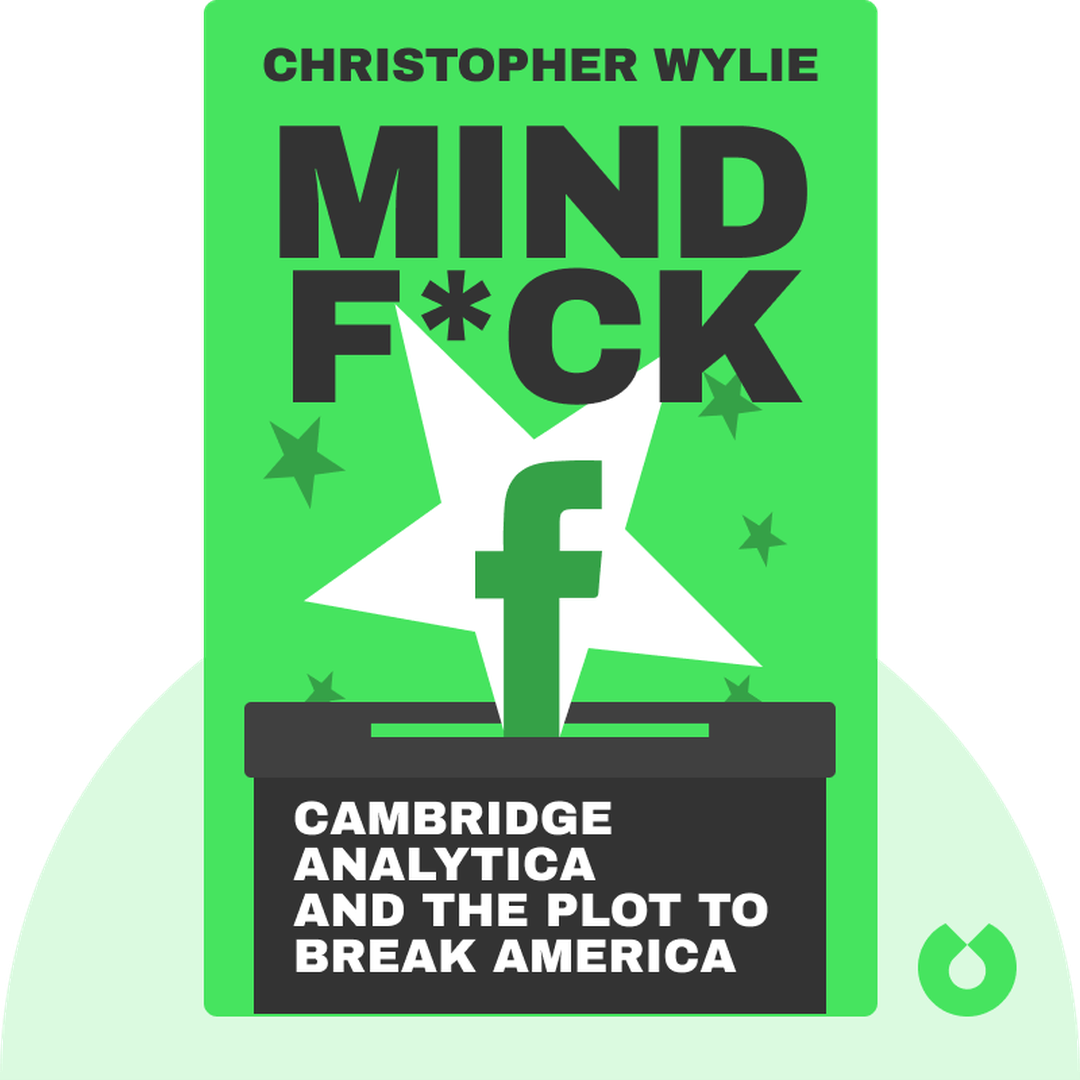
Mindf*ck (2019), written by a whistleblower, tells the story of the largest data crime in history to date. On the eve of the 2016 United States presidential election, consulting firm Cambridge Analytica harvested the Facebook data from 87 million people and used it to conduct a mass disinformation campaign. Now, the full story has finally come to light.
Who Should Listen to Mindf*ck?
- Americans who want to understand Cambridge Analytica’s role in the Trump election
- Left- and right-wingers feeling increasingly resentful of the other side
- Brits interested in why the Brexit referendum turned out the way it did
Books Similar to Mindf*ck
Readers who enjoyed this also liked these titles.