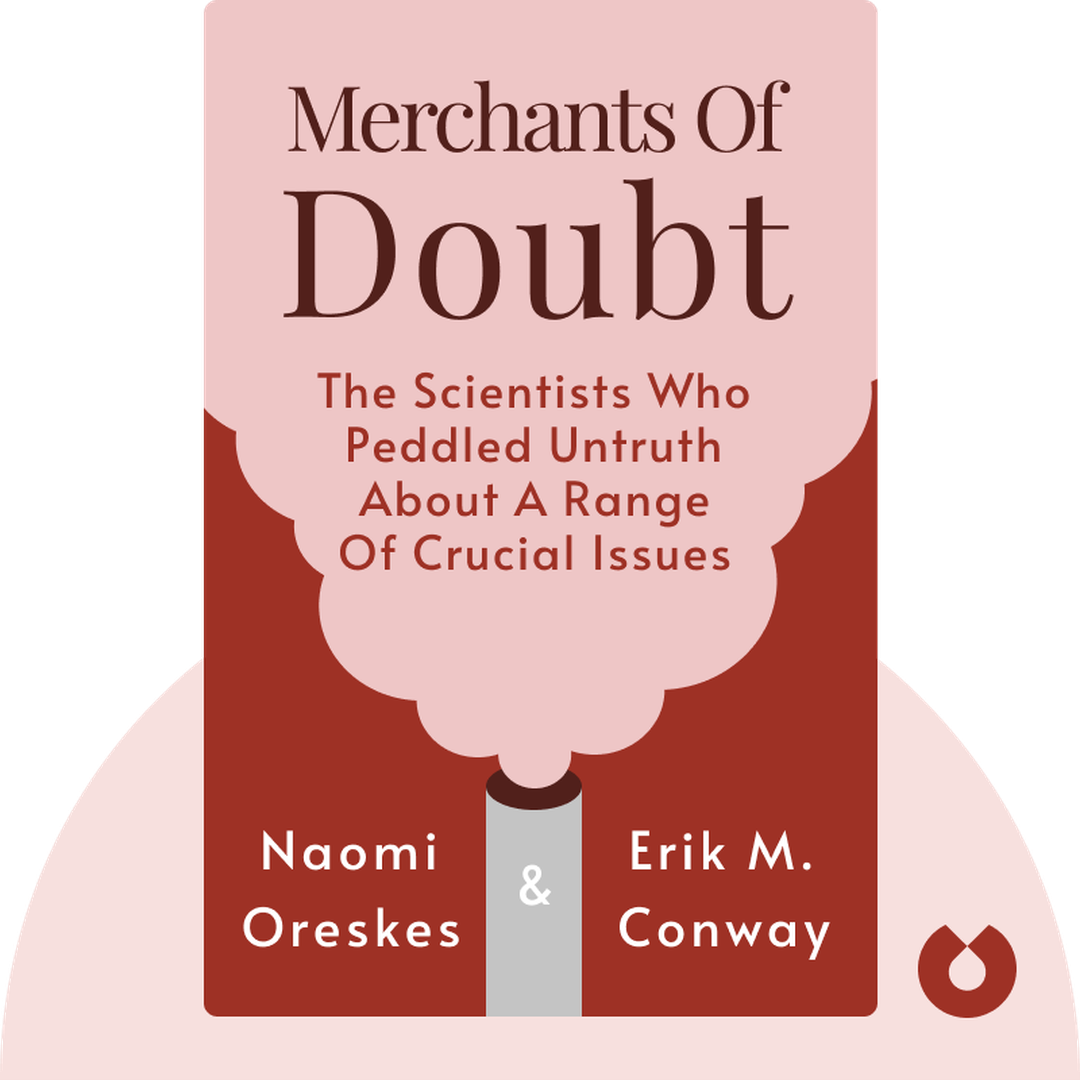
If You're Curious About These Questions...
You should listen to this audiobook
- Did you know that the same elite scientists who defended the tobacco industry also pioneered the tactics used to stall action on climate change today?
- Have you ever wondered how a handful of vocal individuals can convince the public that a scientific consensus is actually a heated debate?
- Are you curious about the secret playbook that powerful corporations use to manipulate the media and undermine public health for decades?
Listen to Merchants of Doubt — Free Audiobook
Loading player...
Key Takeaways from Merchants of Doubt
- Discover how major industries deliberately used public relations firms and funded biased research to cast doubt on established scientific facts.
- Learn how corporate interests escalated their tactics by attacking the scientific method itself, dismissing peer-reviewed data as 'junk science' to hide the dangers of secondhand smoke.
- Understand how fringe groups exploited media policies like the Fairness Doctrine to give their propaganda equal airtime and artificially prolong scientific debates.
- Find out how powerful organizations recruited previously respected scientists to act as credible mouthpieces for dangerous misinformation campaigns.
- Uncover how political agendas drove the US government and conservative institutions to actively undermine valid science regarding nuclear weapons and acid rain.
Learning Tools
Reinforce what you learned from Merchants of Doubt
Mind Map
Merchants of Doubt
The Playbook of Doubt+
Tobacco & Health Risks+
Nuclear Weapons & SDI+
Acid Rain & Emissions+
Ozone Layer Depletion+
Global Warming Denial+
DDT & Anti-Regulation+
Quiz — Test Your Understanding
Question 1 of 7
What was the primary strategy used by the tobacco industry in the mid-twentieth century to combat emerging scientific evidence that smoking was harmful?
Question 2 of 7
How did the tobacco industry and its allied scientists attempt to discredit the EPA's 1992 report on the dangers of secondhand smoke?
Question 3 of 7
How did a small group of conservative scientists at the George C. Marshall Institute keep the scientific debate alive regarding the Strategic Defense Initiative (SDI) despite widespread opposition?
Question 4 of 7
Why did the US government heavily edit the scientific review on acid rain chaired by William A. Nierenberg in the 1980s?
Question 5 of 7
When scientific evidence linked chlorofluorocarbons (CFCs) to the depletion of the ozone layer, what alternative cause did the aerosol industry propose to defend their products?
Question 6 of 7
In the 1980 Carbon Dioxide Assessment Committee report on global warming, how did economists influence the government's response to the issue?
Question 7 of 7
What was the underlying political motive behind the media's vilification of Rachel Carson and the DDT ban in the early 2000s?
Merchants of Doubt — Full Chapter Overview
- 1Recommendation
- 2The tobacco industry deliberately misled the public about the dangers of smoking.
- 3The tobacco industry kept casting doubt on secondhand smoke and science itself.
- 4The scientific debate over nuclear weapons was deliberately drawn out.
- 5The US government downplayed scientific findings on acid rain in the 1970s.
- 6The ozone layer hole remained under debate into the 1990s.
- 7The science behind global warming struggled for acceptance in the 1980s.
- 8In the early 2000s, a long-dormant pesticide debate was revived as an attack on environmental regulation.
- 9Final summary
Merchants of Doubt Summary & Overview
Merchants of Doubt (2011) examines some of the world’s major scientific debates on topics including the environment, smoking and nuclear weapons. These blinks will explain how a handful of extremely vocal scientists have heavily misrepresented these issues through the mainstream media, often with the goal of aiding corporate and industry interests.
Who Should Listen to Merchants of Doubt?
- Anyone interested in politics, the media and public opinion
- Journalists, activists and anyone with a social conscience
Books Similar to Merchants of Doubt
Readers who enjoyed this also liked these titles.