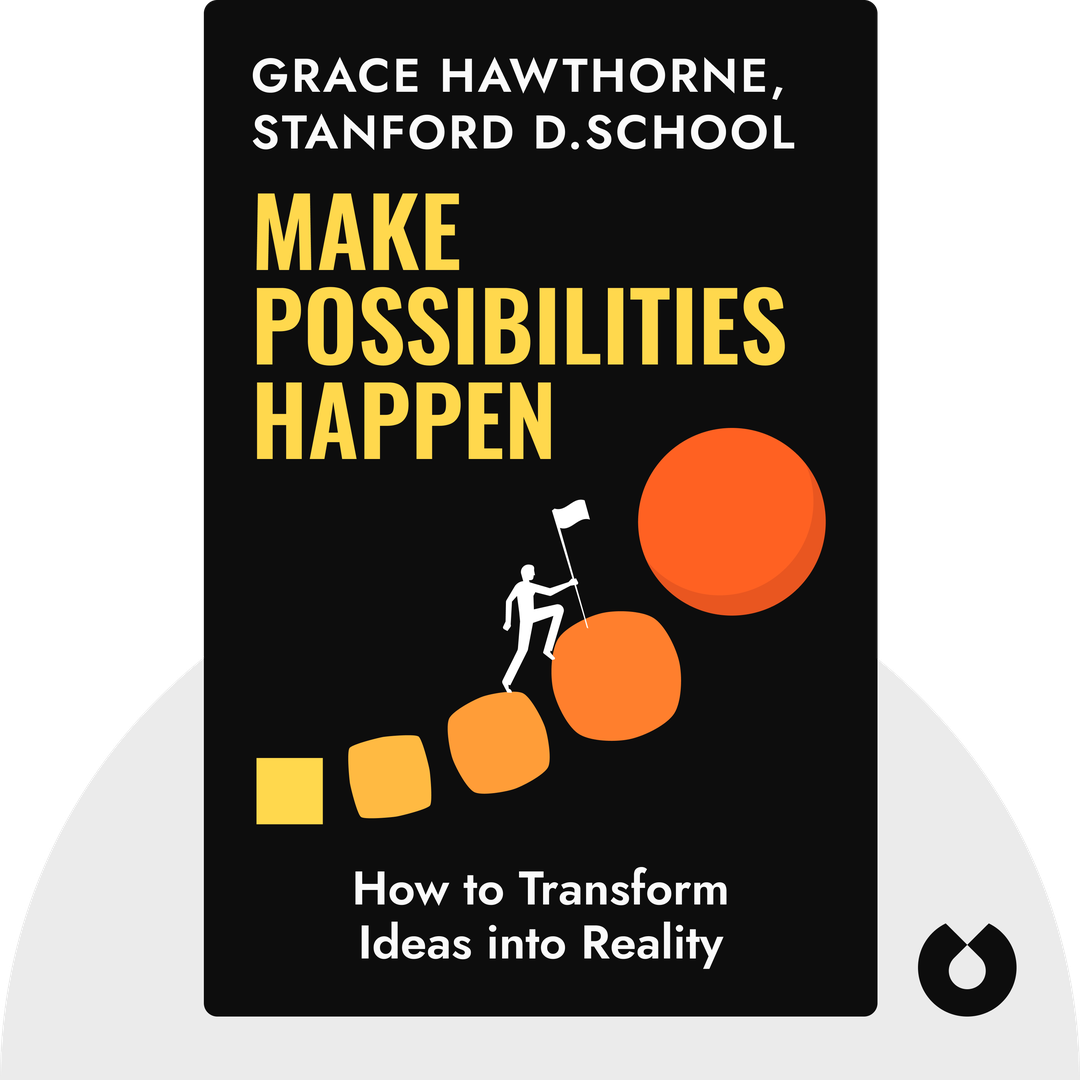
Make Possibilities Happen
Start ListeningDownload Try free on iPhoneScan to start in 5 seconds
Categories:
If You're Curious About These Questions...
You should listen to this audiobook
- Have you ever wondered why some people effortlessly turn their wildest ideas into reality while others struggle to even get started?
- What if you could master the specific mental shifts needed to transform your most ambitious dreams into actionable plans?
- Are you curious about the secret framework used at Stanford's d.school to help you push through obstacles and finally finish what you start?
Listen to Make Possibilities Happen — Free Audiobook
Loading player...
Key Takeaways from Make Possibilities Happen
- Learn how to override your brain's primal risk-aversion and ingrained biases by consistently visualizing your goals to unlock unseen possibilities.
- Understand why pursuing a grand vision rather than rigid expectations will help you avoid frustration and stay open to emerging opportunities.
- Discover how to accelerate your progress by taking immediate action instead of waiting for perfect conditions, using the power of acting 'as-if'.
- Master the ability to short-circuit anxiety-induced paralysis by intentionally redirecting your thoughts away from unproductive worry and leaning into the unknown.
- Find out why ideas alone hold little value, and learn how to actually transform your concepts into reality through steady, compounding incremental steps.
Learning Tools
Reinforce what you learned from Make Possibilities Happen
Mind Map
Make Possibilities Happen
Expanding Perspective+
Starting Right+
Execution & Actualization+
The Art of Finishing+
Quiz — Test Your Understanding
Question 1 of 6
According to the book, why does human innovation often stagnate?
Question 2 of 6
When visualizing a goal, why does the author recommend working toward a 'vision' rather than 'expectations'?
Question 3 of 6
How should you approach a project if you feel your next step hinges on a constraint, such as waiting to finish a degree?
Question 4 of 6
Applying the economic theory of supply and demand to creativity, how does the author categorize 'ideas' versus 'execution'?
Question 5 of 6
What is the author's recommended approach to dealing with failure and friction during a project?
Question 6 of 6
When nearing the end of a project, how does the author suggest combating perfectionism?
Make Possibilities Happen — Full Chapter Overview
- 1Recommendation
- 2You can’t achieve what you can’t envision
- 3How you finish depends on where you begin
- 4Actualize, actualize, actualize!
- 5The art of finishing well
- 6Final summary
Make Possibilities Happen Summary & Overview
Make Possibilities Happen (2023) is filled with practical strategies to turn your dreams into realities through hard work, vision, and perseverance. Through approachable storytelling and actionable advice, it empowers you to take control of your life and pursue your biggest goals and ambitions.
Who Should Listen to Make Possibilities Happen?
- Dreamers who want practical advice on getting their ideas off the ground
- Do-ers who leap into new projects but struggle to finish them
- Anyone who wants to reach their full creative potential
Books Similar to Make Possibilities Happen
Readers who enjoyed this also liked these titles.