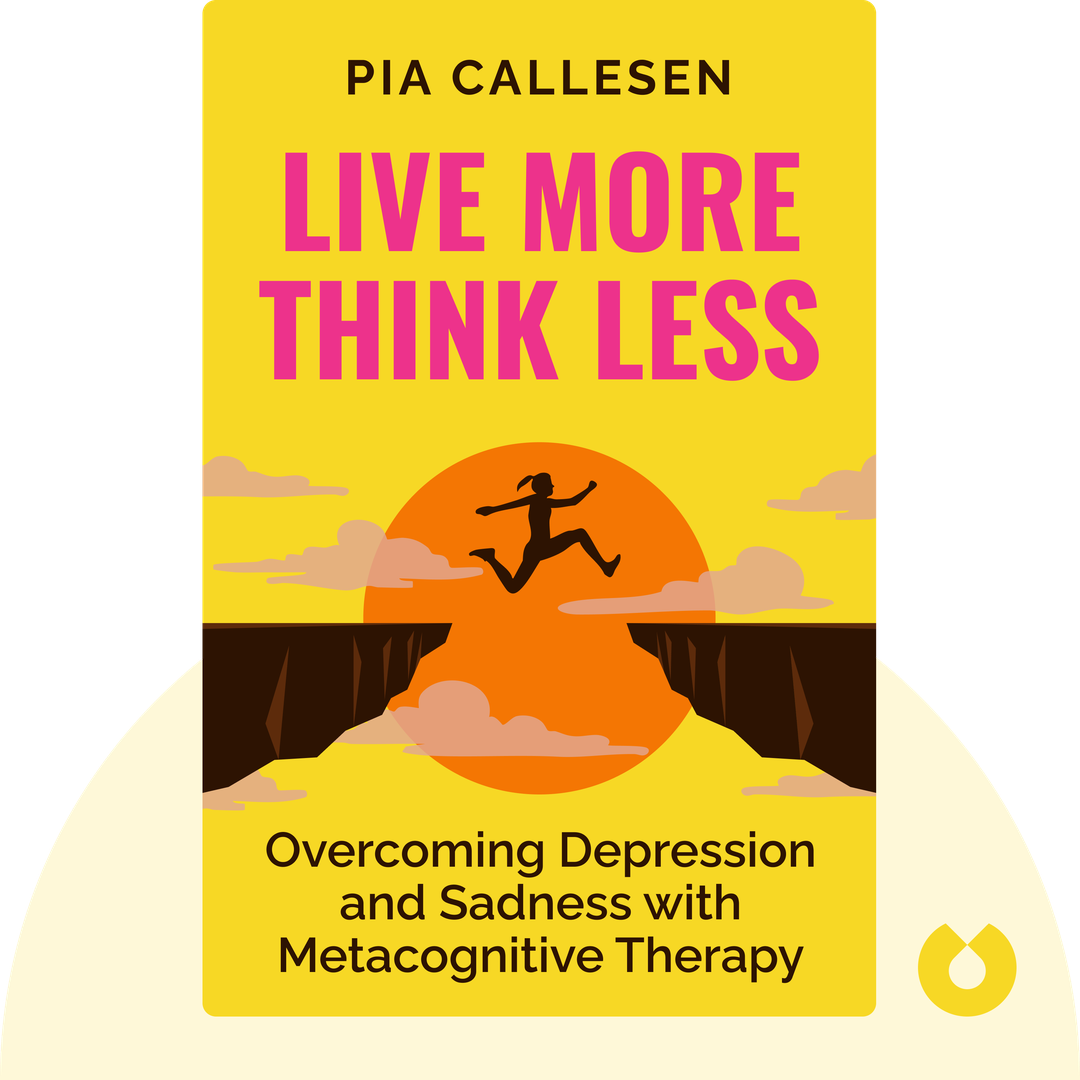
If You're Curious About These Questions...
You should listen to this audiobook
- Have you ever wondered why "thinking it through" often leaves you feeling more stuck and depressed than when you started?
- What if the key to mental health isn't about changing the content of your thoughts, but simply changing how much time you spend on them?
- Are you curious about the research-backed technique that allows you to treat intrusive thoughts like background noise rather than problems to be solved?
Listen to Live More Think Less — Cinematic Audio Edition
Loading player...
Key Takeaways from Live More Think Less
- Understand why depression isn't simply a chemical imbalance, but rather a result of specific, controllable mental habits and your relationship with thinking.
- Discover how your mind operates on three distinct levels and why your metacognitive beliefs—what you believe about thinking itself—form the hidden scaffolding of depression.
- Identify the 'four horsemen' of depression, including rumination and excessive mood monitoring, to break free from the destructive loop of the Cognitive Attentional Syndrome.
- Learn practical techniques to control your overthinking, such as restricting your worry and rumination to a designated one-hour window each day.
- Master the five essential steps of Metacognitive Therapy to abandon the false belief that over-analyzing solves problems and successfully re-engage with life.
Learning Tools
Reinforce what you learned from Live More Think Less
Mind Map
Live More Think Less
Core Premise+
The S-REF Model+
The 4 Flawed Strategies+
Flawed Metacognitive Beliefs+
Handling Trigger Thoughts+
Anti-Rumination Techniques+
The 5 Steps to Recovery+
Quiz — Test Your Understanding
Question 1 of 7
According to Metacognitive Therapy (MCT), what is the primary cause of depression?
Question 2 of 7
In the Self-Regulatory Executive Function model, what does the uppermost 'metacognitive level' consist of?
Question 3 of 7
Which of the following is NOT one of the 'four horsemen' of depression (flawed mental strategies) mentioned in the text?
Question 4 of 7
What does the flawed strategy of 'monitoring behavior' refer to?
Question 5 of 7
How did Steve successfully handle his constant rumination about his adult son's requests for money?
Question 6 of 7
What is the primary purpose of the 'attention training' exercise involving listening to multiple external sounds?
Question 7 of 7
What did the artist in therapy discover when he challenged the belief that extensive daily rumination was necessary for his creativity?
Live More Think Less — Full Chapter Overview
- 1Recommendation
- 2The structure of depressive thinking
- 3The four drivers of depression
- 4The beliefs underneath it all
- 5Triggering thoughts
- 6An anti-rumination training ground
- 7You are not your thoughts
- 8Final summary
Live More Think Less Summary & Overview
Live More Think Less (2021) explores metacognitive therapy, an innovative approach to combating depression by changing your relationship with your thoughts. It offers practical methods, backed by research, to help you stop the cycle of rumination and overthinking that often leads to sadness and helplessness.
Who Should Listen to Live More Think Less?
- People struggling with recurring depression looking for insight
- Overthinkers who find themselves stuck in mental loops
- Anyone interested in practical, evidence-based techniques to improve mental health
Books Similar to Live More Think Less
Readers who enjoyed this also liked these titles.