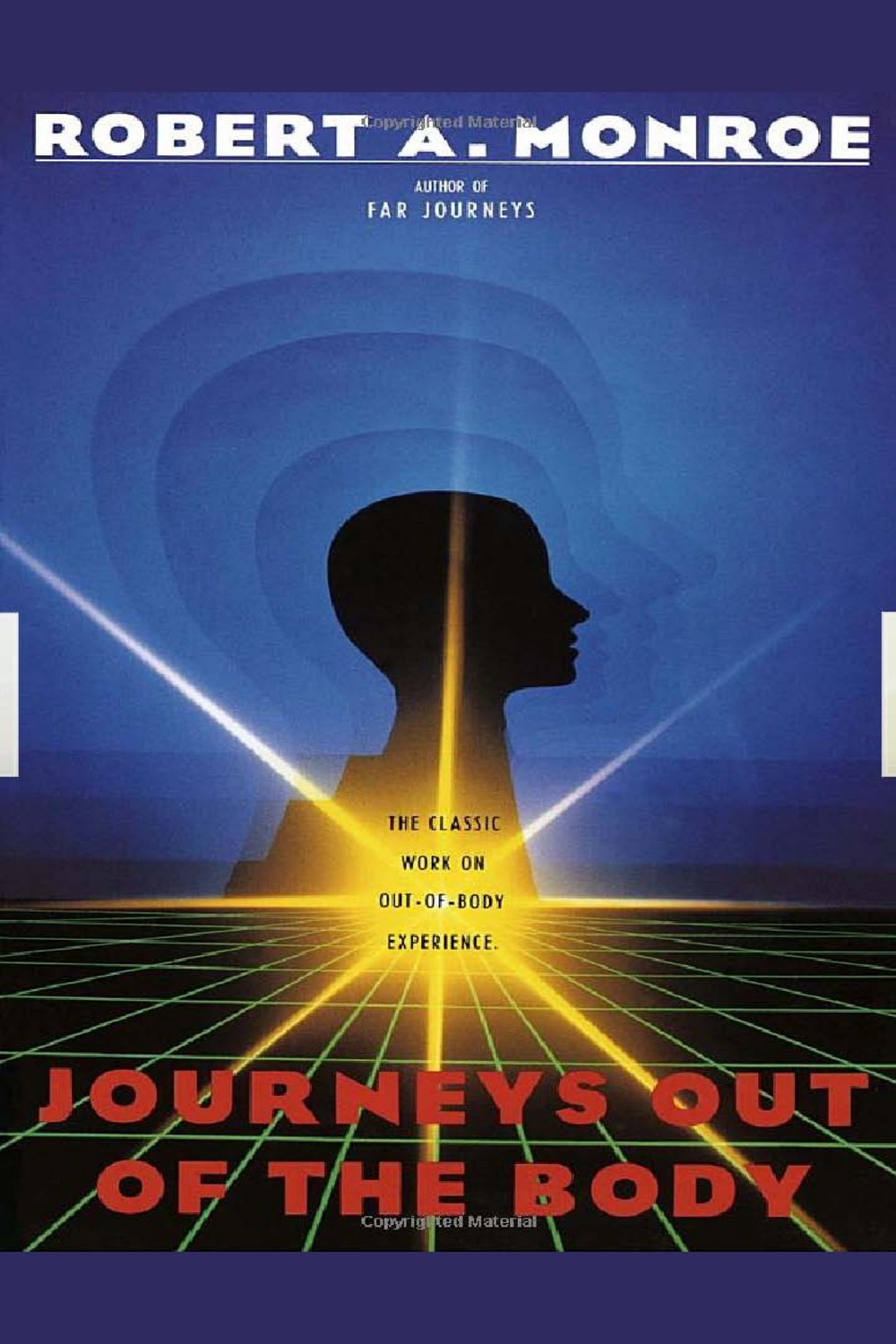
Journeys Out of the Body audiobook cover - A conventional businessman begins floating above his sleeping body, then spends twelve years testing whether consciousness can travel beyond it—producing a provocative record that challenges familiar assumptions about dreams, death, identity, and the boundaries of scientific inquiry.
Theme Song

Journeys Out of the Body

A conventional businessman begins floating above his sleeping body, then spends twelve years testing whether consciousness can travel beyond it—producing a provocative record that challenges familiar assumptions about dreams, death, identity, and the boundaries of scientific inquiry.

Robert A. Monroe

★ 4.2 / 5(5,263 ratings on Goodreads)

Listen to Journeys Out of the Body — Cinematic Audio Edition

Loading player...
Categories:

If You're Curious About These Questions...

You should listen to this audiobook

Key Takeaways from Journeys Out of the Body

Learning Tools

Reinforce what you learned from Journeys Out of the Body

Mind Map

Journeys Out Of The Body
Origins and Significance+
From Fear to Investigation+
Verification and Experiment+
Three Locales of Experience+
Death, Religion, and Other Beings+
Training at the Edge of Sleep+
Evidence, Hypotheses, and Legacy+

Quiz — Test Your Understanding

Question 1 of 13
What change in approach allowed Monroe to begin investigating the frightening vibrations?
  • A. He interpreted them according to conventional religion
  • B. He learned to remain calm and observe them instead of fleeing
  • C. He stopped all sleep-related experiments permanently
  • D. He attempted to suppress them with physical exercise
Question 2 of 13
What two evidential standards guided Monroe's documentation of his experiences?
  • A. Religious agreement and emotional comfort
  • B. Physiological measurement and approval from physicians
  • C. Subjective intensity is not proof, while unexpected verifiable details deserve attention
  • D. Repeated visions are reliable only when they match occult traditions
Question 3 of 13
Why did Monroe regard his apparent visit to Foster Bradshaw as significant?
  • A. Bradshaw consciously saw Monroe and spoke with him
  • B. Monroe accurately described the bedroom where Bradshaw was resting
  • C. The observed scene contradicted Monroe's expectation but broadly matched later reports
  • D. The visit was reproduced successfully under laboratory conditions
Question 4 of 13
What did the motel observations demonstrate about Monroe's claimed distant perception?
  • A. It always reproduced distant scenes with photographic precision
  • B. It could include correct details that the mind translated into misleading familiar symbols
  • C. It worked only when Monroe knew the destination in advance
  • D. It was reliable only when observing machines rather than people
Question 5 of 13
Why does the alleged pinch of R.W. not constitute universally binding proof in the book's analysis?
  • A. R.W. denied feeling anything unusual
  • B. Monroe already knew the exact location and arrangement of the cottage
  • C. The marks appeared several years after the reported incident
  • D. It remained an uncontrolled personal report rather than a repeatable laboratory demonstration
Question 6 of 13
According to Monroe's three-locale framework, what primarily governs movement and destination in Locale II?
  • A. Geographic coordinates and physical landmarks
  • B. Historical period and technological development
  • C. Intention and emotional affinity
  • D. Instructions issued by laboratory observers
Question 7 of 13
How should Monroe's three locales ultimately be understood?
  • A. As scientifically proven dimensions with fixed boundaries
  • B. As working categories that organize experiences without explaining their objective nature
  • C. As three stages of ordinary dreaming
  • D. As exact equivalents of hell, Earth, and heaven
Question 8 of 13
What caused Monroe to reconsider the young man he encountered while searching for the deceased Richard Gordon?
  • A. Gordon's family reported seeing the same institution in a dream
  • B. The young man gave Monroe a private medical diagnosis
  • C. A voice said Monroe had already met Gordon, and a later photograph resembled the young figure
  • D. Laboratory instruments identified the young man as Gordon
Question 9 of 13
What methodological lesson does Monroe draw from experiences involving radiant presences and frightening creatures?
  • A. Familiar religious labels should be accepted immediately
  • B. Emotional intensity establishes the independent existence of an entity
  • C. Observed experiences must be distinguished from conclusions about what caused them
  • D. Frightening experiences are always fragments of the traveler's personality
Question 10 of 13
What response did Monroe find more effective than fighting troublesome beings?
  • A. Increasing fear to repel them
  • B. Repeating religious formulas more loudly
  • C. Stillness, reduced emotion, and deliberate withdrawal
  • D. Attempting to communicate through physical speech
Question 11 of 13
What foundation does Monroe recommend for attempting separation from the physical body?
  • A. Deep relaxation while maintaining alert awareness near the edge of sleep
  • B. Complete unconsciousness followed by sudden awakening
  • C. Intense physical movement combined with rapid breathing
  • D. Concentration on several destinations at once
Question 12 of 13
What is Monroe's recommended emergency method for returning to ordinary physical awareness?
  • A. Visualize Locale I as a detailed map
  • B. Think strongly of the body and attempt a definite physical action
  • C. Call mentally for one of the unpredictable helpers
  • D. Intensify the vibrations until they become rough shaking
Question 13 of 13
What can the laboratory findings discussed in the book reasonably establish?
  • A. That consciousness definitely travels independently of the body
  • B. That all out-of-body experiences are ordinary dreams
  • C. That Monroe entered an unusual altered state, but not that consciousness literally traveled
  • D. That Monroe's proposed Second Body is electromagnetic

Journeys Out of the Body — Full Chapter Overview

Journeys Out of the Body Summary & Overview

Journeys Out of the Body recounts Robert A. Monroe’s attempt to investigate the startling experiences that began disrupting his otherwise conventional life in 1958. After unexplained vibrations swept through his body, he found himself apparently floating above his bed and looking down at his physical form. Rather than immediately treating the episodes as spiritual revelation, Monroe consulted physicians, psychologists, and psychiatrists, then began keeping systematic records.

The book combines personal memoir, experimental notes, speculative theory, and practical exercises. Monroe describes visits to recognizable physical locations, unfamiliar nonphysical environments, and a seemingly parallel world. He also examines apparent encounters with deceased people, unusual beings, and what he interpreted as helpers. Laboratory sessions produced intriguing physiological observations and a few suggestive correspondences, but not definitive scientific proof. The result is best approached as a detailed case study in altered consciousness: candid, imaginative, methodical in aspiration, and careful enough to distinguish reported experience from established fact.

Who Should Listen to Journeys Out of the Body?

  • Listeners interested in out-of-body experiences, lucid dreaming, near-death reports, and altered states of consciousness.
  • Readers who appreciate personal investigations positioned between memoir, psychology, spirituality, and speculative science.
  • Skeptical but open-minded listeners willing to examine extraordinary claims without treating subjective testimony as conclusive proof.

About the Author: Robert A. Monroe

Robert A. Monroe was an American broadcasting executive, entrepreneur, and experimental researcher. After reporting spontaneous out-of-body experiences beginning in 1958, he documented them for years and later established a research institute devoted to altered states of consciousness and experiential training.

🎧
Listen in the AppOffline playback & background play
Get App
Journeys Out of the BodyTheme Song
NOW PLAYING
Journeys Out of the Body

Journeys Out of the Body

Theme Song
0:000:00