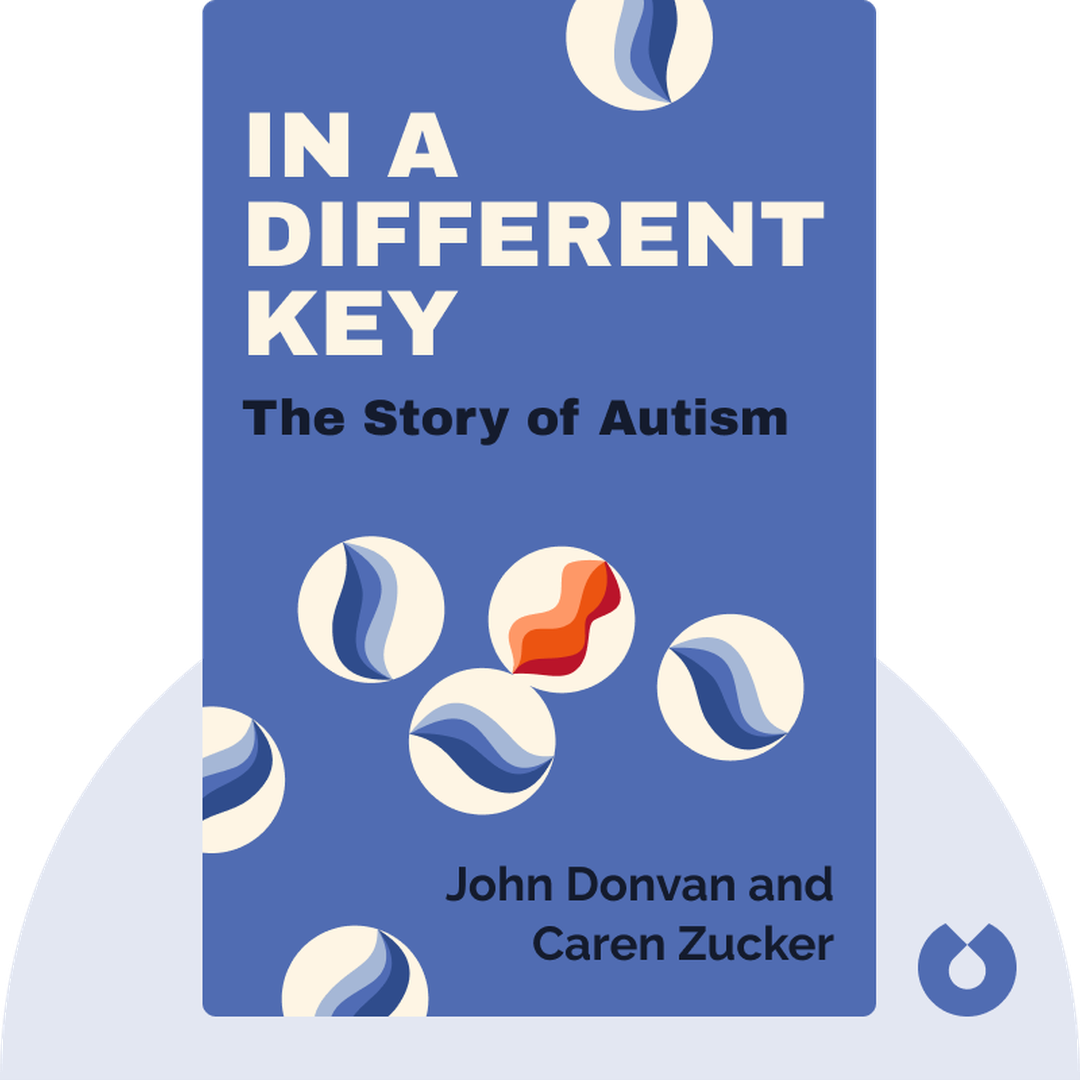
If You're Curious About These Questions...
You should listen to this audiobook
- Did you know that the entire history of autism can be traced back to a single boy in a small Mississippi town, whose diagnosis sparked a global medical revolution?
- Have you ever wondered why the treatment of autism was once defined by blame and conflict, and what it took for the voices of autistic individuals to finally be heard?
- Are you curious about how the fight for autism rights transformed from a quest for a 'cure' into a powerful movement for acceptance and civil rights?
Listen to In a Different Key — Free Audiobook
Loading player...
Key Takeaways from In a Different Key
- Understand the dark history of twentieth-century American medicine, where individuals with cognitive abnormalities were hidden away in institutions or targeted by the eugenics movement.
- Discover the fascinating story of Donald Triplett, the landmark 'Case 1' patient whose unique behavioral traits led to the first official medical diagnosis of autism.
- Learn how Dr. Leo Kanner's 1943 paper officially defined autism by identifying its three core traits: an inability to relate to others, a preference for isolation, and a strict insistence on routines.
- Uncover the tragic origins of the 'refrigerator mother' theory, a completely false medical concept popularized in the 1950s that unjustly blamed cold, uncaring parenting for a child's autism.
- Find out how passionate advocacy by parents in the 1960s sparked a powerful movement to debunk harmful psychological theories and fundamentally reshape society's understanding of autism.
Learning Tools
Reinforce what you learned from In a Different Key
Mind Map
In a Different Key
Early History & Dark Past+
The First Diagnosis+
Discovery & Blame Era+
Parent Activism+
Controversial Treatments & Myths+
Modern Understanding+
Quiz — Test Your Understanding
Question 1 of 7
How were terms like 'defective', 'idiot', and 'moron' originally used in early twentieth-century American medicine?
Question 2 of 7
Who was Donald Triplett and why is he historically significant in the study of autism?
Question 3 of 7
What was the core premise of the 'refrigerator mother' theory popularized in the mid-twentieth century?
Question 4 of 7
What significant contribution did Ruth Sullivan make to the autism community in the 1960s?
Question 5 of 7
Why do modern critics sometimes object to Applied Behavioral Analysis (ABA) as a treatment for autism?
Question 6 of 7
What was the ultimate outcome of Andrew Wakefield's 1998 article suggesting a link between the MMR vaccine and autism?
Question 7 of 7
According to the text, what makes diagnosing autism particularly complicated even today?
In a Different Key — Full Chapter Overview
- 1Recommendation
- 2The American medical community has a troubled history with mental illness.
- 3Donald Triplett was a pivotal patient in the identification of autism.
- 4Mothers were wrongly blamed for causing autism in their children.
- 5Determined activism by persecuted parents helped build autism awareness.
- 6Autism has a long history of harmful and misguided theories.
- 7Even today, autism has no exact definition or agreed-upon best treatment.
- 8Final summary
In a Different Key Summary & Overview
In a Different Key (2016) takes you on a journey through the history of autism, from the first diagnosis to the different and often conflicting opinions about how it should be treated. These blinks also show us that those with autism have a powerful and important voice and that, despite numerous complexities and many unsolved mysteries, there is hope for a more compassionate future.
Who Should Listen to In a Different Key?
- People interested in human rights and public policy
- Specialists in child development and psychiatry
- Family and friends of people with autism
Books Similar to In a Different Key
Readers who enjoyed this also liked these titles.