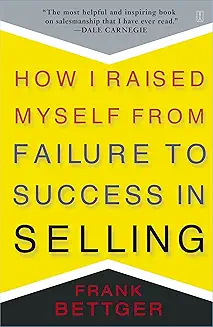
How I Raised Myself from Failure to Success in Selling audiobook cover - A former pro baseball player turns disastrous early failure in life insurance into a masterclass in sales—by learning enthusiasm, disciplined activity, question-based interviews, and trust-building habits that turn strangers into buyers and buyers into lifelong promoters.

How I Raised Myself from Failure to Success in Selling

A former pro baseball player turns disastrous early failure in life insurance into a masterclass in sales—by learning enthusiasm, disciplined activity, question-based interviews, and trust-building habits that turn strangers into buyers and buyers into lifelong promoters.

Frank Bettger

4.3 / 5(4 ratings)
Start ListeningDownloadQR code that opens AudiobookHub on the App StoreTry free on iPhoneScan to start in 5 seconds

If You're Curious About These Questions...

You should listen to this audiobook

Listen to How I Raised Myself from Failure to Success in Selling — Free Audiobook

Loading player...

Key Takeaways from How I Raised Myself from Failure to Success in Selling

Learning Tools

Reinforce what you learned from How I Raised Myself from Failure to Success in Selling

Mind Map

Oceanofpdf.Com How I Raised Myself From Failure To Success In Selling Frank Bettger
Foundational Mindset+
Organization & Activity Tracking+
Understanding the Buyer+
Navigating High-Stakes Sales+
Building Trust & Credibility+
Relationship Skills & Habits+

Quiz — Test Your Understanding

Question 1 of 10
What was Frank Bettger's first major realization about enthusiasm after being fired from a minor league baseball team?
  • A. Enthusiasm must be genuine to be effective.
  • B. Acting enthusiastic can actually make you feel and become enthusiastic.
  • C. Only naturally energetic people can succeed in sales.
  • D. Enthusiasm is less important than technical skill.
Question 2 of 10
When Bettger was on the verge of quitting the insurance business, what single phrase from the company president reframed his approach to selling?
  • A. "Always close the deal."
  • B. "Never take no for an answer."
  • C. "Seeing the people."
  • D. "Know your product inside out."
Question 3 of 10
Why did Bettger decide to take a public-speaking course with Dale Carnegie?
  • A. He wanted to become a professional motivational speaker.
  • B. He was terrified of audiences after being invited to speak at a YMCA event.
  • C. His manager required it to improve his sales pitches.
  • D. He wanted to learn how to manipulate large crowds into buying insurance.
Question 4 of 10
How did Bettger overcome the chaos of good intentions failing to translate into consistent action?
  • A. By hiring a full-time administrative assistant to manage his schedule.
  • B. By working seven days a week to ensure he hit his quota.
  • C. By instituting a weekly "self-organization day" to plan and schedule the week.
  • D. By using a complex digital CRM system to automate his outreach.
Question 5 of 10
According to Bettger's central rule, what is the core secret to making a sale?
  • A. Convince the buyer that your product is superior to the competition.
  • B. Find out what the other person wants, then help him get it.
  • C. Memorize the perfect pitch and deliver it flawlessly every time.
  • D. Highlight all the negative consequences of not buying the product.
Question 6 of 10
Instead of using prepared rebuttals and arguments, what technique did Bettger adopt to defuse objections?
  • A. Asking chains of questions that lead the prospect to a conclusion.
  • B. Using aggressive closing tactics to pressure the buyer.
  • C. Offering immediate discounts whenever a prospect raised an objection.
  • D. Ignoring objections and simply repeating the benefits of the product.
Question 7 of 10
In the $250,000 insurance case in New York, how did Bettger secure the deal against numerous competitors?
  • A. By offering the lowest premium price among all the proposals.
  • B. By providing a comprehensive 50-page analysis of the client's business.
  • C. By telling the prospect to throw away the proposals and focusing entirely on the urgency of a medical exam.
  • D. By bringing in the insurance company's president to leverage executive relationships.
Question 8 of 10
Which of the following is a practical tool Bettger recommends for building trust with a prospect?
  • A. Criticizing competitors to highlight your own product's strengths.
  • B. Praising competitors to reduce suspicion and position yourself as fair.
  • C. Pretending to know the answer to every question to appear competent.
  • D. Dressing as casually as possible to make the prospect feel relaxed.
Question 9 of 10
According to Bettger, how should a salesperson interact with a prospect's secretary or gatekeeper?
  • A. By using clever conversational tricks and vague language to bypass them.
  • B. By ignoring them and trying to walk directly into the prospect's office.
  • C. By offering them small bribes or gifts in exchange for access.
  • D. By treating them with absolute honesty rather than using tricks.
Question 10 of 10
What system did Bettger borrow from Benjamin Franklin for sustained self-improvement?
  • A. A 13-week method focusing on improving one habit per week.
  • B. A daily journaling practice focusing on gratitude.
  • C. A mastermind group that meets monthly to discuss sales targets.
  • D. A rigid daily schedule tracking every 15-minute increment.

How I Raised Myself from Failure to Success in Selling — Full Chapter Overview

How I Raised Myself from Failure to Success in Selling Summary & Overview

Frank Bettger’s classic sales memoir follows his transformation from an undereducated, nervous ex–baseball player who was failing in life insurance, into one of America’s top earners in selling. Rather than offering abstract theory, Bettger tells story after story of specific moments—botched calls, surprising wins, mentors’ one-sentence lessons, and hard-earned habits—that changed his results.

The core message is simple but demanding: selling success comes from consistent activity (seeing people), planned preparation, and a buyer-focused conversation style built on questions, listening, and sincerity. Bettger also shows how confidence is earned through truthfulness, knowledge, and social skills—remembering names, smiling, being brief, and building genuine friendships. The later sections become a practical playbook for appointments, approaches, closing, follow-up, and handling failure through the “law of averages.”

Who Should Listen to How I Raised Myself from Failure to Success in Selling?

  • Salespeople who want field-tested fundamentals: approach, questioning, closing, and follow-up habits.
  • Entrepreneurs and professionals who sell ideas/services and need better human-relations skills without “slick” tactics.
  • Managers and trainers who want memorable stories and drills to coach consistent selling behavior.

About the Author: Frank Bettger

Frank Bettger (1888–1981) was a former professional baseball player who later became a highly successful life-insurance salesman. He lectured widely—often alongside Dale Carnegie—and wrote this book to document the specific habits and principles that lifted him from early failure to sustained top performance in selling.

🎧
Listen in the AppOffline playback & background play
Get App