If You're Curious About These Questions...
You should listen to this audiobook
- Have you ever wondered who really fills the gaps when a society lacks a social safety net?
- Did you know that the American economy relies on a hidden 'shadow workforce' of women who are pushed to their breaking points?
- What if the overwhelming pressure you feel to 'hold it all together' isn't a personal struggle, but a calculated feature of our political system?
Listen to Holding It Together — Free Audiobook
Loading player...
Key Takeaways from Holding It Together
- Understand how the absence of a US social safety net forces women to become the invisible glue holding the economy together through underpaid labor and endless caregiving.
- Discover how young girls are socially groomed to be 'mothers-in-waiting' and how restricted access to reproductive healthcare traps many women in overwhelming caregiving roles.
- Learn why society wrongly blames women for their hardships, even when making the supposed 'right' choices like attending college no longer guarantees financial security.
- Uncover the dangerous myth of meritocracy, which falsely promises that hard work guarantees success while shifting the blame for systemic poverty onto struggling families.
- Find out how ingrained philosophies of self-determination actually benefit billionaires and large corporations by suppressing the demand for essential government support systems.
Learning Tools
Reinforce what you learned from Holding It Together
Mind Map
Holding It Together
The Core Crisis+
Lack of Safety Net+
The Caregiving Trap+
Myth of Meritocracy+
The Pandemic Proof+
Unions of Care+
Quiz — Test Your Understanding
Question 1 of 6
According to Jessica Calarco, why do women disproportionately bear the burden of balancing work and family in the United States?
Question 2 of 6
How does American society typically respond when women in caregiving roles inevitably begin to struggle financially or personally?
Question 3 of 6
How do historical philosophies like the New Thought Movement and modern books like 'The Secret' negatively impact struggling low-income families?
Question 4 of 6
What lesson did the COVID-19 pandemic provide regarding the social safety net in the United States?
Question 5 of 6
Why is Iceland mentioned as a contrast to the United States in the book?
Question 6 of 6
What does Jessica Calarco propose as a primary solution to the systemic issues facing caregivers?
Holding It Together — Full Chapter Overview
- 1Recommendation
- 2The glue that holds the country together
- 3Expected to become caregivers
- 4The meritocracy myth
- 5Still without a safety net
- 6A solution: care unions
- 7Final summary
Holding It Together Summary & Overview
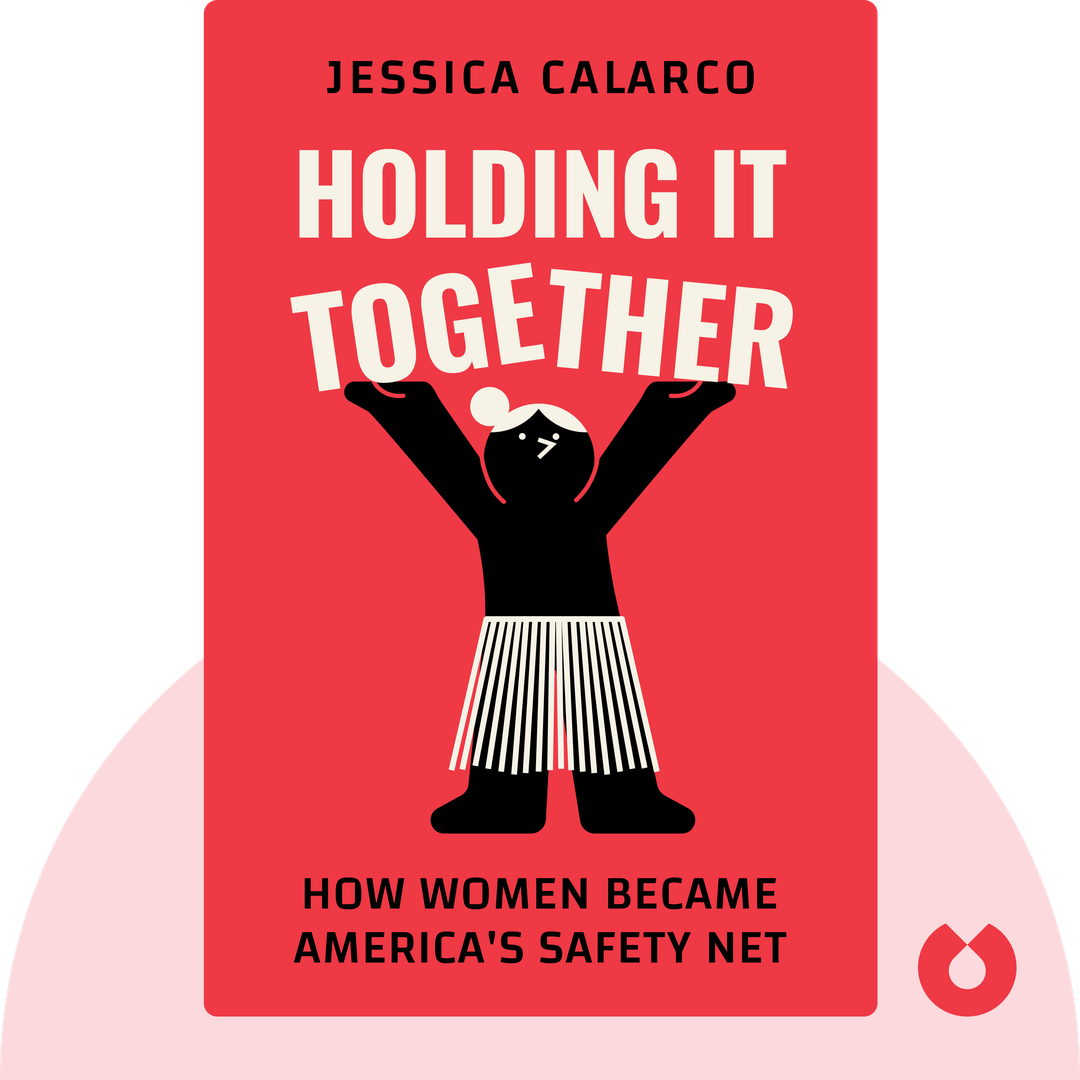
Holding It Together (2024) explores the hardships facing women all over the US. In the absence of any social safety net, women endure immense pressure in their multiple roles as caregivers and low-paid workers to sustain life for themselves and their families with little to no help.
Who Should Listen to Holding It Together?
- Feminists
- People interested in social inequality in the US
- Policy makers interested in ethics
Books Similar to Holding It Together
Readers who enjoyed this also liked these titles.