If You're Curious About These Questions...
You should listen to this audiobook
- Did you know that many of the world’s most iconic tech giants started as completely different products—or were even born out of total failure?
- Have you ever wondered what the founders of companies like Hotmail and Blogger actually did during those chaotic early days when their businesses were on the brink of collapse?
- What if you could uncover the unfiltered, raw lessons that over 30 legendary entrepreneurs learned while navigating the trials and tribulations of building a startup from scratch?
Listen to Founders at Work — Cinematic Audio Edition
Loading player...
Key Takeaways from Founders at Work
- Discover why wildly successful startups like PayPal and Blogger completely abandoned their original business plans to pivot toward what users actually wanted.
- Understand why truly groundbreaking ideas often face intense investor skepticism, and how founders of companies like Hotmail overcame this pushback to achieve massive growth.
- Learn why assembling a passionate, intelligent team is often more crucial to a startup's success than having a brilliant business idea on day one.
- Find out how observing unexpected user behavior—like the massive traffic on PayPal's simple website demo—can reveal the true path to scaling your product.
- Master the art of breaking through industry 'catch-22s' by securing just enough initial funding to build a working prototype and prove your market viability.
Learning Tools
Reinforce what you learned from Founders at Work
Mind Map
Founders at Work
Evolution of Ideas+
Overcoming Skepticism+
Team Over Idea+
Personal Projects to Empires+
Power of Simplicity+
Dangers of Venture Capital+
Customer Focus & Honesty+
Importance of Timing+
Quiz — Test Your Understanding
Question 1 of 8
What did PayPal initially start out as before pivoting to web-based money transfers?
Question 2 of 8
Why did investors initially reject Sabeer Bhatia and Jack Smith's business plan for Hotmail?
Question 3 of 8
According to the stories of Excite and Marimba, what is often more important than having a great initial idea when launching a startup?
Question 4 of 8
How did Yahoo originally begin before it became a pioneering web empire?
Question 5 of 8
What key lesson about startup growth is illustrated by the collapse of the web design company ArsDigita?
Question 6 of 8
How did Joel Spolsky avoid needing venture capital to fund his programmer-friendly environment at Fog Creek Software?
Question 7 of 8
What did Paul Graham discover was an incredibly persuasive tool for selling Viaweb to clients?
Question 8 of 8
Which of the following factors contributed to Flickr's success at a time when other photo-sharing services struggled?
Founders at Work — Full Chapter Overview
- 1Recommendation
- 2Many startups, including PayPal and Blogger, didn’t finish with the idea they began with.
- 3Innovative ideas can make it harder for people to recognize their potential.
- 4When starting a company, a strong team can matter more than a strong idea.
- 5Yahoo and del.icio.us show how a personal project can become enormously valuable.
- 6Sometimes, as Apple and ArsDigita show, simpler is better.
- 7Too much investor money can damage a startup, so find other revenue sources or keep costs low.
- 8As Paul Graham learned, it’s best to be honest and build something people truly need.
- 9For Flickr, the timing was perfect for photo sharing.
- 10Final summary
Founders at Work Summary & Overview
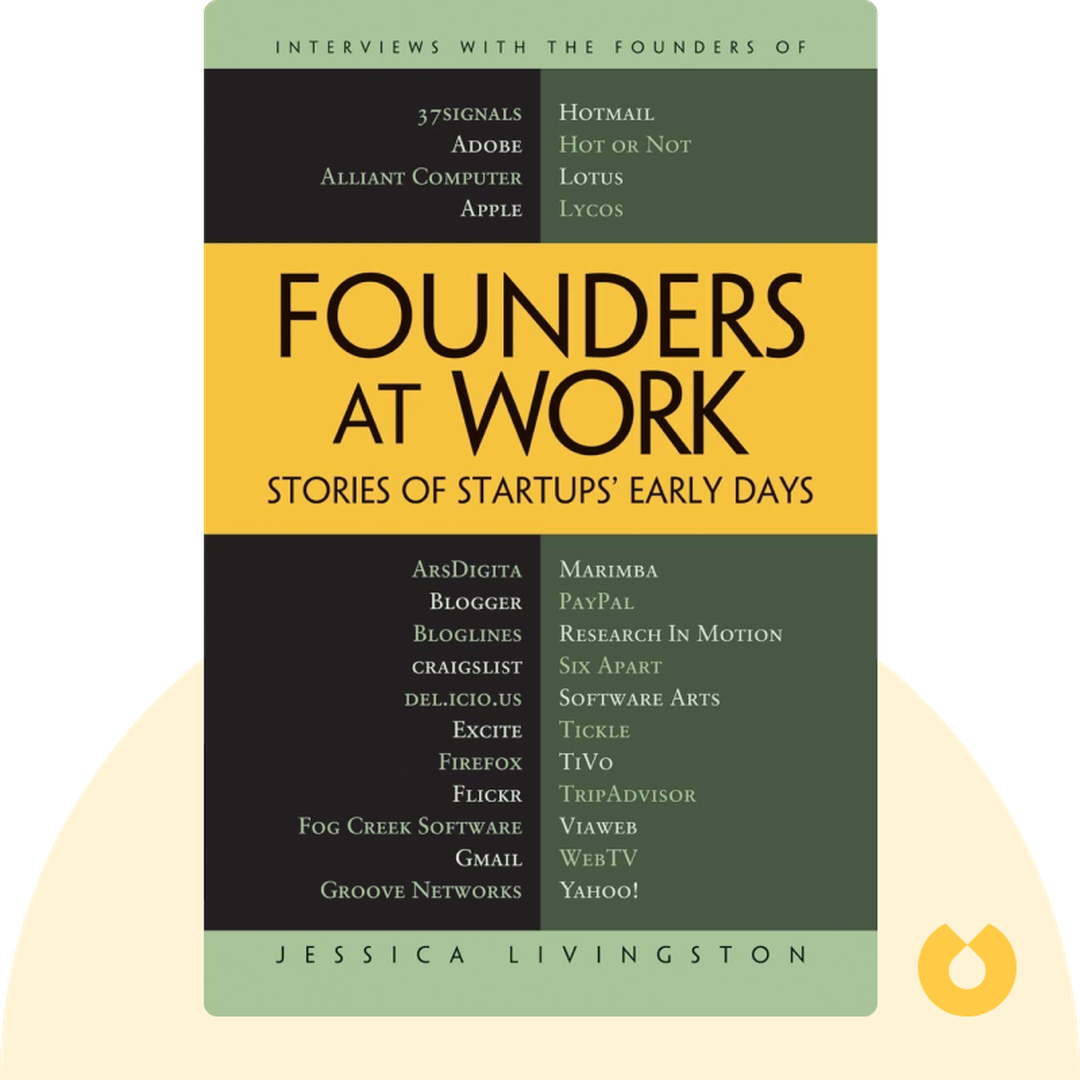
Founders at Work (2007) is a revealing look at what went on in the early days of over 30 influential US startups. In their own words, the founders of landmark companies such as Hotmail and Blogger.com tell their stories about the many ups and downs and twists and turns it took to make their ideas a reality. They also share the lessons they learned and the insight they’ve gained looking back on the trials and tribulations of those chaotic early days.
Who Should Listen to Founders at Work?
- Entrepreneurs and aspiring inventors
- Business students
- Anyone looking for inspiration
Books Similar to Founders at Work
Readers who enjoyed this also liked these titles.