If You're Curious About These Questions...
You should listen to this audiobook
- Have you ever wondered why the classic 'pro-con' list often fails us when we’re making our most life-altering decisions?
- What if you could master a mental 'time-travel' technique to identify the fatal flaws in your plan before you even take the first step?
- Are you curious about the secret storytelling frameworks that top strategists use to navigate deep uncertainty and make better long-term choices?
Listen to Farsighted — Free Audiobook
Loading player...
Key Takeaways from Farsighted
- Learn how our innate 'loss aversion' creates blind spots in our choices, using George Washington's military mistakes to show why we irrationally resist losses instead of seeking long-term gains.
- Master the art of navigating 'full-spectrum decisions' by systematically breaking down the complex, conflicting factors that often paralyze even the most pragmatic leaders.
- Discover why consulting diverse groups of people leads to more accurate, thorough, and unbiased problem-solving than relying on traditional, homogenous top-down hierarchies.
- Find out why highly specialized experts are consistently worse at predicting the future than generalists who look past their own fields to consider a broad variety of trends.
- Understand the fatal human flaw of assuming current trends will continue indefinitely, and recognize how unpredictable, converging factors actually determine future outcomes.
Learning Tools
Reinforce what you learned from Farsighted
Mind Map
Farsighted
The Challenge of Decision-Making+
Forecasting the Future+
Strategic Frameworks & Tools+
Time and Intuition+
Quiz — Test Your Understanding
Question 1 of 8
Why did George Washington initially make a poor decision regarding the defense of New York against the British?
Question 2 of 8
According to Samuel Sommer's mock trial studies, why do diverse groups tend to make better decisions than homogenous ones?
Question 3 of 8
What did Philip Tetlock’s forecasting tournaments reveal about the ability of experts to predict the future?
Question 4 of 8
Why are future events, such as the invention and rise of the personal computer, so difficult to predict based on current trends?
Question 5 of 8
What is the primary function of a 'red team' in strategic decision-making?
Question 6 of 8
How did the Obama administration utilize Ronald Reagan’s approach to cost-benefit analysis?
Question 7 of 8
How does linear value modeling assist humans and machines in making complex decisions?
Question 8 of 8
Why does the author recommend taking a long walk or allowing your mind to wander after deeply considering a complex decision?
Farsighted — Full Chapter Overview
- 1Recommendation
- 2We all fall victim to blind spots when making decisions, even George Washington.
- 3Strong decisions come from considering diverse viewpoints from a diverse range of people.
- 4The average person can’t predict the future – and experts are even worse at it.
- 5Future events depend on unpredictable converging factors that current trends don’t always reveal.
- 6Red teams can improve planning and prediction, even in covert operations.
- 7Governments use cost-benefit analysis to make decisions, even for environmental protection.
- 8Linear value modeling supports decision-making, whether you’re human or machine.
- 9Mathematical decision-making has limits, but thinking things over can still take you far.
- 10Final summary
Farsighted Summary & Overview
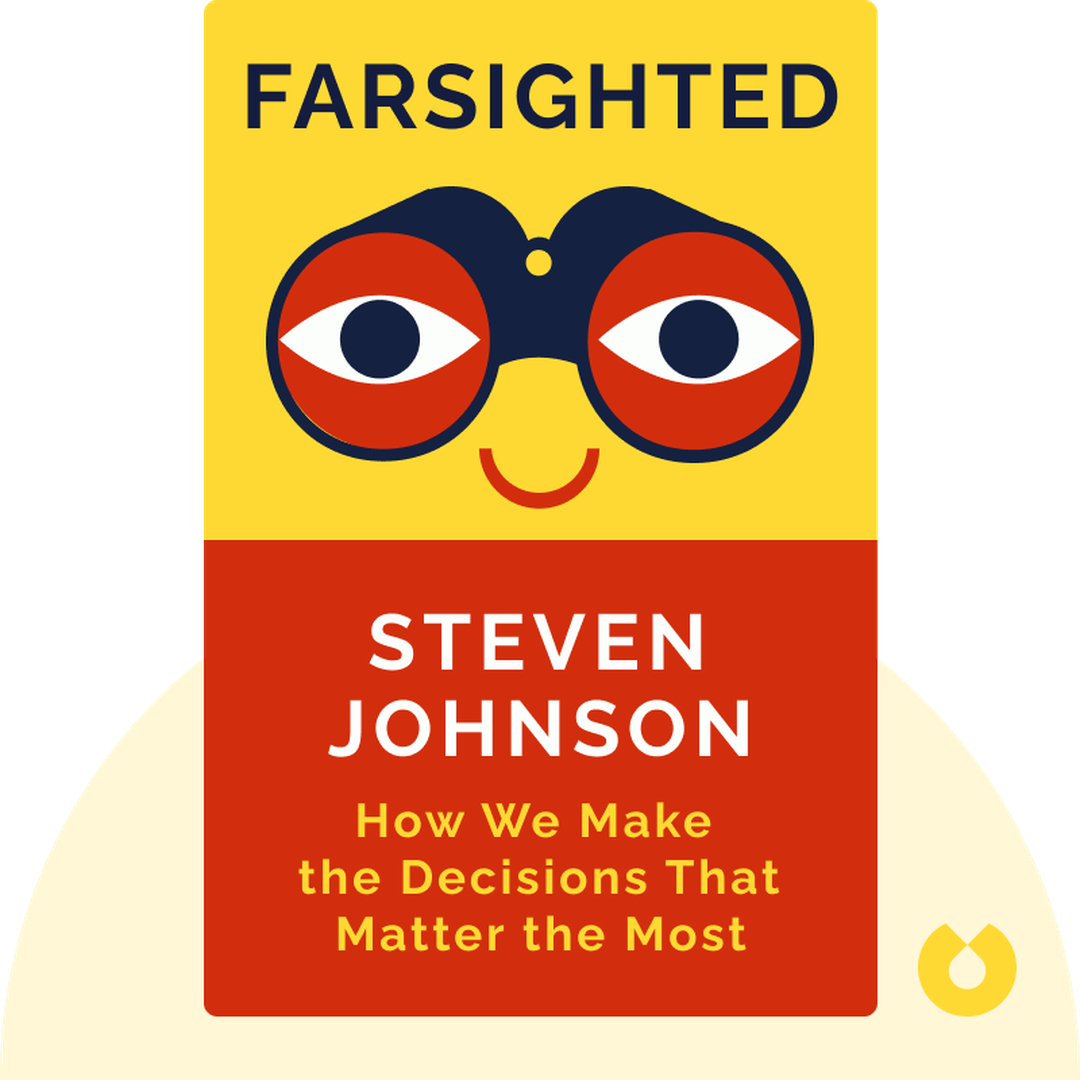
Farsighted (2018) is concerned with the complexity of decision-making. It demonstrates why decision-making can be so difficult, and how hard it can be to predict the outcome of any given decision. Farsighted also provides some helpful tools that can help anyone make better decisions, despite the difficulties.
Who Should Listen to Farsighted?
- Strategists and managers
- Psychologists
- Ditherers who struggle to make decisions
Books Similar to Farsighted
Readers who enjoyed this also liked these titles.