If You're Curious About These Questions...
You should listen to this audiobook
- Did you know that the same criteria the U.S. uses to define 'failed states' abroad could actually be applied to its own actions both at home and on the world stage?
- Have you ever wondered why there is such a massive disconnect between the U.S. government's rhetoric about promoting democracy and the reality of its historical interventions?
- Are you curious about how the pursuit of global dominance has led the world's most powerful nation to repeatedly bypass the very international laws it helped create?
Listen to Failed States — Free Audiobook
Loading player...
Key Takeaways from Failed States
- Discover why the United States' actual foreign policy contradicts its self-proclaimed role as a global protector, often resulting in increased violence and instability worldwide.
- Learn how the United States leverages its power within the UN Security Council to bypass international law and manipulate critical legal definitions, such as the meaning of torture.
- Understand the dangerous double standard of anticipatory self-defense, a military stance that ignores UN charters and could theoretically justify preemptive strikes against America itself.
- Find out why American leadership consistently prioritizes protecting its own economic dominance over taking critical action against existential global threats like climate change and nuclear proliferation.
- Explore how the United States engages in deliberate campaigns of economic and covert warfare, such as the decades-long embargo against Cuba, to punish nations that refuse to submit to its will.
Learning Tools
Reinforce what you learned from Failed States
Mind Map
Failed States
Defying International Law+
Prioritizing Economic Interests+
Destructive Middle East Interventions+
The US as a Failed State+
Quiz — Test Your Understanding
Question 1 of 8
According to the text, how did the US Justice Department's Office of Legal Counsel redefine 'torture' compared to the Geneva Convention?
Question 2 of 8
What is the primary logical flaw the author points out regarding the Bush administration's use of 'anticipatory self-defense' to justify the war in Afghanistan?
Question 3 of 8
Why did the United States refuse to take immediate steps to reduce greenhouse gas emissions at the 2005 G8 summit?
Question 4 of 8
What does the resource allocation of the Office of Foreign Assets Control (OFAC) in 2004 reveal about US foreign policy priorities?
Question 5 of 8
How did the US response to the opening of an oil pipeline in Azerbaijan illustrate a contradiction in its foreign policy?
Question 6 of 8
According to the text, why did the United States wait until after Yasser Arafat's death in 2004 to strongly push for democratic elections in Palestine?
Question 7 of 8
Which action during the 2004 US attack on Fallujah does the text cite as a direct violation of the Geneva Conventions?
Question 8 of 8
Based on the expanded definition used by the Bush administration, why does the author argue that the United States can be considered a 'failed state'?
Failed States — Full Chapter Overview
- 1Recommendation
- 2The United States claims a unique status that lets it disregard international law.
- 3The United States makes its own rules for punishing enemies, real or perceived.
- 4For the United States, economic interests outweigh the fight against climate change.
- 5The United States deliberately antagonized Cuba for refusing to bend to its will.
- 6US economic interests often eclipse its stated goal of promoting democracy abroad.
- 7The United States seeks peace in the Middle East, but only when it benefits as well.
- 8The US-led invasion of Iraq was legally and morally questionable – and a failure.
- 9The United States has a democracy deficit, making it possible to call it a failed state.
- 10Final summary
Failed States Summary & Overview
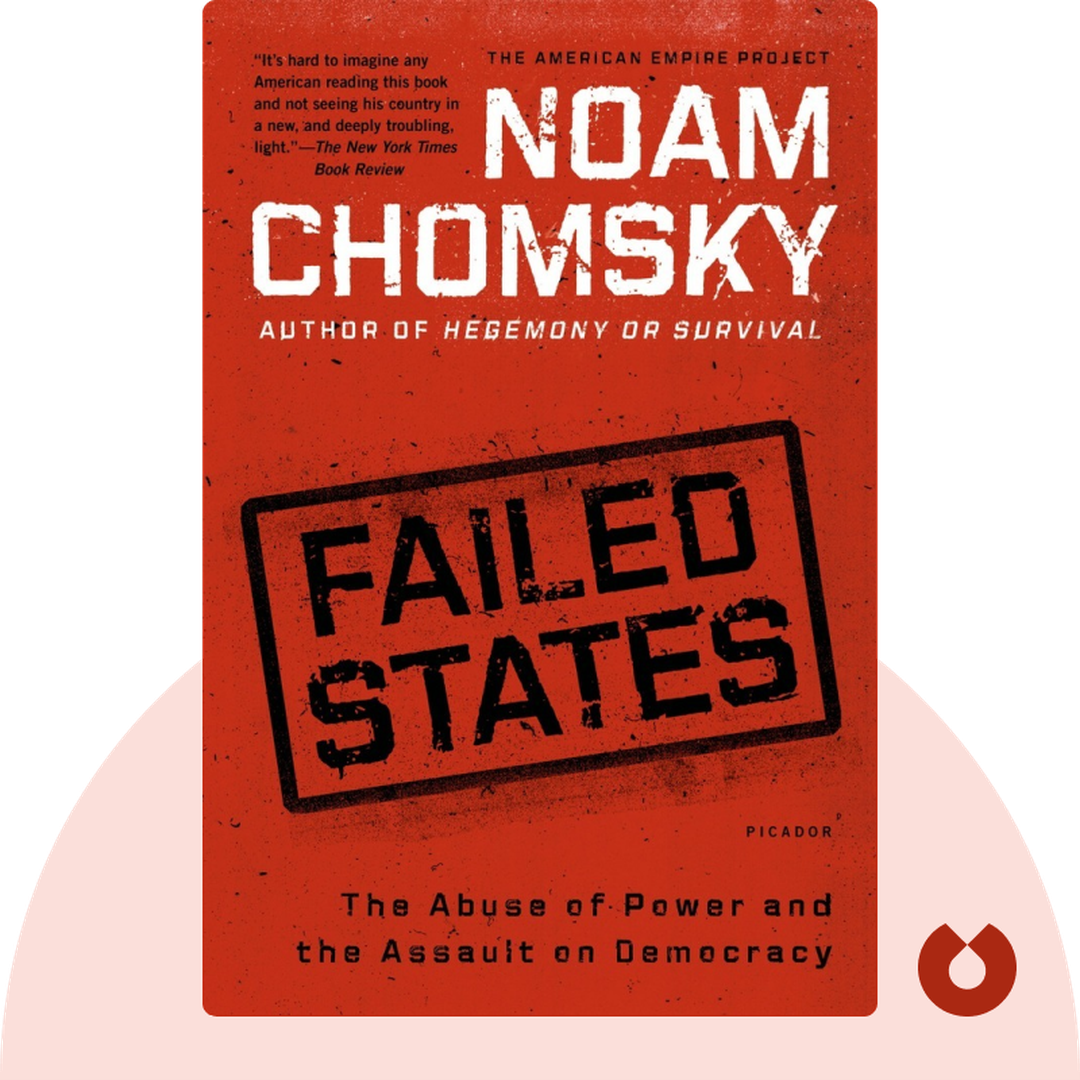
In Failed States, author Noam Chomsky details the ways in which the United States has used its power to relentlessly pursue its own geopolitical and economic interests. The book cites examples from throughout history to demonstrate why the United States’ stated goal of promoting democracy is inconsistent with its own actions, at home and abroad.
Who Should Listen to Failed States?
- Anyone critical of US foreign policy
- Anyone interested in international politics
- Anyone interested in history
Books Similar to Failed States
Readers who enjoyed this also liked these titles.